
Introduction
Berlin, the capital of Germany, has long been a symbol of resilience, cultural dynamism, and historical change. The history of Berlin started in the 13th century, and it evolved from a small trading post into one of Europe’s most vibrant and influential cities. As the capital of Prussia and later Germany, Berlin witnessed periods of remarkable growth and intense conflict, from the rise of the Nazi regime to the devastation of World War II and the ensuing Cold War. This article explores Berlin’s journey through these defining moments, shedding light on the events and transformations that have shaped the city’s unique identity and enduring spirit.
Founding and Early Development
Berlin’s origins date back to the 13th century, when two small settlements, Berlin and Cölln, were established along the River Spree. Located at the crossing of two major trade routes, the area quickly developed as a center for commerce and culture, attracting merchants, artisans, and traders from surrounding regions. By 1307, the two towns formed a union, marking the first step toward Berlin’s growth as a significant urban center.
Throughout the medieval period, Berlin grew in both size and prominence, benefiting from its favorable location for trade. In 1415, the region came under the control of Frederick I, who established the Margraviate of Brandenburg. This event marked the beginning of Berlin’s association with the Hohenzollern dynasty, which would later shape its political and cultural landscape. Under Hohenzollern rule, Berlin saw the construction of significant landmarks, including the Marienkirche and the Stadtschloss, or City Palace, which became symbols of the city’s growing stature.
The Protestant Reformation in the 16th century had a profound impact on Berlin, aligning it with the religious and political shifts that swept through Europe. The adoption of Protestantism under Elector Joachim II brought religious reform and increased autonomy from the Catholic Church, fostering a sense of independence that became a defining characteristic of the city. As Berlin continued to expand, it developed a unique identity as a place of innovation, trade, and governance.
By the 17th century, Berlin had solidified its role as the center of the Brandenburg-Prussian state, positioning itself for further growth in the coming eras. The city’s development was marked by cultural and economic prosperity, which laid the foundation for its transformation into a major European capital in the centuries that followed.
Berlin in the Prussian and Imperial German Eras
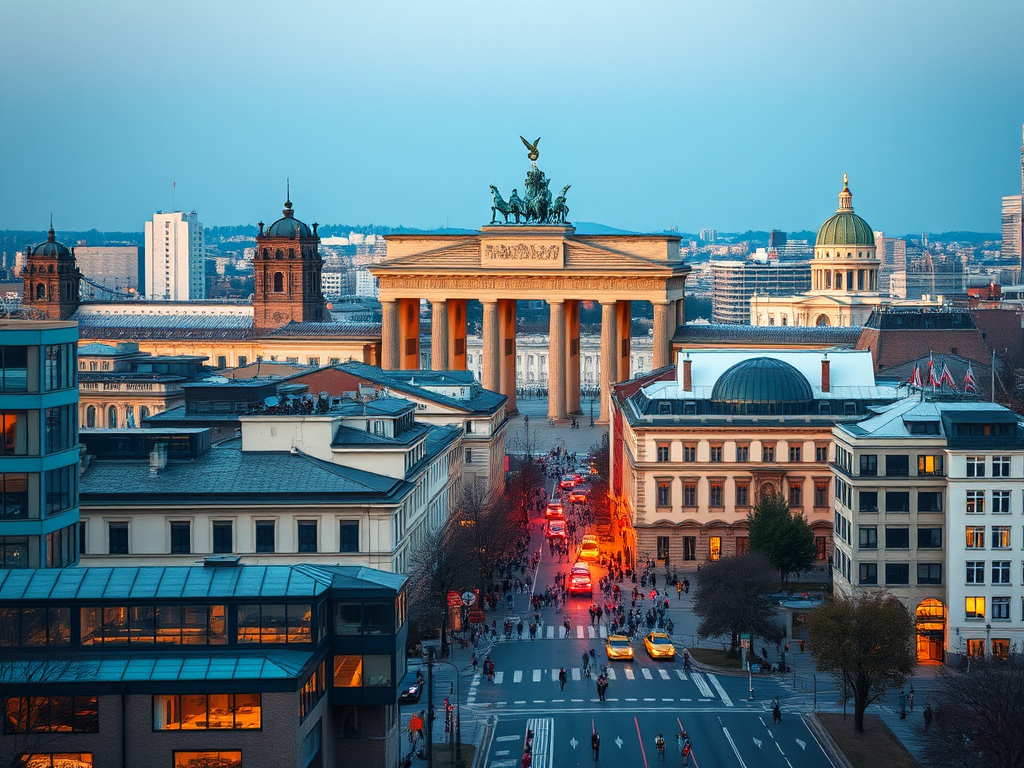
The 18th and 19th centuries marked a period of profound change for Berlin as it became the capital of the Kingdom of Prussia. Under the rule of Frederick the Great in the mid-18th century, Berlin flourished as a center of arts, education, and military power. Frederick’s vision transformed the city with architectural masterpieces, including the Berlin State Opera and the Brandenburg Gate, which remains an iconic symbol of the city today.
As Prussia expanded its influence in Europe, Berlin’s population and importance grew. The Industrial Revolution brought rapid urbanization, transforming Berlin into an economic powerhouse. Factories, railways, and modern infrastructure turned the city into one of Europe’s leading industrial centers, attracting workers from across Germany and beyond. This period of growth continued into the formation of the German Empire in 1871, when Berlin was declared the imperial capital of a newly unified Germany.
With its new status, Berlin underwent massive development, becoming a hub for politics, science, and the arts. The city’s universities, theaters, and scientific institutions attracted scholars and artists, establishing Berlin as a beacon of intellectual and cultural achievement. However, this era was also marked by social and political tensions, as industrialization brought about economic disparities and demands for political reform. Despite these challenges, Berlin’s status as the heart of the German Empire solidified its role as a major European capital.
By the early 20th century, Berlin was at the height of its power, a symbol of Germany’s unity and ambition. However, the political upheaval and eventual outbreak of World War I would soon bring about drastic changes, setting the stage for a turbulent new chapter in the city’s history.
Weimar Republic and the Rise of Nazi Berlin
After Germany’s defeat in World War I, Berlin became the capital of the Weimar Republic, a period marked by both cultural blossoming and political turmoil. The city emerged as a global hub for art, theater, and intellectual thought, symbolizing the avant-garde spirit of the 1920s. Known for its vibrant nightlife, Berlin attracted artists, writers, and performers who pushed the boundaries of creativity and self-expression, making it one of the most progressive cities in Europe.
However, the economic instability and political divisions that plagued the Weimar Republic also affected Berlin. Hyperinflation, unemployment, and street violence became common, as various political factions, including communists and right-wing extremists, vied for power. Amid this unrest, Adolf Hitler’s Nazi Party gained support by exploiting the city’s discontent, and in 1933, Hitler was appointed Chancellor of Germany, marking the end of the Weimar era.
Under Nazi rule, Berlin transformed into the nerve center of the Third Reich. The city’s architectural landscape was reshaped to reflect Nazi ideology, with grandiose plans by architect Albert Speer to make Berlin the capital of a new world empire, Germania. During this period, Berlin also became a site of oppression, with systematic persecution of Jews, political dissidents, and other groups. The city’s Jewish population, once a vibrant part of its cultural fabric, faced brutal repression, leading to the tragic events of the Holocaust.
World War II brought devastating consequences for Berlin, as Allied bombings destroyed much of the city’s infrastructure. By 1945, Berlin was a city in ruins, marking the end of the Nazi regime and the beginning of a new, divided chapter in its history. The fall of Berlin in 1945 was symbolic of the larger collapse of Nazi Germany, leaving the city scarred but poised for reconstruction and change.
Division, the Berlin Wall, and the Cold War
After World War II, Berlin became the focal point of Cold War tensions between the Soviet Union and the Western Allies. Divided into four occupation zones controlled by the United States, the United Kingdom, France, and the Soviet Union, Berlin quickly became a microcosm of the ideological divide between East and West. In 1949, the establishment of the German Democratic Republic (East Germany) and the Federal Republic of Germany (West Germany) formalized this division, with East Berlin as the capital of East Germany and West Berlin remaining a democratic enclave within the communist state.
In 1961, the construction of the Berlin Wall physically divided the city, separating families, friends, and communities. The Wall became a powerful symbol of the Cold War, representing the stark division between communist and capitalist ideologies. For nearly three decades, the Berlin Wall dominated the city’s landscape, with escape attempts from East Berlin often ending in tragedy.
Life in Berlin was dramatically different on each side of the Wall. West Berlin thrived as a center of culture, innovation, and freedom, while East Berlin, under the control of the socialist government, struggled with economic hardships and restrictions on personal freedoms. The Berlin Wall became a focal point of international attention, with political leaders like U.S. President John F. Kennedy famously declaring “Ich bin ein Berliner†as a statement of solidarity with the people of Berlin.
The Cold War tensions began to thaw in the late 1980s, and on November 9, 1989, the Berlin Wall fell, marking a turning point in history. The reunification of Berlin and Germany soon followed, symbolizing the end of the Cold War and the beginning of a new era for the city.
Reunification and Modern Berlin
The fall of the Berlin Wall was a pivotal moment in Berlin’s history, leading to the reunification of Germany in 1990. Berlin was once again named the capital of Germany, and a massive reconstruction effort began to unify the city’s infrastructure, economy, and society. This period of transformation saw Berlin emerge as a vibrant, cosmopolitan metropolis, attracting people from all over the world.
In the years following reunification, Berlin embraced its multicultural identity, becoming a hub for art, music, and technology. Iconic landmarks like the Brandenburg Gate, once located in the shadow of the Wall, were restored as symbols of unity and freedom. The city also undertook significant economic development, with modern skyscrapers and business districts rising alongside historic buildings, creating a unique blend of old and new.
Berlin’s cultural scene flourished, with events like the Berlinale film festival, the Berlin Philharmonic, and its numerous museums and galleries attracting millions of visitors each year. The city also became a center for political and social movements, reflecting its role as a place of progressive thought and activism.
Today, Berlin stands as a testament to resilience and reinvention. It is a city that has confronted and overcome immense challenges, from war and division to economic hardship. The story of Berlin is one of transformation and hope, embodying the enduring spirit of a city that has always managed to rebuild, renew, and redefine itself.
Conclusion
Berlin’s history is a tapestry of triumphs, tragedies, and transformations. From its medieval roots to its role as the capital of a unified Germany, Berlin has been shaped by the forces of politics, war, culture, and resilience. Each era in the city’s history has left an indelible mark, creating a metropolis that reflects both the hardships and hopes of its people. Today, Berlin stands as a symbol of unity and progress, a city that embraces its past while looking toward the future. Its journey serves as a reminder of the resilience of human spirit and the power of a city to continuously reinvent itself.




[…] Europe, the destruction was particularly severe. Cities like Warsaw, Berlin, and London suffered extensive damage, with entire neighborhoods razed and industries […]