Introduction
Turin, the capital of the Piedmont region in northern Italy, is a city steeped in history, culture, and economic significance. Often overshadowed by Italy’s more famous tourist destinations such as Rome, Florence, and Venice, Turin offers its own unique charm with a blend of historical grandeur, industrial prowess, and cultural richness. The city has been at the forefront of Italy’s economic and political transformations, serving as a capital city during critical moments in the country’s unification and industrialization.
In this article, we will explore the history of Turin from its ancient origins to its present-day role as a vibrant cultural and economic hub. We will examine the city’s evolution, its contributions to Italy’s industrial growth, and its most important tourist attractions that make it a must-visit destination for travelers.
Foundation of Turin and Roman Era
Turin’s history dates back over 2,000 years to the time of the ancient Celts and Ligurians who first settled in the region. However, it was the Romans who established the city as we know it today. In 28 BC, the Romans founded Augusta Taurinorum on the site of present-day Turin. The city was strategically located at the confluence of the Po River and the Dora Riparia, making it an ideal military outpost for controlling the western Alpine passes and facilitating trade between Italy and the rest of Europe.
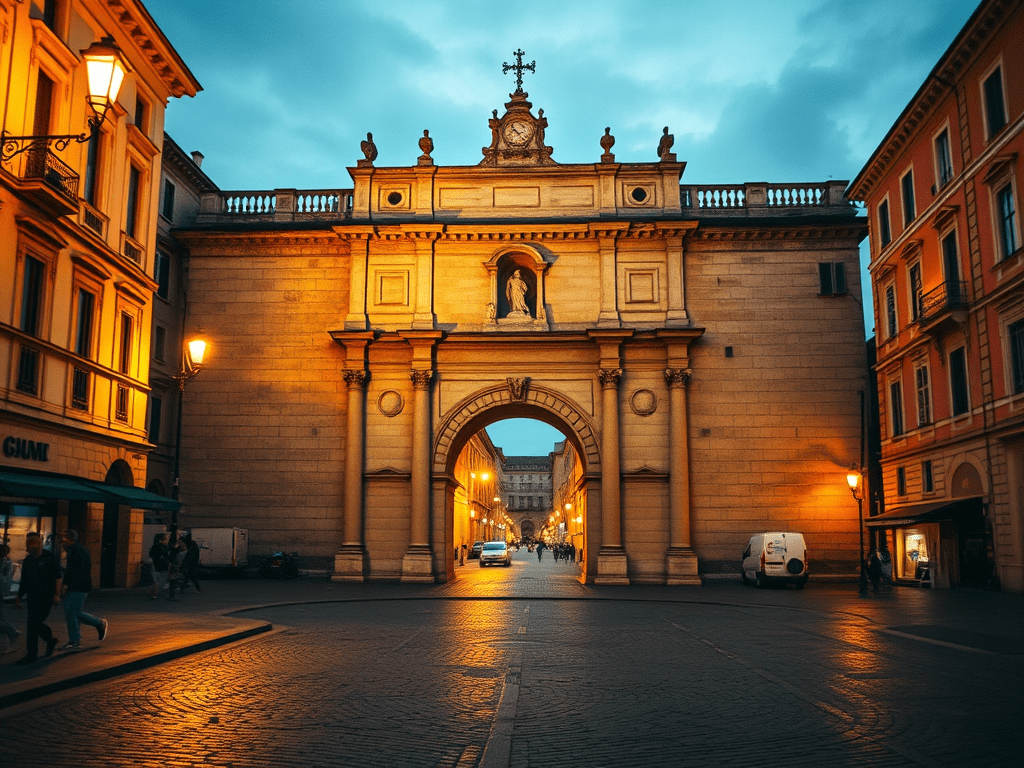
Turin’s Roman layout, with its rectangular grid of streets and fortified walls, remains visible to this day. Key Roman landmarks such as the Porta Palatina (a well-preserved Roman gate) still stand as a testament to the city’s ancient origins. The city quickly became a crucial part of the Roman Empire, serving both military and commercial purposes. During the Roman period, Turin was a modest yet important settlement with a forum, public baths, and a theater.
Middle Ages and Lombard Influence
Following the fall of the Roman Empire, Turin entered a period of instability, like much of Europe. In the 6th century, the city came under the control of the Lombards, a Germanic people who established the Kingdom of Lombardy in northern Italy. Turin became a duchy within this kingdom, and its strategic location once again made it a site of military and political significance.
During the Middle Ages, Turin was part of the Holy Roman Empire and was controlled by various noble families, including the Counts of Savoy. The House of Savoy would later play a critical role in shaping the city’s destiny. Turin during this period was a fortified town, known for its defensive walls, towers, and castles. Though smaller and less influential compared to other Italian cities like Venice or Florence, it maintained a steady economic base through agriculture, trade, and artisanal production.
Turin and the House of Savoy
The House of Savoy, one of Europe’s oldest noble families, began to assert control over Turin in the 13th century. Their influence would grow steadily over the next few centuries, turning the city into the political and military capital of the Duchy of Savoy. In the 16th century, Emmanuel Philibert, Duke of Savoy, moved the ducal capital from Chambéry (now in France) to Turin in 1563, cementing the city’s role as the center of Savoyard power.
Under the Savoy dynasty, Turin underwent significant urban and architectural transformations. The dukes of Savoy sought to make Turin a modern, fortified capital, commissioning grand palaces, churches, and defensive structures. Architects such as Guarino Guarini and Filippo Juvarra were employed to create Baroque masterpieces that still define Turin’s skyline today, including the Palazzo Reale (Royal Palace), Palazzo Madama, and the Superga Basilica.
In the 18th century, the House of Savoy expanded its territorial holdings and became rulers of the Kingdom of Sardinia, with Turin as the capital. This period marked a golden age for Turin, as the city flourished both economically and culturally. It became a hub for intellectuals, scientists, and architects, laying the groundwork for its later role in Italian unification.
The 18th and early 19th centuries also saw the rise of the first stirrings of Italian nationalism. Turin, as the capital of the Kingdom of Sardinia, became a focal point for the Risorgimento, the movement for Italian unification. King Victor Emmanuel II of Sardinia, along with his prime minister, Count Camillo Benso di Cavour, spearheaded the efforts to unite Italy under a single monarchy, with Turin playing a leading role in this political process.
Turin and Italian Unification
The culmination of the Risorgimento came in 1861 when the Kingdom of Italy was officially proclaimed, and Turin was chosen as the first capital of unified Italy. This was a momentous occasion for the city, which had been at the heart of the unification process. However, Turin’s status as capital was short-lived. In 1865, the capital was moved to Florence, and later to Rome in 1871, reflecting the centralization of power in the newly unified nation.
Despite losing its status as the capital, Turin remained an influential city, especially in terms of economic development. The late 19th century saw the city transform into one of Italy’s major industrial centers, laying the foundation for its role in the automotive industry and its association with Fiat.
Turin and the Industrial Revolution
Turin was one of the first cities in Italy to embrace the Industrial Revolution. The late 19th century saw a rapid expansion of factories, particularly in textiles and mechanical engineering. The arrival of the railway in the mid-1800s helped connect Turin with other major Italian and European cities, boosting trade and transportation.
However, it was in the early 20th century that Turin truly earned its reputation as Italy’s industrial powerhouse, thanks in large part to the founding of Fiat (Fabbrica Italiana Automobili Torino) in 1899. Fiat’s emergence marked the beginning of Turin’s dominance in the automotive industry, and the company would go on to become a symbol of Italian industrial strength.
Under the leadership of Giovanni Agnelli, Fiat became Italy’s largest and most important automobile manufacturer. The company’s growth during the 20th century was extraordinary, with Turin emerging as a hub of automotive innovation and production. The Fiat Lingotto factory, completed in 1923, became a symbol of modern industrial architecture with its rooftop test track and innovative production techniques.
During the Fascist regime and World War II, Fiat’s production shifted toward military vehicles, contributing significantly to Italy’s war effort. However, this also made Turin a target for Allied bombing raids, which caused significant destruction to the city’s industrial infrastructure.
After the war, Turin and Fiat played a crucial role in Italy’s post-war economic recovery, known as the Italian economic miracle. The city attracted thousands of workers from southern Italy, leading to rapid urban expansion and social changes. By the 1960s, Fiat was producing millions of cars each year, and Turin had become synonymous with Italian automotive excellence.
Post-War Turin: Economic Transformation
The post-war period was a time of economic growth and transformation for Turin. The city benefited from Italy’s broader industrial boom, with Fiat leading the way as one of the country’s largest employers. Turin became a melting pot of cultures as thousands of migrants from southern Italy moved to the city in search of jobs, leading to a rapid increase in population.
The city’s industrial success was not without its challenges. Labor unrest and strikes were common, as workers demanded better wages and conditions. The social tensions of the 1960s and 70s, coupled with economic crises in the 1980s, led to a period of decline for Turin’s manufacturing sector. However, despite these challenges, Fiat remained a key player in the city’s economy.
By the late 20th century, Turin’s reliance on heavy industry began to wane, and the city embarked on a process of economic diversification. While the automotive sector remained important, Turin began to develop other industries, including aerospace, telecommunications, and information technology. The city is now home to leading companies such as Leonardo (aerospace and defense), Telecom Italia, and Lavazza (coffee production).
Turin also became a hub for research and innovation, with the Polytechnic University of Turin playing a leading role in developing cutting-edge technologies. The city’s shift from a purely industrial base to a more knowledge-based economy has helped it weather the challenges of deindustrialization.
Modern Turin: Culture, Tourism, and Economy
In recent decades, Turin has undergone a cultural renaissance, repositioning itself as a leading cultural and tourist destination. The city’s rich architectural heritage, with its Baroque palaces, churches, and grand piazzas, has been restored and preserved, attracting visitors from around the world. Major renovations of historic buildings such as the Palazzo Reale and Palazzo Madama have helped showcase Turin’s royal past.
The city is also home to a vibrant arts and cultural scene. The Museo Egizio (Egyptian Museum) is one of the most important collections of Egyptian artifacts outside of Cairo, while the Museo Nazionale del Cinema, housed in the iconic Mole Antonelliana, celebrates Italy’s rich cinematic history. Turin has also become a hub for contemporary art, with numerous galleries and cultural festivals held throughout the year.
Key Tourist Attractions
Turin offers a wide array of tourist attractions that reflect its rich history and cultural diversity. Some of the must-see sites include:
- Mole Antonelliana: Turin’s most recognizable landmark, originally conceived as a synagogue and now home to the Museo Nazionale del Cinema.
- Palazzo Reale: The former royal palace of the House of Savoy, a UNESCO World Heritage site.
- Superga Basilica: A beautiful baroque church overlooking the city, also serving as the burial place of the Savoy family.
- Museo Egizio: One of the world’s largest and most important collections of Egyptian antiquities.
- Shroud of Turin: Held in the Cathedral of St. John the Baptist, the Shroud is one of the most revered Christian relics, though its authenticity is still debated.
- Piazza Castello and Palazzo Madama: The heart of Turin, featuring impressive architecture and vibrant public spaces.
Turin’s Role in Modern Italy
Today, Turin remains an important economic and cultural hub within Italy. Although its industrial base has shifted, the city has managed to reinvent itself as a center for innovation, research, and culture. The automotive sector, led by Fiat Chrysler Automobiles (now part of Stellantis), remains central to the city’s economy, but new industries such as aerospace, robotics, and renewable energy are emerging as key drivers of growth.
Turin’s successful hosting of the 2006 Winter Olympics further boosted the city’s international profile, leading to extensive urban regeneration projects and increased tourism.
Conclusion
From its Roman origins to its pivotal role in Italian unification and industrialization, Turin has always been a city of great historical and economic importance. Today, it stands as a dynamic and multifaceted city, blending its rich cultural heritage with modern innovation and economic diversification. Its world-class museums, architectural wonders, and vibrant cultural scene make it a prime destination for travelers, while its role in Italy’s economy remains significant, particularly in the automotive and technological sectors.
As Turin continues to evolve, it retains its identity as a city that is both rooted in history and forward-looking, playing a vital role in shaping the future of Italy and Europe.