

Introduction
Vatican City, the world’s smallest independent state, is a unique enclave within Rome, Italy, and the spiritual epicenter of Catholicism. Though it covers just 44 hectares, its significance far surpasses its size. Home to the Pope and serving as the seat of the Roman Catholic Church, Vatican City is rich in history, art, and religious importance.
The story of the Vatican begins in ancient times, tracing back to the martyrdom of St. Peter and the establishment of his tomb on Vatican Hill. Over the centuries, it evolved from a religious sanctuary to a bustling center of papal authority. Today, it captivates millions of visitors with its iconic landmarks, including St. Peter’s Basilica, the Sistine Chapel, and the Vatican Museums.
This article explores the history of Vatican City and its most famous sites, uncovering the deep connections between faith, culture, and architectural grandeur that define this extraordinary city-state.
Origins of Vatican City: From Ancient Times to the Papal States
The origins of Vatican City date back to ancient Rome, long before it became the sovereign state we know today. Situated on Vatican Hill, the site held significant historical and religious importance even during the pre-Christian era. It was initially an uninhabited marshland used as a necropolis by the Romans, containing burial grounds and temples dedicated to pagan gods.
The transformative moment for Vatican Hill came with the martyrdom of St. Peter, one of Jesus Christ’s apostles and the first Bishop of Rome. According to tradition, St. Peter was crucified during Emperor Nero’s reign around 64 CE, and his burial site became a sacred place for early Christians. By the 2nd century, a small shrine was erected over his tomb, drawing pilgrims from across the Roman Empire. This site would later become the foundation for St. Peter’s Basilica.
In 313 CE, Emperor Constantine’s Edict of Milan legalized Christianity, paving the way for the construction of significant Christian monuments. By 326 CE, Constantine commissioned the Old St. Peter’s Basilica directly over St. Peter’s tomb. This grand basilica served as a focal point for Christian worship and solidified Vatican Hill’s status as a sacred site.
As Christianity spread and the power of the Roman Catholic Church grew, the Vatican area became increasingly central to religious and administrative activities. By the Middle Ages, the Papal States—a group of territories under direct papal control—began to take shape, encompassing large parts of central Italy. The Vatican’s role evolved from being merely a pilgrimage site to becoming the administrative heart of the Church.
The decline of the Western Roman Empire in the 5th century left a power vacuum in Italy, which the Catholic Church partially filled. The popes became both spiritual leaders and political rulers, wielding influence over secular matters in the Papal States. By the Renaissance, the Vatican had become a center of artistic and cultural patronage, commissioning masterpieces from artists like Michelangelo, Raphael, and Bernini.
However, the 19th century brought challenges to papal authority. The unification of Italy under the Kingdom of Italy led to the annexation of the Papal States, leaving the Pope confined to the Vatican. This loss of territory marked a turning point, culminating in the Lateran Treaty of 1929, which established Vatican City as an independent state.
The historical evolution of Vatican City from a Roman burial ground to the heart of Catholicism underscores its enduring significance. Its ancient roots and development through centuries of faith, art, and governance have shaped it into a unique and revered location that continues to inspire millions worldwide.
The Establishment of Vatican City as an Independent State
The Vatican’s journey to becoming an independent state is deeply intertwined with the political upheavals of 19th-century Italy and the eventual reconciliation between the Catholic Church and the Italian government. This transformation was formalized through the Lateran Treaty of 1929, which established Vatican City as the smallest sovereign state in the world, both in size and population.
The Fall of the Papal States
By the mid-19th century, Italy was fragmented into various kingdoms, duchies, and territories. Among these were the Papal States, a vast region in central Italy governed by the Pope. For centuries, the Papal States were both a spiritual and temporal stronghold, symbolizing the Pope’s dual authority as a religious leader and a political ruler.
However, the 19th century was marked by the rise of Italian nationalism and the movement for unification, known as the Risorgimento. Revolutionary leaders like Giuseppe Garibaldi and Count Camillo di Cavour sought to consolidate Italy into a single nation-state. The Papal States were seen as an obstacle to this vision, as they divided the Italian peninsula and resisted integration.
In 1860, much of the Papal States was annexed by the Kingdom of Sardinia, led by King Victor Emmanuel II. This culminated in the capture of Rome by Italian troops in 1870, effectively ending the Pope’s temporal rule. Pope Pius IX retreated to the Vatican, declaring himself a “prisoner in the Vatican†and refusing to recognize the authority of the Italian government over the former Papal territories.
The Roman Question
For nearly six decades, the standoff between the Holy See and the Italian state remained unresolved. This period, known as the “Roman Question,†created a unique impasse where the Pope exercised spiritual authority over Catholics worldwide but had no recognized sovereignty or territorial base. The Italian government, meanwhile, faced criticism from Catholic nations and citizens for its occupation of Rome, the spiritual heart of Catholicism.
During this time, popes limited their public activities and focused on strengthening the Church’s spiritual and moral authority. While Vatican City became isolated as a political entity, it remained a center of religious influence, hosting international pilgrimages and continuing its role as the seat of the papacy.
The Lateran Treaty of 1929
The Roman Question was finally resolved on February 11, 1929, with the signing of the Lateran Treaty between Pope Pius XI and Benito Mussolini, who represented the Kingdom of Italy. This landmark agreement, negotiated at the Lateran Palace, established Vatican City as an independent state, restoring the Pope’s temporal sovereignty over a small but significant territory.
The treaty had three key components:
- Recognition of Vatican City: Italy formally recognized the Vatican as a sovereign entity, granting it independence and territorial inviolability.
- Financial Compensation: Italy provided the Holy See with financial compensation for the loss of the Papal States, strengthening the Vatican’s economic stability.
- Religious Agreement: Catholicism was established as the state religion of Italy, with guarantees of Church influence in education and public life.
The Vatican’s New Role
With the Lateran Treaty, Vatican City emerged as a unique political and religious entity. It became the spiritual headquarters of the Catholic Church, a hub for international diplomacy, and a center for cultural preservation. The Pope, as both the head of state and the leader of over a billion Catholics worldwide, gained a new platform to influence global affairs.
The establishment of Vatican City solidified the Holy See’s independence while preserving its legacy as a religious and cultural powerhouse. Today, the Vatican continues to serve as a symbol of spiritual unity and an enduring testament to the resolution of historical conflicts through diplomacy and mutual understanding.
St. Peter’s Basilica: A Masterpiece of Renaissance and Baroque Architecture
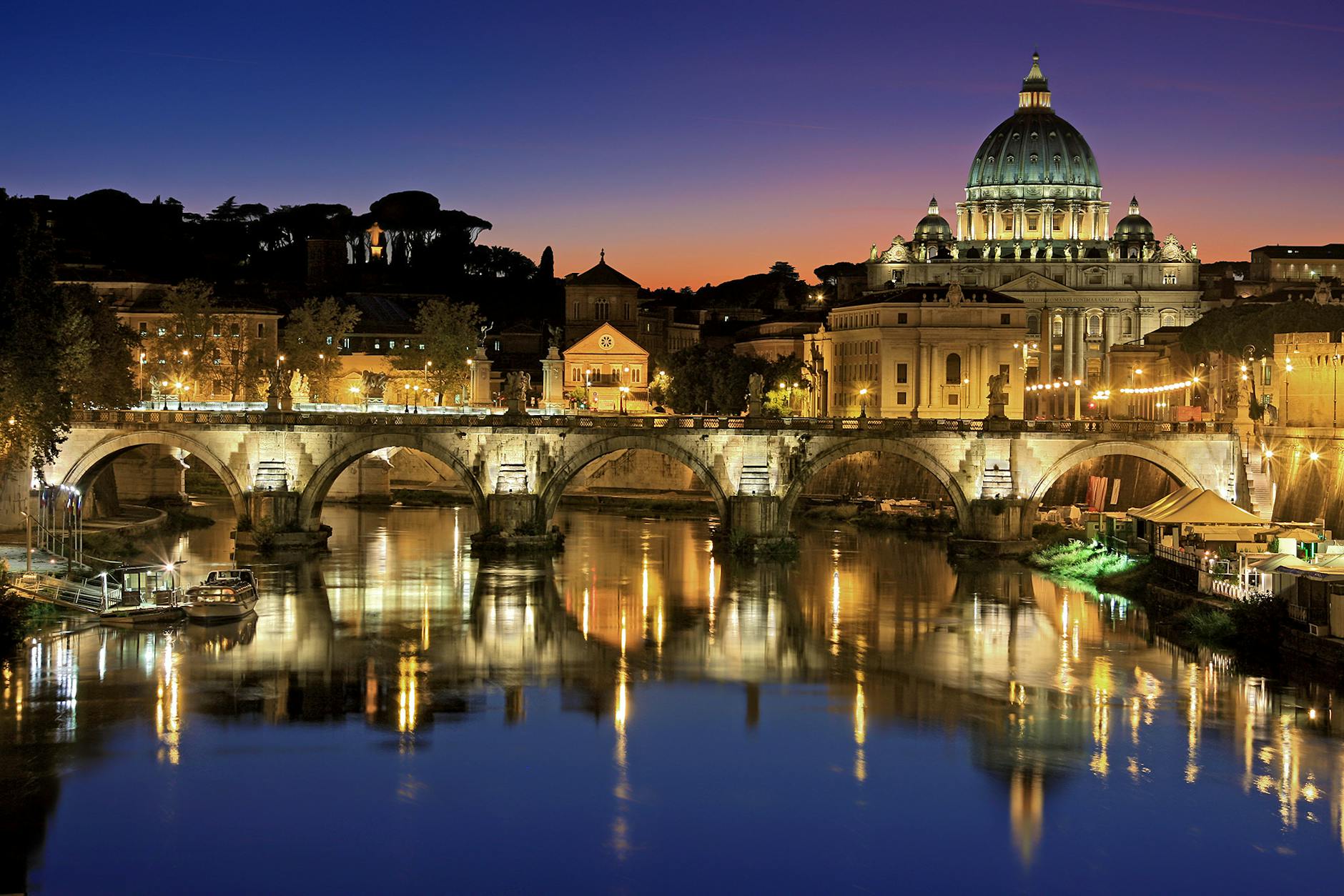
St. Peter’s Basilica, the crown jewel of Vatican City, stands as one of the most iconic architectural and religious landmarks in the world. Its grandeur, historical significance, and artistic brilliance make it a pilgrimage destination for millions and a testament to the ingenuity of Renaissance and Baroque architecture. The basilica’s story is deeply intertwined with the development of Vatican City itself, symbolizing both the spiritual and artistic aspirations of the Catholic Church.
The Historical Foundations
The site of St. Peter’s Basilica holds profound religious significance, as it is traditionally believed to be the burial place of St. Peter, one of Jesus Christ’s apostles and the first Bishop of Rome. In 326 CE, Emperor Constantine the Great commissioned the construction of the Old St. Peter’s Basilica over St. Peter’s tomb. This early basilica, with its imposing structure and ornate decorations, served as a place of worship for centuries and became a focal point for Christian pilgrims.
By the 15th century, however, the original basilica had fallen into disrepair. Pope Julius II, a fervent patron of the arts, envisioned a grand reconstruction that would not only honor St. Peter but also assert the Church’s power and influence during the Renaissance. In 1506, the foundation stone for the new St. Peter’s Basilica was laid, marking the beginning of an ambitious architectural endeavor that spanned over a century.
Architectural and Artistic Mastery
The construction of St. Peter’s Basilica brought together some of the most brilliant minds of the Renaissance and Baroque periods. Initial designs were created by Donato Bramante, who envisioned a grand central-plan church with a majestic dome inspired by the Pantheon of ancient Rome. Bramante’s vision set the stage for subsequent architects, including Raphael, Antonio da Sangallo the Younger, and Michelangelo, each of whom contributed to the basilica’s evolving design.
Michelangelo, appointed chief architect in 1547, played a pivotal role in shaping St. Peter’s Basilica into the masterpiece it is today. His design for the dome, towering 136 meters above the basilica floor, remains one of the most recognizable features of the Vatican skyline. Drawing on his expertise as a sculptor and architect, Michelangelo created a structure that combined engineering innovation with artistic grace, emphasizing verticality and light to inspire awe.
The completion of the basilica’s façade and colonnades in the 17th century under Carlo Maderno and Gian Lorenzo Bernini marked the culmination of the project. Bernini’s contributions, particularly the grand piazza and colonnades that encircle St. Peter’s Square, created a harmonious connection between the basilica and its surroundings, symbolizing the Church’s embrace of the faithful.
A Symbol of Faith and Artistic Heritage
St. Peter’s Basilica is not only an architectural marvel but also a spiritual sanctuary. It houses priceless artworks, including Michelangelo’s Pietà , Bernini’s Baldachin, and the bronze statue of St. Peter, whose foot is worn smooth by centuries of reverent touches from pilgrims. The basilica’s interior, with its soaring ceilings, intricate mosaics, and ornate chapels, invites visitors to reflect on the divine and the eternal.
As the site of major liturgical events, including papal masses and canonizations, St. Peter’s Basilica remains central to the life of the Catholic Church. It serves as a symbol of faith, resilience, and artistic achievement, drawing millions of visitors each year to witness its splendor.
In summary, St. Peter’s Basilica stands as a testament to the vision, creativity, and devotion that defined the Renaissance and Baroque eras. Its enduring legacy continues to inspire awe and reverence, reminding humanity of the profound connections between art, architecture, and spirituality.
The Sistine Chapel: Michelangelo’s Timeless Frescoed Ceiling
The Sistine Chapel, located within the Apostolic Palace of Vatican City, is an extraordinary masterpiece of art and spirituality. Renowned for Michelangelo’s breathtaking frescoed ceiling, the chapel represents a harmonious convergence of religious devotion, artistic innovation, and human creativity. Beyond its aesthetic significance, the Sistine Chapel also holds immense importance as the site of papal conclaves, where the next leader of the Catholic Church is elected.
The Origins of the Sistine Chapel
Commissioned by Pope Sixtus IV in the late 15th century, the Sistine Chapel was constructed between 1477 and 1480 to serve as both a private chapel for the Pope and a venue for important Church ceremonies. The chapel was designed by architect Giovanni dei Dolci and is modeled after the dimensions of Solomon’s Temple as described in the Old Testament. Its unassuming exterior contrasts with its interior, which became a showcase for Renaissance artistic talent.
Before Michelangelo’s involvement, the chapel’s walls were adorned with frescoes by prominent artists of the time, including Sandro Botticelli, Pietro Perugino, Domenico Ghirlandaio, and Cosimo Rosselli. These frescoes depicted scenes from the life of Moses and the life of Christ, emphasizing themes of salvation and divine authority. However, it was Michelangelo’s later contributions that transformed the Sistine Chapel into one of the greatest artistic achievements in history.
Michelangelo’s Ceiling: A Revolutionary Undertaking
In 1508, Pope Julius II commissioned Michelangelo to paint the chapel’s ceiling, replacing its original blue and gold starry design. Despite his reluctance—Michelangelo considered himself primarily a sculptor—he accepted the commission and embarked on what would become one of the most challenging and monumental projects of his career.
Over four years, from 1508 to 1512, Michelangelo worked tirelessly, often lying on scaffolding high above the chapel floor. The result was a stunning visual narrative that spans over 500 square meters and features over 300 figures. The ceiling’s centerpiece is the Creation of Adam, a depiction of God reaching out to impart the spark of life to Adam, which has become one of the most iconic images in Western art.
Michelangelo’s ceiling frescoes present a sweeping story of human existence, from the separation of light and darkness to the story of Noah. The composition showcases his mastery of anatomy, perspective, and dramatic expression, pushing the boundaries of Renaissance art. The vibrancy of the colors and the complexity of the design create a sense of movement and vitality that draws viewers into the divine narrative.
The Last Judgment: Michelangelo’s Final Contribution
In 1535, Michelangelo returned to the Sistine Chapel to create The Last Judgment on the altar wall, commissioned by Pope Clement VII. Completed in 1541, this powerful fresco depicts Christ’s second coming and the final judgment of souls. With its dramatic imagery and emotional intensity, The Last Judgment reflects the spiritual and political turmoil of the period, marking a shift toward Mannerism in Michelangelo’s style.
A Legacy of Artistic and Spiritual Significance
The Sistine Chapel remains one of the most visited and revered landmarks in the Vatican. It continues to serve its original purpose as a place of worship and as the setting for papal conclaves, where the College of Cardinals gathers to elect a new Pope. Visitors from around the world come to admire its unparalleled artistry and to experience its profound spiritual resonance.
Michelangelo’s work in the Sistine Chapel is a testament to human ingenuity and devotion, reminding us of the enduring power of art to transcend time, inspire faith, and communicate the divine.
The Vatican Museums: A Treasure Trove of Art and History
The Vatican Museums, among the most celebrated museums in the world, serve as a gateway to the vast artistic, cultural, and historical heritage of the Catholic Church. Spanning over 54 galleries, the museums house an extraordinary collection of masterpieces gathered by popes over centuries, ranging from ancient artifacts to Renaissance art and beyond. They stand as a testament to the Church’s commitment to preserving and showcasing humanity’s creative achievements.
Origins and Growth of the Collection
The origins of the Vatican Museums date back to 1506, when Pope Julius II acquired the Laocoön and His Sons sculpture, a masterpiece of Hellenistic art discovered in a vineyard near Rome. Recognizing its historical and artistic value, Pope Julius II placed the statue on public display, marking the beginning of the Vatican’s vast art collection. Over time, subsequent popes expanded the collection, acquiring works from across Europe and the Mediterranean, as well as commissioning new pieces from leading artists of their eras.
The museums officially opened to the public in the 18th century under Pope Clement XIV and Pope Pius VI, further solidifying their role as a repository of global cultural heritage. Today, the Vatican Museums attract millions of visitors annually, offering a journey through centuries of artistic evolution and religious devotion.
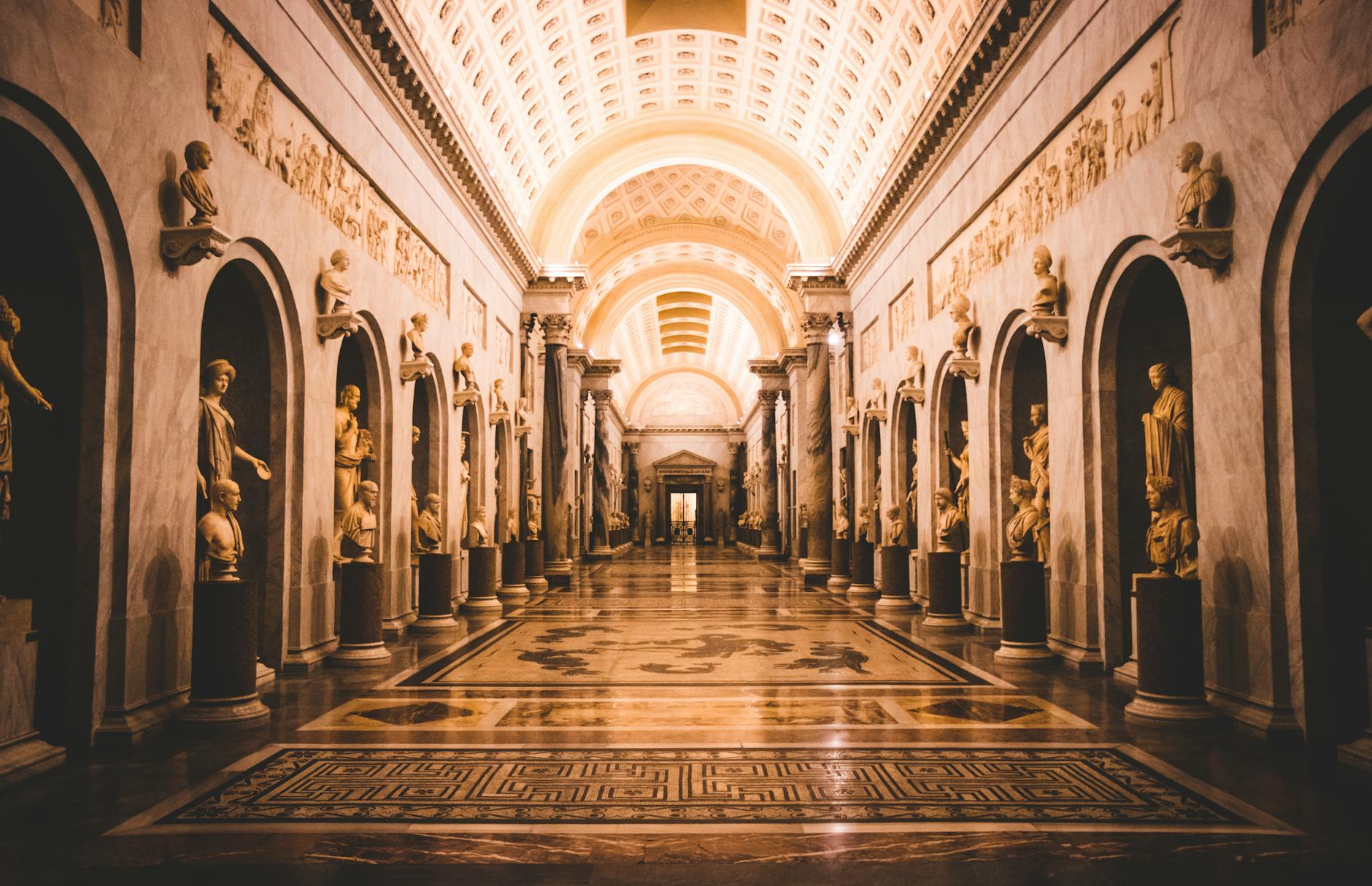
Photo by Jeswin Thomas on Pexels.com
Highlights of the Collections
The Vatican Museums house an unparalleled range of art and artifacts, representing various civilizations and periods in history. Some of the most notable sections include:
- The Gregorian Egyptian Museum: Founded by Pope Gregory XVI in 1839, this museum showcases artifacts from ancient Egypt, including mummies, statues, and papyri. The collection highlights the cultural and religious exchanges between ancient Egypt and early Christianity.
- The Raphael Rooms: These four rooms, once the private apartments of Pope Julius II, are adorned with frescoes by Raphael and his students. The School of Athens, depicting great philosophers of antiquity, is a standout piece, celebrated for its harmonious composition and intellectual depth.
- The Gallery of Maps: A breathtaking 120-meter-long corridor, this gallery features detailed frescoed maps of Italy and its regions, created between 1580 and 1585 under Pope Gregory XIII. The maps offer a fascinating glimpse into Renaissance cartography and geography.
- The Pinacoteca: This art gallery displays a collection of paintings by renowned artists, including Caravaggio, Leonardo da Vinci, and Giotto. Highlights include Raphael’s Transfiguration and Caravaggio’s Deposition.
- The Sistine Chapel: A crown jewel of the Vatican Museums, the Sistine Chapel showcases Michelangelo’s legendary frescoes on its ceiling and altar wall. Visitors can marvel at The Creation of Adam and The Last Judgment, both iconic representations of Renaissance art.
The Visitor Experience
Walking through the Vatican Museums is an immersive journey through history and art. Visitors can explore the intricate sculptures of the Pio-Clementine Museum, the classical antiquities of the Chiaramonti Museum, and the ethereal beauty of the Borgia Apartments. Each gallery and room reveals a unique chapter of human creativity, tied closely to the Church’s efforts to preserve and celebrate art.
The museums culminate in the Sistine Chapel, where visitors often pause in awe of Michelangelo’s frescoes. The sheer scale and beauty of the works on display leave an indelible impression, reflecting the Vatican’s enduring role as a guardian of culture and spirituality.
A Legacy of Preservation
The Vatican Museums continue to evolve, incorporating modern techniques to conserve and protect their priceless collections. They also embrace technology to enhance the visitor experience, offering virtual tours and educational resources to make their treasures accessible to a global audience.
In conclusion, the Vatican Museums stand as a living archive of humanity’s artistic and spiritual journey. They invite visitors to engage with history, admire unparalleled artistry, and reflect on the profound connections between creativity, faith, and human achievement.
St. Peter’s Square: The Heart of Vatican City
St. Peter’s Square, an architectural masterpiece and one of the most recognizable public spaces in the world, serves as the gateway to St. Peter’s Basilica and the symbolic heart of Vatican City. Designed by the brilliant Gian Lorenzo Bernini in the 17th century, the square reflects the spiritual and historical significance of the Vatican while serving as a focal point for religious ceremonies, papal audiences, and pilgrims from all over the globe.
The Vision of Gian Lorenzo Bernini
In 1656, Pope Alexander VII commissioned Gian Lorenzo Bernini to redesign the space in front of St. Peter’s Basilica. Bernini, a leading Baroque artist and architect, envisioned a grand piazza that would embody the Catholic Church’s embrace of the faithful. The resulting design is a stunning combination of architectural ingenuity and spiritual symbolism, creating a space that is both functional and deeply meaningful.
The square features a massive elliptical shape, flanked by two sweeping colonnades consisting of 284 Doric columns and 88 pilasters. These colonnades, often likened to outstretched arms, symbolize the Church’s welcoming embrace of humanity. The design ensures that visitors approaching the basilica feel both awed by its grandeur and invited into its sacred space.
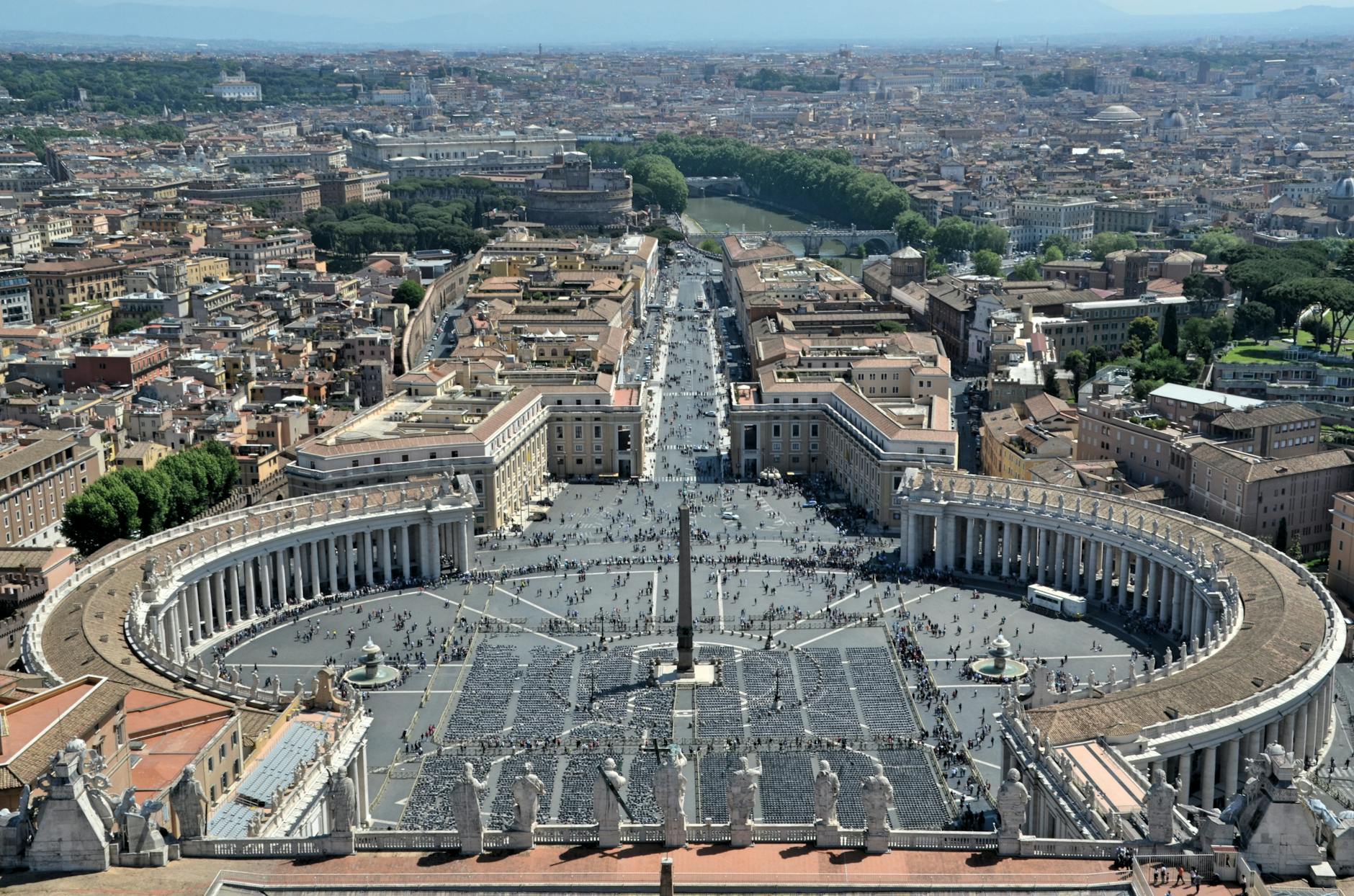
Photo by Davide Cacciatori on Pexels.com
The Obelisk and Fountains: Central Elements of the Square
At the center of St. Peter’s Square stands a 25.5-meter-tall Egyptian obelisk, a striking feature that predates Christianity. Originally erected in Heliopolis around 2500 BCE and brought to Rome by Emperor Caligula, the obelisk was relocated to its current position in 1586 by Pope Sixtus V with the help of architect Domenico Fontana. Topped with a cross, the obelisk serves as a reminder of Christ’s victory over paganism and as a unifying focal point for the square.
Flanking the obelisk are two magnificent Baroque fountains: one designed by Carlo Maderno in 1613 and the other by Bernini in 1675. The fountains enhance the square’s symmetry and provide a sense of tranquility amidst its vast expanse. Their continuous flow of water, a symbol of life and renewal, adds to the spiritual atmosphere of the space.
A Space for Pilgrims and Celebrations
St. Peter’s Square is not merely a place of architectural beauty; it is a living space that hosts some of the Catholic Church’s most significant events. On occasions such as Easter and Christmas Mass, the square fills with tens of thousands of worshippers gathered to receive the Pope’s blessing. The Urbi et Orbi (to the city and the world) blessing, delivered from the basilica’s central balcony, is a highlight of these ceremonies.
Additionally, the square is the site of weekly papal audiences, during which the Pope addresses the faithful and delivers messages of hope and guidance. These events underscore the square’s role as a space of connection between the Pope and the global Catholic community.
A Symbol of Unity and Faith
St. Peter’s Square is a powerful symbol of unity, reflecting the Vatican’s role as the spiritual center of the Catholic Church. Its design encourages both personal reflection and communal worship, embodying the principles of openness, harmony, and divine connection. For visitors, standing in the square and gazing up at St. Peter’s Basilica is an awe-inspiring experience that often deepens their sense of faith and wonder.
In summary, St. Peter’s Square is more than just an architectural achievement; it is a space imbued with spiritual significance and cultural history. Bernini’s vision, combined with its dynamic role in the life of the Church, makes the square a cornerstone of Vatican City and a beacon of faith for millions around the world.
The Vatican Gardens: A Serene Retreat of Natural Beauty
Hidden behind the bustling grandeur of St. Peter’s Basilica and the Vatican Museums lies the Vatican Gardens, a lush sanctuary of natural beauty, artistic treasures, and spiritual tranquility. Covering nearly half of Vatican City’s 44 hectares, the gardens are a harmonious blend of meticulously landscaped grounds, religious monuments, and historical structures, offering a peaceful escape for those privileged to enter.
Historical Origins
The origins of the Vatican Gardens can be traced back to the Renaissance era. In 1279, Pope Nicholas III moved the papal residence from the Lateran Palace to the Vatican. To create a private space for reflection and prayer, he enclosed the area with walls and cultivated an orchard, a meadow, and a garden. Over the centuries, successive popes expanded and transformed the gardens, integrating elements of Baroque, Renaissance, and modern landscaping styles.
By the 16th century, under Pope Julius II, the gardens underwent significant development, coinciding with the construction of the new St. Peter’s Basilica. Architects and gardeners designed spaces that reflected the spiritual and artistic ideals of the time, incorporating fountains, sculptures, and symbolic plants. The result was a serene environment that combined natural beauty with religious and cultural significance.
Architectural and Artistic Highlights
The Vatican Gardens are home to numerous architectural and artistic marvels. Among them are small chapels, grottoes, fountains, and statues that enhance the spiritual atmosphere of the grounds. Notable highlights include:
- The Fountain of the Eagle: A Baroque masterpiece designed by Carlo Maderno, this fountain features an eagle perched atop a sculpted globe, symbolizing the Church’s universal reach.
- The Lourdes Grotto: A replica of the famous grotto in Lourdes, France, this sacred site is a place of prayer and devotion, often visited by the Pope.
- The Vatican Radio Tower: Constructed in 1931 under Pope Pius XI, this tower symbolizes the Church’s embrace of modern technology to spread its message worldwide.
- The Vatican Helipad: A contemporary addition, the helipad underscores the gardens’ dual role as a private retreat and a functional space for the Vatican’s operations.
Biodiversity and Landscaping
The Vatican Gardens are a testament to the Church’s appreciation of God’s creation. They host a diverse array of plant species, some of which are native to the Mediterranean region, while others have been brought from distant lands. Olive trees, cypress, and magnolia coexist with exotic flowers and shrubs, creating a vibrant tapestry of colors and textures.
Each section of the gardens has its unique character, from the geometric precision of the Italian Garden to the more freeform layout of the English Garden. Together, these spaces offer a reflection of the different artistic and horticultural traditions that have influenced the Vatican over the centuries.
A Place of Reflection and Renewal
For centuries, the Vatican Gardens have served as a place of retreat for popes seeking solitude and spiritual renewal. Walking among the gardens’ shaded paths and listening to the gentle trickle of fountains, one can easily imagine the inspiration they have provided to countless leaders of the Church.
In recent years, the gardens have been opened to limited public access, allowing visitors to experience their beauty firsthand through guided tours. These tours provide a unique glimpse into the hidden heart of Vatican City, offering a deeper appreciation for its blend of history, faith, and natural splendor.
The Vatican Gardens as a Symbol of Harmony
The Vatican Gardens symbolize the Church’s commitment to harmony between humanity and nature. They remind visitors of the spiritual significance of creation and the responsibility to care for the environment as a reflection of divine beauty.
In conclusion, the Vatican Gardens stand as a serene testament to the Church’s dedication to preserving natural and artistic heritage. They offer a tranquil space for reflection and provide a profound connection between faith, culture, and the beauty of the natural world.
Conclusion: A Timeless Journey Through Faith, Art, and History
The Vatican City, though the smallest country in the world, holds an unparalleled significance as a global center of faith, culture, and history. From the awe-inspiring St. Peter’s Basilica to the serene Vatican Gardens, every corner of this sacred enclave reflects centuries of artistic achievement, spiritual devotion, and historical resonance.
As visitors walk through the Vatican Museums, marvel at Michelangelo’s frescoes in the Sistine Chapel, or stand amidst the architectural grandeur of St. Peter’s Square, they embark on a journey that transcends time and space. The Vatican’s treasures are not just monuments of the past; they are living symbols of the enduring power of human creativity and divine inspiration.
For millions of pilgrims and tourists each year, Vatican City offers a unique blend of spiritual enrichment and cultural discovery, making it a destination unlike any other. It remains a timeless beacon of faith and a celebration of humanity’s shared heritage.





[…] The gathering â£of world leaders⣠was for the funeral†of Pope Francis in Vatican City. […]
[…] conclave commenced under the watchful eyes of the world, with 111 cardinals gathering at the Vatican. The atmosphere was charged with anticipation and concern, as speculation ran rampant about the […]
[…] Vatican Museums, an illustrious institution nestled within the heart of the Vatican City, offers a glimpse into one of the most important collections of art and historical artifacts in the […]
[…] as the new leader of the Catholic Church occurred⢠Thursday, following a two-day conclave in Vatican City after the death of Pope‌ Francis. â¤On Saturday, he visited a sanctuary near Rome and prayed at […]
[…] Vatican City – Pope Francis has continued a practice initiated by his predecessor,offering a personal response to a letter published in “Piazza San Pietro,†the monthly magazine of St. Peter’s Basilica. The Pontiff’s reply centered on themes of faith, family, and persevering through life’s difficulties. […]