
Introduction
Rome, famously known as the “Eternal City,” is a timeless symbol of human achievement, resilience, and cultural significance. As the epicenter of ancient civilization and the birthplace of ideas that shaped Western culture, the history of Rome spans over 2,700 years. From its mythological founding by Romulus and Remus to its dominance as the capital of one of the world’s greatest empires, Rome has left an indelible mark on history.
The city has been a beacon of political innovation during the Roman Republic, a hub of imperial grandeur under the Roman Empire, and a spiritual epicenter during the reign of the Papacy. Rome’s Renaissance period revitalized art and architecture, establishing it as a cultural capital. Today, as the heart of modern Italy, it seamlessly blends ancient ruins with contemporary vibrance. This article explores the rich layers of Rome’s history, uncovering its transformation through the ages.
The Foundation of Rome: Myth and Early Beginnings
The story of Rome’s foundation is as legendary as the city itself. According to ancient Roman mythology, the city was founded in 753 BCE by Romulus, the first of seven kings who would reign over the early city-state. The myth begins with the twin brothers Romulus and Remus, sons of the war god Mars and the vestal virgin Rhea Silvia. Abandoned at birth and cast into the Tiber River, the twins were famously suckled by a she-wolf, a symbol of resilience and strength. Later raised by a shepherd, they grew to overthrow their uncle, Amulius, and reclaim their rightful place as heirs of Alba Longa.
The founding of Rome is steeped in both legend and historical speculation. Romulus and Remus are said to have argued over the location and leadership of their new city, leading to Romulus killing Remus and becoming Rome’s sole founder. Romulus established the city atop the Palatine Hill, one of Rome’s famous Seven Hills, marking the beginning of what would become the Roman Kingdom.
While the myth is central to Roman cultural identity, historians suggest that the city’s origins were more complex. Archeological evidence indicates that Rome began as a small settlement of Latin-speaking peoples who lived in simple huts. These early inhabitants were influenced by neighboring Etruscan and Greek cultures, borrowing architectural, religious, and political elements that shaped their society.
The early Roman Kingdom was a time of monarchy, with kings wielding considerable power over religious, military, and political matters. Among these kings, Numa Pompilius, Rome’s second ruler, is credited with instituting many religious traditions and rituals that became the bedrock of Roman spirituality. Later kings like Tullus Hostilius and Ancus Marcius expanded the city’s territory and infrastructure, laying the foundation for its eventual rise as a regional power.
Rome’s geography also played a crucial role in its early success. Located along the Tiber River, the city was well-positioned for trade and defense. Its proximity to fertile plains allowed for agricultural prosperity, while its central location in the Italian Peninsula enabled interactions with diverse cultures. The Seven Hills provided natural fortifications, which were critical for the city’s protection during its formative years.
The transition from myth to historical reality marks an essential aspect of Rome’s identity. The city’s founders intentionally intertwined history with legend, crafting a narrative that celebrated divine favor and human determination. This blending of fact and fiction established a cultural and ideological framework that persisted throughout Roman history, influencing its art, politics, and societal values.
The story of Rome’s foundation, both mythical and factual, set the stage for its transformation into a city of unparalleled influence. From humble beginnings as a small settlement to becoming a kingdom led by semi-legendary monarchs, Rome’s origins reflect the resilience and ambition that would define it for millennia.
The Roman Republic: The Rise of Governance and Conquest
The Roman Republic, established in 509 BCE, marked a pivotal era in the city’s history, replacing the monarchy with a system of governance that emphasized shared power and civic duty. This new political structure laid the groundwork for Rome’s transformation from a modest city-state to a dominant Mediterranean power.
At the heart of the Republic was the concept of res publica (the public affair), where authority was distributed among elected officials, including consuls, senators, and tribunes. The Republic’s political system was characterized by a complex balance of power. Consuls, elected annually, served as the highest executives, while the Senate, composed of Rome’s elite, provided advisory and legislative functions. The popular assemblies allowed citizens to vote on laws and elect magistrates, ensuring a degree of public participation.
Rome’s expansion during the Republic was driven by its military prowess and strategic diplomacy. The city’s army, composed of citizen-soldiers, was one of the most disciplined and adaptable forces of its time. Early conquests focused on unifying the Italian Peninsula, achieved through a combination of alliances, treaties, and warfare. The defeat of the Etruscans, Samnites, and other rival tribes solidified Rome’s dominance in the region.
The Republic’s ambitions extended beyond Italy with the Punic Wars (264–146 BCE), a series of conflicts with Carthage, Rome’s formidable rival. These wars showcased Rome’s strategic brilliance, particularly under leaders like Scipio Africanus, who secured victory in the decisive Battle of Zama. The destruction of Carthage and the annexation of its territories marked the beginning of Rome’s control over the western Mediterranean.
Economic and social transformations accompanied the Republic’s expansion. Conquered lands were integrated into the Roman system, providing resources, wealth, and manpower. The Republic also saw the rise of a wealthy elite who controlled vast estates known as latifundia. However, this concentration of wealth led to growing disparities between the rich and the poor, planting the seeds for future internal conflicts.
Despite its successes, the Republic faced significant challenges. Political corruption, power struggles, and the increasing reliance on powerful generals like Julius Caesar and Pompey undermined the system’s stability. The late Republic was marked by a series of civil wars that ultimately led to its collapse. Julius Caesar’s appointment as dictator for life in 44 BCE and his subsequent assassination signaled the end of the Republic.
The Roman Republic’s legacy lies in its innovations in governance and law. Concepts such as the separation of powers, checks and balances, and representative institutions inspired political thought for centuries, influencing modern democracies. The Republic’s achievements in military organization, engineering, and cultural integration laid the foundation for the Roman Empire, which would carry forward its ideals on an even grander scale.
The Roman Empire: Unprecedented Expansion and Cultural Flourishing
The transition from the Roman Republic to the Roman Empire in 27 BCE was a turning point in Rome’s history, marked by the centralization of power under Augustus, the first Roman emperor. The Empire’s establishment brought an era of unprecedented territorial expansion, political stability, and cultural flourishing known as Pax Romana (Roman Peace), which lasted for approximately two centuries.
Under Augustus, Rome saw the consolidation of its territories and the creation of an imperial bureaucracy to govern its vast lands, which stretched from Britain in the northwest to Egypt in the southeast. Augustus implemented reforms in taxation, legal systems, and urban planning, ensuring the stability and prosperity of the Empire. Infrastructure projects, including roads, aqueducts, and public buildings, facilitated communication, trade, and the integration of diverse cultures within the Empire.
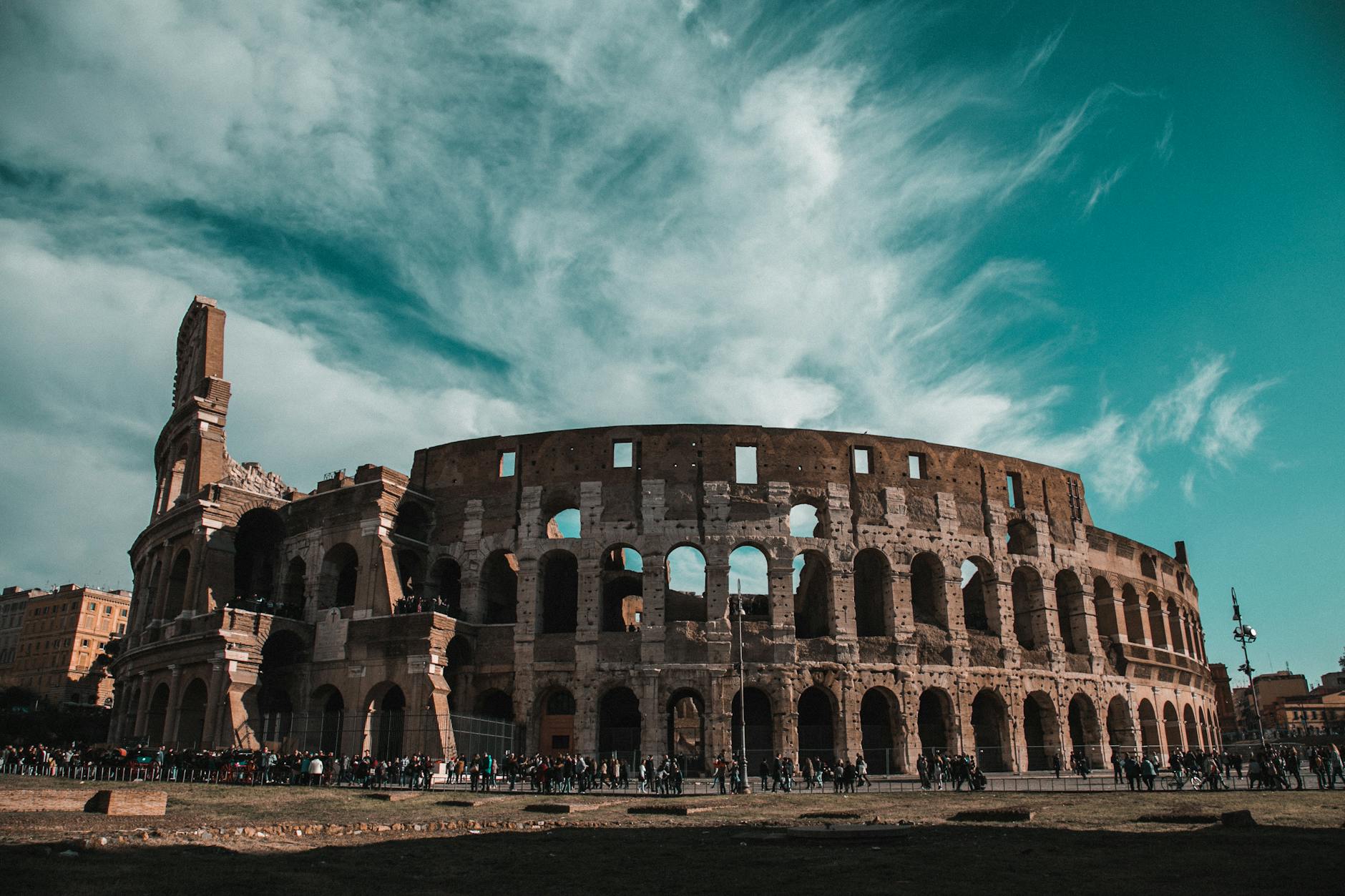
One of the Empire’s most remarkable features was its ability to assimilate conquered peoples. Rome’s policy of granting citizenship to non-Romans created a sense of unity and loyalty among its subjects. This inclusivity, combined with the spread of Latin and Roman law, established a shared cultural identity across the Empire. Roman engineering and architecture, exemplified by structures like the Colosseum and the Pantheon, symbolized the grandeur and innovation of the period.
The Empire’s expansion continued under emperors like Trajan, who extended Roman rule to its greatest territorial extent, including Dacia (modern-day Romania) and Mesopotamia. The construction of monumental projects, such as Trajan’s Forum and Trajan’s Column, celebrated military victories and demonstrated the Empire’s engineering brilliance. Similarly, Hadrian’s reign was marked by consolidation rather than expansion, as seen in the construction of Hadrian’s Wall in Britain, which served as a defensive boundary and symbol of Roman authority.

The cultural achievements of the Roman Empire were equally impressive. Literature, art, and philosophy flourished, with figures like Virgil, Horace, and Seneca leaving an indelible mark on Western thought. Roman law, codified during the Empire, became the foundation of legal systems in many parts of the world. The Latin language, spread through Roman conquests, influenced the development of Romance languages and remains a cornerstone of Western culture.
However, the Roman Empire was not without challenges. The vastness of its territories made administration increasingly difficult, and internal power struggles often destabilized the leadership. The third century CE saw a period of crisis, marked by economic decline, invasions, and a succession of short-lived emperors. Despite efforts to restore stability, the Empire eventually split into Eastern and Western halves in 285 CE, under Emperor Diocletian.
The Western Roman Empire ultimately fell in 476 CE, marking the end of ancient Rome as a political entity. However, the Eastern Roman Empire, known as the Byzantine Empire, continued to preserve Roman traditions for another thousand years. The Roman Empire’s legacy is vast, shaping governance, architecture, language, and cultural ideals that continue to influence the modern world.
The Fall of the Western Roman Empire: Causes and Consequences
The fall of the Western Roman Empire in 476 CE marked a profound shift in European history. While the event is often symbolized by the deposition of the last Roman emperor, Romulus Augustulus, by the Germanic king Odoacer, the decline of the Empire was a long and complex process influenced by political, economic, social, and military factors.
One of the primary causes of the Empire’s fall was its vast size, which made effective governance increasingly difficult. By the third century CE, the Empire was struggling to maintain control over its territories, which stretched across Europe, North Africa, and parts of Asia. Internal divisions and weak leadership compounded the problem, with frequent power struggles among emperors, generals, and political factions.
Economic instability also played a significant role. The Empire faced declining agricultural productivity, heavy taxation, and reliance on slave labor, which hindered economic innovation. Trade disruptions, caused by invasions and internal strife, further weakened the economy. The devaluation of Roman currency and inflation eroded public confidence, exacerbating the financial crisis.
The military, once the backbone of Rome’s power, became increasingly strained. The reliance on mercenaries—foreign soldiers hired to supplement Roman forces—led to a decline in discipline and loyalty. These mercenaries, often from Germanic tribes, had little allegiance to the Roman state and sometimes turned against it. The Empire also faced constant external pressures from migrating and invading groups, such as the Visigoths, Vandals, and Huns. The sack of Rome by the Visigoths in 410 CE and the Vandals in 455 CE demonstrated the Empire’s vulnerability.
Social and cultural shifts further undermined the Empire. The division between the wealthy elite and the impoverished masses grew wider, eroding social cohesion. The rise of Christianity also transformed Roman society. While the religion provided spiritual unity and moral guidance, it shifted focus away from traditional Roman civic virtues and institutions, contributing to the decline of classical Roman culture.
The administrative division of the Empire into Eastern and Western halves in 285 CE by Emperor Diocletian aimed to improve governance but ultimately weakened the West. The Eastern Roman Empire, centered in Constantinople, was wealthier and better fortified, allowing it to survive for another thousand years as the Byzantine Empire. Meanwhile, the Western Roman Empire struggled with fewer resources and greater threats.
The deposition of Romulus Augustulus in 476 CE marked the end of the Western Roman Empire as a political entity. However, the idea of Rome persisted. The Eastern Roman Empire continued to identify as Roman, preserving and adapting its traditions. In the West, the fall of Rome paved the way for the emergence of medieval Europe. Germanic kingdoms rose to prominence, blending Roman and native traditions. The Roman Catholic Church also played a crucial role in preserving Roman heritage, becoming a unifying force in the fragmented post-Roman world.
The fall of the Western Roman Empire remains one of history’s most studied events, symbolizing the transition from antiquity to the Middle Ages. Its causes and consequences continue to offer lessons on the challenges of maintaining vast, complex systems of governance.
The Rise of Medieval Rome and the Papal States
After the fall of the Western Roman Empire, Rome entered a period of transition, marked by the rise of the Papacy and the establishment of the Papal States. During the early medieval period, the city’s political power declined, but its spiritual influence grew as it became the center of the Roman Catholic Church.
As Germanic tribes carved out kingdoms in former Roman territories, Rome found a new identity as a religious capital. The Pope, as the Bishop of Rome, gained increasing authority, not only in spiritual matters but also in political affairs. This transformation was particularly evident under Pope Gregory I (Gregory the Great) in the 6th century, who reformed Church administration and promoted missionary efforts that spread Christianity throughout Europe.
During the Middle Ages, the city saw the construction of numerous churches and religious institutions, many of which still stand today. While much of the ancient city fell into ruin, new centers of devotion arose, such as the Basilica of Santa Maria Maggiore and the Church of San Clemente, which reflected a blending of early Christian and Roman architectural styles.
The Papal States, established in the 8th century, were a unique theocratic territory governed by the Pope. They played a vital role in shaping Rome’s history, providing the city with a renewed sense of importance. Pilgrims flocked to Rome, seeking spiritual redemption and contributing to its cultural and economic revival.
Renaissance and Baroque Rome: The Rebirth of a City
The Renaissance was a golden age for Rome, transforming it into a center of art, architecture, and scholarship. Beginning in the 15th century, Popes such as Julius II and Leo X initiated ambitious projects to restore Rome’s former glory. They commissioned renowned artists like Michelangelo, Raphael, and Bernini to create masterpieces that continue to define the city’s identity.
The rebuilding of St. Peter’s Basilica and the creation of the Sistine Chapel were monumental undertakings that showcased the Church’s wealth and power. Michelangelo’s frescoes in the Sistine Chapel and his design for the Basilica’s dome remain iconic symbols of Renaissance artistry. Raphael’s works, including the frescoes in the Apostolic Palace, reflected the intellectual and cultural revival of the period.
The Baroque era further enhanced Rome’s grandeur with dramatic, ornate architectural projects. Gian Lorenzo Bernini’s contributions, such as the colonnade of St. Peter’s Square and the Fountain of the Four Rivers in Piazza Navona, epitomized the dynamism and theatricality of Baroque art. These projects transformed Rome into a city of fountains, piazzas, and monumental churches, drawing visitors from across Europe.
Iconic Places to Visit in Rome Today
Rome today is a living museum, offering visitors a journey through thousands of years of history. Here are the must-visit landmarks that reflect the city’s layered past:
- The Colosseum and Roman Forum: The Colosseum, a symbol of ancient Rome, is a marvel of engineering and a testament to the city’s imperial grandeur. Nearby, the Roman Forum reveals the political and social heart of ancient Rome.
- The Vatican City: Home to St. Peter’s Basilica, the Sistine Chapel, and the Vatican Museums, this independent city-state showcases Renaissance and Baroque treasures.
- The Pantheon: An ancient Roman temple dedicated to all gods, the Pantheon is renowned for its perfect dome and continues to inspire architects worldwide.
- Trevi Fountain: This Baroque masterpiece is not only a symbol of Rome’s artistic heritage but also a tradition for visitors wishing to return to the city.
- Piazza Navona: Built on the site of an ancient stadium, this vibrant square features Bernini’s Fountain of the Four Rivers and is a hub of Roman culture.
- The Spanish Steps: A popular gathering spot, the Spanish Steps offer a picturesque view of Rome and lead to the Trinità dei Monti Church.
- The Catacombs and Basilica of San Clemente: These sites offer a glimpse into early Christian Rome, with underground burial chambers and layered archaeological treasures.
Whether exploring ancient ruins, Renaissance masterpieces, or vibrant piazzas, Rome offers a timeless experience for every traveler.
Conclusion
Rome is more than just a city; it is a timeless emblem of history, culture, and innovation. From its foundation in legend as the cradle of the Roman Empire to its role as the heart of the Christian world and its transformation into a modern global capital, Rome stands as a testament to human ingenuity and resilience. Each chapter of its history—ancient, medieval, Renaissance, and modern—has left an indelible mark on its streets, monuments, and culture.
Today, Rome is a mosaic of its past, seamlessly blending antiquity and modernity. Visitors can walk through the ruins of the Roman Forum, marvel at the grandeur of St. Peter’s Basilica, toss coins into the Trevi Fountain, or simply lose themselves in the city’s vibrant piazzas. Each experience reveals a piece of Rome’s layered identity, creating a living connection to its extraordinary history.
As you explore this Eternal City, it becomes clear why Rome continues to captivate the world. Its enduring beauty, cultural richness, and iconic landmarks not only honor its past but also inspire generations to come. Truly, all roads lead to Rome—a city that never ceases to amaze.







[…] Colosseum, also known as the Flavian Amphitheatre, is one of the most iconic landmarks of ancient Rome and a testament to the engineering prowess and architectural ingenuity of the Roman Empire. Situated […]
[…] of Roman artistry, stands as one of the most iconic fountains in the world. Nestled in the heart of Rome, this Baroque masterpiece is not only an architectural wonder but also a symbol of the city’s […]
[…] story of the Pantheon begins in the heart of Rome during the early days of the Roman Empire. The first Pantheon was commissioned in 27 BCE by Marcus […]
[…] City, the world’s smallest independent state, is a unique enclave within Rome, Italy, and the spiritual epicenter of Catholicism. Though it covers just 44 hectares, its […]