Introduction
The Pantheon of Rome stands as one of the most extraordinary testaments to ancient engineering and architectural brilliance. Constructed during the reign of Emperor Hadrian in the early 2nd century CE, the Pantheon was originally conceived as a temple dedicated to all Roman gods. Its imposing structure, marked by a massive dome and harmonious proportions, continues to inspire awe in architects, historians, and visitors alike. Beyond its architectural marvels, the Pantheon is a living narrative of Rome’s evolving identity—from its origins as a pagan temple to its consecration as a Christian church in the 7th century. Surviving centuries of transformation and weathering the passage of time, it represents not only the ingenuity of Roman engineering but also the enduring cultural and religious significance of Rome. This article delves into the history, design, influence, and preservation of the Pantheon, unraveling the layers of its captivating story.
The Origins: Commissioning and Purpose in Ancient Rome
The story of the Pantheon begins in the heart of Rome during the early days of the Roman Empire. The first Pantheon was commissioned in 27 BCE by Marcus Agrippa, the trusted lieutenant of Emperor Augustus. Agrippa’s vision was to create a temple honoring the Roman pantheon of gods, a symbolic gesture of Rome’s devotion to divine protection and unity. The structure’s original purpose was deeply rooted in the religiosity and civic pride that characterized the early Roman Empire.
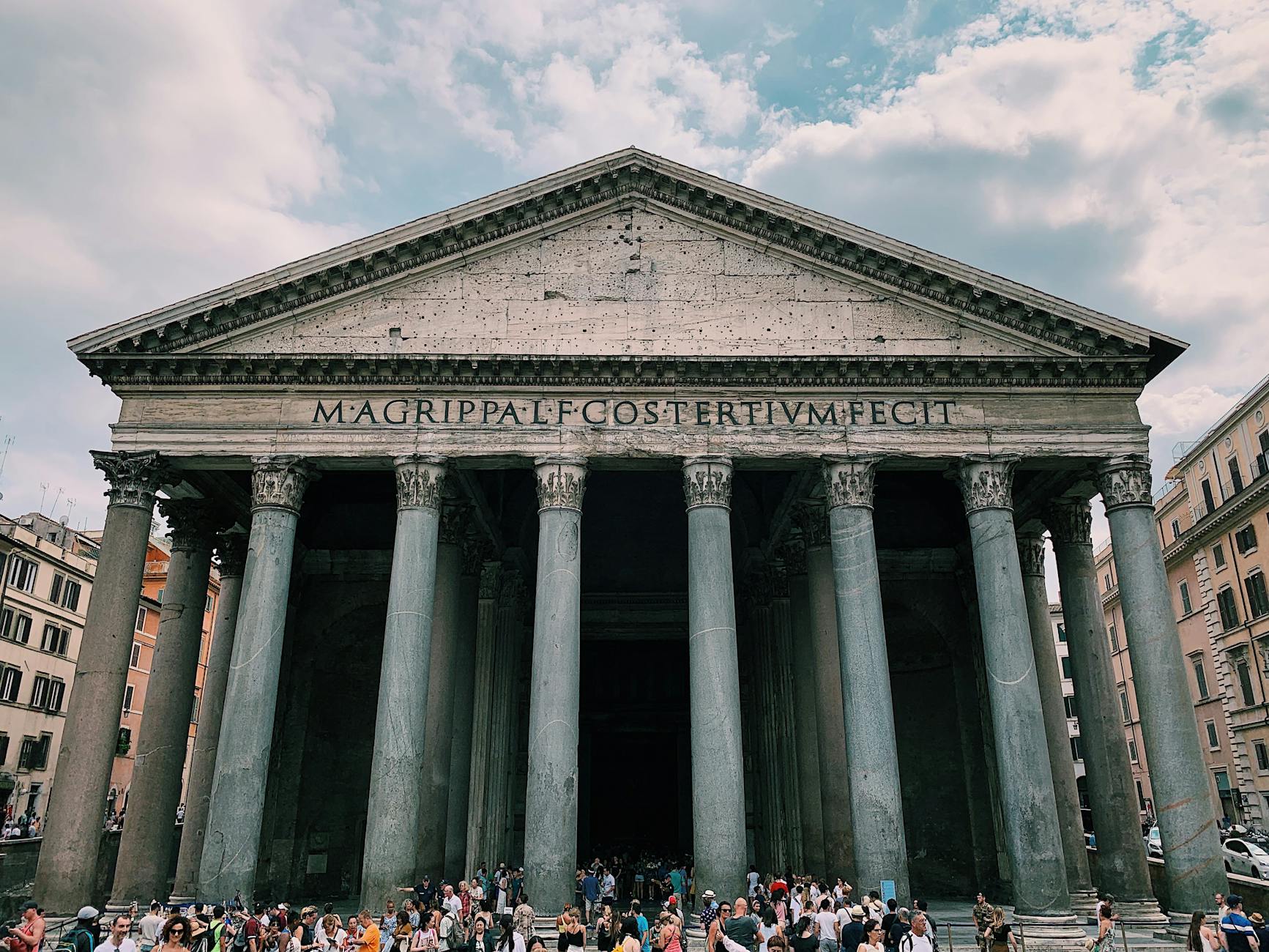
Agrippa’s Pantheon was destroyed in a fire in 80 CE, but its foundational significance laid the groundwork for the magnificent structure that would follow. The current Pantheon was reconstructed under Emperor Hadrian around 118–125 CE, although he modestly retained the inscription honoring Agrippa. Hadrian envisioned the temple as not only a religious sanctuary but also as an architectural statement of Rome’s supremacy.
The design of the Pantheon reflected a shift in Roman religious architecture. Unlike traditional rectangular temples with porticoes, the Pantheon’s circular design symbolized the cosmos, with its central oculus connecting the heavens and the earth. This innovative approach emphasized the universality and inclusivity of Roman religious practices, inviting all gods to reside within its walls.
Hadrian’s involvement in the Pantheon’s reconstruction also highlighted his personal interest in architecture and his dedication to immortalizing Roman achievements. Unlike his predecessors, Hadrian often engaged directly with architectural projects, earning a reputation as a “philosopher-king.â€
The Pantheon’s enduring legacy as a temple to “all gods†encapsulates its initial purpose. However, its historical significance extends beyond its religious function. The Pantheon represented the Roman Empire’s ambition, ingenuity, and capacity to transcend traditional boundaries—qualities that would define the structure’s lasting influence on architecture and culture.
Architectural Innovations: The Dome and Its Ingenious Design
The Pantheon’s dome is an architectural triumph, showcasing the peak of Roman engineering ingenuity. At its completion, the dome was the largest in the world, a record it held for over a millennium. Its sheer scale and harmonious proportions were unprecedented, solidifying the Pantheon’s status as a masterpiece of architectural design.
At the heart of the dome’s innovation lies the oculus—a circular opening at its apex. Measuring 8.2 meters (27 feet) in diameter, the oculus serves both practical and symbolic purposes. Architecturally, it reduces the weight at the dome’s apex, ensuring structural stability. Symbolically, the oculus acts as a celestial window, allowing sunlight to illuminate the interior dynamically throughout the day, creating a spiritual connection between the heavens and the space below.
The dome’s construction utilized a groundbreaking technique involving Roman concrete, or opus caementicium. Layers of concrete with varying densities were used, with heavier materials like basalt at the base and lighter ones like pumice towards the top. This gradient reduced stress on the structure and allowed for its remarkable height of 43.3 meters (142 feet).
The geometry of the dome is also significant. Its hemispherical shape creates a perfect sphere when imagined with its reflection below, symbolizing completeness and the universe. This geometric perfection was a testament to the Romans’ advanced understanding of mathematics and engineering.
In addition to its construction, the Pantheon’s dome influenced countless architectural works, from the Florence Cathedral to St. Peter’s Basilica and modern structures like the U.S. Capitol. Its revolutionary design remains a benchmark in architectural history, a reminder of the innovation that defined Roman ingenuity.
The Materials and Techniques: Mastery of Roman Concrete
Roman concrete, or opus caementicium, was the key to the Pantheon’s enduring strength and iconic design. Unlike modern concrete, which often weathers and cracks over centuries, Roman concrete has survived nearly two millennia, thanks to its unique composition and application.
The Pantheon’s construction employed a mix of lime, volcanic ash, and aggregates, a formula that produced a durable and adaptable material. Volcanic ash, specifically pozzolana, played a crucial role in the mixture. When combined with water, pozzolana created a chemical reaction that prevented cracks from spreading, ensuring the long-term stability of the structure.
The walls of the Pantheon, which are up to 6 meters (20 feet) thick at the base, were built using a combination of concrete and brick-faced masonry. This robust foundation supported the immense weight of the dome above. Additionally, the Romans incorporated relieving arches into the walls, distributing the weight evenly and preventing structural failure.
One of the most innovative aspects of Roman concrete was its use in the dome. By carefully layering materials, with heavier aggregates like travertine at the base and lighter ones like pumice towards the top, the Romans reduced the overall weight without compromising strength. The coffered design of the dome’s interior further reduced its mass while adding an aesthetic rhythm to the space.
The mastery of Roman concrete not only enabled the Pantheon’s construction but also ensured its resilience against natural disasters, including earthquakes. Modern engineers continue to study this ancient material, seeking to replicate its durability and adaptability. The Pantheon thus stands not only as a testament to Roman architectural skill but also as an enduring symbol of innovation.
Transformations Across Time: From Pagan Temple to Christian Church
The Pantheon’s history is a fascinating narrative of transformation, reflecting Rome’s evolving religious and cultural landscape. Initially built as a temple to honor the Roman gods, the Pantheon’s original function was tied closely to the polytheistic practices of ancient Rome. This purpose was integral to its design, with its circular layout and oculus symbolizing the heavens and the divine.
However, as the Roman Empire transitioned from paganism to Christianity, the Pantheon’s role in Roman society shifted dramatically. By the 4th century CE, Christianity had become the dominant religion, and the traditional worship of Roman gods began to wane. During this period, many pagan temples were abandoned, repurposed, or destroyed.
The Pantheon’s survival during this transitional era was largely due to its conversion into a Christian church in 609 CE. Pope Boniface IV consecrated the structure as the “Church of St. Mary and the Martyrs,†or Santa Maria ad Martyres. This act of consecration not only preserved the building but also redefined its purpose. By dedicating the space to Christian worship, the church symbolized the triumph of Christianity over Rome’s pagan past.

Despite this change in function, the Pantheon retained many of its original architectural elements, including its vast dome and iconic oculus. However, Christian additions, such as altars, religious imagery, and inscriptions, were incorporated into the space, blending ancient Roman engineering with Christian iconography. This hybrid identity made the Pantheon unique among Rome’s historic structures.
The Christianization of the Pantheon also marked the beginning of its continuous use as a religious site, ensuring its maintenance and protection through centuries of political and social upheaval. Unlike many ancient Roman buildings, which fell into ruin during the medieval period, the Pantheon’s status as a church safeguarded it from neglect and destruction.
The building’s adaptive reuse also speaks to its enduring appeal and versatility. As a Christian church, it became a symbol of continuity, bridging Rome’s ancient and medieval eras. Its preservation through this transformation highlights the ingenuity of Rome’s leaders, who recognized the Pantheon’s historical and architectural significance and ensured its legacy for future generations.
The Influence of the Pantheon on Western Architecture
The Pantheon’s architectural design has had a profound influence on Western architecture, inspiring countless structures over the centuries. Its combination of innovative engineering, harmonious proportions, and symbolic elements set a precedent for monumental architecture, particularly in the realms of religious and civic buildings.
One of the Pantheon’s most significant contributions to architectural history is its dome, which became a model for subsequent domed structures worldwide. During the Renaissance, architects like Filippo Brunelleschi and Michelangelo studied the Pantheon extensively. Brunelleschi’s design for the dome of the Florence Cathedral (Santa Maria del Fiore) drew heavily on the Pantheon’s engineering principles, adapting its techniques for a new cultural and technological context.
Similarly, Michelangelo’s work on the dome of St. Peter’s Basilica in Vatican City was deeply influenced by the Pantheon. He famously described the Pantheon as “angelic, not human,†acknowledging its unparalleled mastery. The Pantheon’s geometric perfection and coffered ceiling became hallmarks of Renaissance architecture, symbolizing the revival of classical ideals.
In later centuries, the Pantheon’s influence extended to the Baroque, Neoclassical, and modern architectural movements. The U.S. Capitol Building in Washington, D.C., and the Panthéon in Paris are prominent examples of Neoclassical structures that drew inspiration from the Pantheon’s design. Both buildings emulate its portico, massive dome, and emphasis on symmetry, adapting these elements to convey grandeur and authority.
The Pantheon’s adaptability also underscores its universal appeal. Its ability to inspire diverse architectural traditions—ranging from Gothic to contemporary styles—reflects its timelessness. Architects across eras have reinterpreted its principles, incorporating its emphasis on light, space, and proportion into their own works.
Moreover, the Pantheon’s symbolic significance as a structure that unites spiritual and civic ideals has made it a model for spaces that transcend religious boundaries. Whether serving as a church, a government building, or a commemorative site, the Pantheon’s architectural language continues to resonate with designers and audiences alike.
The Pantheon as a Symbol of Roman Resilience and Power
The Pantheon’s enduring presence is a powerful symbol of Roman resilience and imperial might. Constructed during a time when the Roman Empire was at its zenith, the Pantheon embodied the technological prowess, cultural ambition, and political stability that defined Rome’s Golden Age.
The decision to rebuild the Pantheon under Emperor Hadrian was not merely an architectural endeavor but also a statement of continuity and renewal. Hadrian’s reign was marked by efforts to preserve and celebrate Rome’s heritage while showcasing its capacity for innovation. By reconstructing the Pantheon on a grander scale, Hadrian reaffirmed Rome’s dominance and its commitment to enduring greatness.
The structure’s resilience through centuries of change and adversity also highlights its symbolic power. Surviving fires, invasions, and societal shifts, the Pantheon became a testament to the durability of Roman engineering. Its survival is particularly remarkable given the fate of many other ancient Roman buildings, which succumbed to neglect or were dismantled for materials.
As a public space, the Pantheon also symbolized Rome’s inclusivity and unity. Its dedication to “all gods†reflected the empire’s vast and diverse population, promoting the idea of a universal Roman identity. This inclusivity was later mirrored in its Christian transformation, as the church preserved the Pantheon’s role as a unifying space.
The Pantheon’s continued use and preservation further emphasize its role as a symbol of power. Its architecture and history have made it a focal point for tourists, historians, and scholars, solidifying its place as a cultural and historical landmark. Today, it stands not only as a monument to Rome’s past but also as a reminder of the enduring influence of its ideals and achievements.
Modern Preservation and Legacy of the Pantheon
Modern efforts to preserve the Pantheon reflect its status as a global heritage site and an enduring symbol of Rome’s architectural brilliance. Recognized as one of the best-preserved ancient Roman structures, the Pantheon is protected under Italian heritage laws and receives significant attention from conservationists and historians.
Preservation efforts have focused on maintaining the structural integrity of the building, particularly its dome, which remains a marvel of engineering. Regular inspections and restorations are carried out to address issues such as weathering, pollution, and the impact of millions of annual visitors. These efforts include cleaning the façade, reinforcing the foundation, and preserving the original materials, such as Roman concrete and marble.
The Pantheon’s cultural legacy is also preserved through its role as a functioning church and a historical site. Its dual identity as a religious space and a tourist attraction ensures that it remains relevant to contemporary audiences while honoring its ancient origins. Special events, including religious ceremonies and cultural exhibitions, celebrate its historical significance and keep its story alive.
In addition to its preservation, the Pantheon’s legacy is perpetuated through its influence on education and architecture. Universities and architectural schools around the world study the Pantheon as a case study in engineering, design, and cultural heritage. Its design principles continue to inspire architects seeking to blend functionality with aesthetic beauty.
The Pantheon’s enduring appeal lies in its ability to connect past and present, serving as a bridge between ancient Rome and modern society. Its preservation efforts ensure that future generations will continue to experience the awe and wonder it inspires, safeguarding its legacy as one of the greatest achievements in architectural history.
Conclusion
The Pantheon of Rome is a timeless masterpiece that embodies the ingenuity, resilience, and cultural richness of ancient Rome. From its origins as a temple dedicated to the Roman gods to its transformation into a Christian church, the Pantheon’s history is a microcosm of Rome’s evolution. Its architectural innovations, particularly its awe-inspiring dome, have influenced countless structures worldwide, cementing its place as a cornerstone of architectural heritage.
The Pantheon’s ability to endure the ravages of time and adapt to changing cultural and religious contexts underscores its universal appeal. Modern preservation efforts ensure that this iconic structure remains a living monument, connecting the past with the present. As a symbol of Rome’s enduring legacy, the Pantheon continues to inspire admiration and reverence, reminding the world of the boundless potential of human creativity and ambition.