Introduction
The Puerta del Sol is one of Madrid’s most iconic landmarks and a focal point of Spanish culture and history. Nestled in the heart of the capital, this vibrant square has evolved over centuries from a gateway in the city’s medieval walls to a bustling hub of activity. It serves as Spain’s Kilómetro Cero, the symbolic starting point of the country’s road network, and is steeped in historical significance as a witness to revolutions, political movements, and joyous celebrations.
Beyond its historical importance, Puerta del Sol is renowned for its architectural landmarks, such as the Casa de Correos and the Bear and Strawberry Tree statue, and for hosting beloved traditions like the New Year’s Eve grape-eating ritual. It is a place where past and present collide, making it an essential part of Madrid’s identity. This article delves into its rich history, cultural resonance, and ongoing transformation.
Origins of the Puerta del Sol: From Gateway to Icon
The Puerta del Sol, now one of Madrid’s busiest and most emblematic squares, has a rich history that dates back to the Middle Ages. Its transformation from a modest gateway in the city’s walls to the symbolic and geographical heart of Spain reflects the evolution of Madrid itself.
Medieval Beginnings
In the 15th century, the Puerta del Sol was a literal gate in Madrid’s eastern wall, named after the sun that adorned its façade. This gate faced east, where the sun rises, symbolizing a connection between the city and the new day. The wall itself served to protect the city, which was then a modest settlement compared to the bustling metropolis it would later become. As the population grew, the area around the gate began to develop into a small marketplace, attracting merchants and travelers entering Madrid.
The square’s location on the main road to Alcalá de Henares, an important cultural and religious center at the time, further enhanced its significance. It became a key entry point for goods and people, laying the groundwork for its future role as a hub of activity.
Growth During the Habsburg Period
By the 16th and 17th centuries, under the Habsburg dynasty, Madrid had become the capital of Spain. The Puerta del Sol’s importance grew as the city expanded. The medieval walls were eventually dismantled, transforming the area into an open plaza. This change allowed for increased trade and commerce, solidifying the square’s role as a meeting point for citizens and visitors alike.
During this period, the square began to take on a more formal appearance. Buildings were constructed around its perimeter, including inns, taverns, and small shops catering to the influx of people. It was no longer just a gateway but a lively center of urban life.
Enlightenment and Urban Development
The 18th century brought significant changes to Madrid, influenced by the Enlightenment ideals of modernization and urban planning. The Puerta del Sol underwent substantial renovations during this era, shaping its modern identity. The most notable addition was the Casa de Correos (House of the Post Office), built in 1768 under the reign of Charles III. Designed by architect Jaime Marquet, this neoclassical building became a landmark of the square and would later play a central role in Spanish history.
The square also began to serve as a stage for civic life, hosting public announcements, celebrations, and even protests. Its strategic location at the intersection of major roads made it a natural gathering point for Madrileños.
A Gateway to Modern Madrid
As Madrid transitioned into the 19th and 20th centuries, the Puerta del Sol evolved alongside it. By this time, it was no longer just a functional space but a symbol of the city’s vibrant character. With the advent of modern transportation, including the construction of a metro station in 1919, the square became even more accessible and bustling with activity.
The origins of the Puerta del Sol tell the story of Madrid’s transformation from a walled medieval town to a thriving European capital. Its journey from a simple gateway to a beloved landmark reflects the city’s growth, resilience, and adaptability. Today, it stands not only as a historical site but as a testament to the dynamic spirit of Madrid.
Puerta del Sol as the Center of Spain: Kilómetro Cero and Beyond
One of the most significant features of the Puerta del Sol is its role as the symbolic center of Spain. This central location, marked by the famous Kilómetro Cero plaque, is the starting point for all of Spain’s radial roads and holds immense cultural, political, and practical significance. As the heart of the city and the country, Puerta del Sol serves as a benchmark for distances across Spain and remains a central meeting point for Madrileños and visitors alike.
Kilómetro Cero: The Geographical and Symbolic Center
Kilómetro Cero, located at the very center of the Puerta del Sol, marks the origin of Spain’s national road system. The plaque, set into the cobblestones, is an iconic symbol of Madrid’s central position within the country. From this point, all distances in Spain are measured, which gives the square a unique significance in the nation’s geography.
The plaque was first placed in 1950, although the location had served as the unofficial starting point for centuries. It is a beloved symbol of the city and a popular spot for tourists and locals alike, who often take photos with the marker. Kilómetro Cero has become much more than a practical tool; it is a national landmark and a powerful symbol of Madrid’s status as the heart of Spain.
This central location also influences the architecture and layout of the surrounding area. The Puerta del Sol is the focal point of Madrid’s urban design, with important roads radiating outward from this square, including Calle de Alcalá, Gran VÃa, and Calle Mayor. This positioning emphasizes the square’s importance as a central junction for the entire city and, by extension, the country.
Political Significance: A Hub of Power
Over the years, Puerta del Sol has become the epicenter of Madrid’s political life. The square has hosted significant political events, protests, and demonstrations throughout Spain’s history, and it continues to serve as a gathering point for citizens voicing their political concerns. From the aftermath of the Spanish Civil War to the movements for democracy in the late 20th century, the Puerta del Sol has been at the heart of political change in Spain.
The proximity of government institutions such as the Palacio de Cibeles (the City Hall) and the Casa de Correos has solidified Puerta del Sol’s role as a space for political expression. The Puerta del Sol is where political leaders and citizens often come together, especially during important national moments. For example, the annual Spanish New Year’s Eve celebration, where the clock tower chimes in the new year, is not only a family tradition but a communal and national event that is broadcasted across the country.
Cultural and Social Significance
Beyond its practical and political importance, Puerta del Sol also plays a vital role in the cultural fabric of Madrid. As a social gathering place, the square hosts a variety of events ranging from concerts and public celebrations to protests and memorials. The central location makes it a prime venue for cultural and social movements, allowing people from all walks of life to converge and share their voices.
The square also serves as a starting point for many cultural tours of Madrid, as it connects to some of the city’s most famous landmarks. Streets leading off from the square, such as Gran VÃa and Calle Mayor, are lined with theaters, restaurants, and shops, making Puerta del Sol a natural hub for visitors exploring the city’s vibrant life.
A Meeting Point for Locals and Tourists
For both locals and tourists, Puerta del Sol is a common meeting point. Its easy accessibility, central location, and rich history make it an ideal place to begin or end a day in Madrid. The square’s numerous cafés and stores are popular for people-watching or grabbing a quick bite, and the proximity to key landmarks like Plaza Mayor, the Royal Palace, and Retiro Park further enhances its role as a crossroads in the city.
Over the years, the square’s importance as a meeting place has evolved with modern technologies. Today, many people use their phones to coordinate meetups at the Kilómetro Cero plaque, reinforcing its status as a focal point of the city. The square continues to be an anchor for Madrid’s social and cultural life, offering a sense of place and connection in a rapidly changing world.
Beyond Madrid: Symbol of Spanish Identity
Puerta del Sol’s role as the center of Spain also extends beyond Madrid’s borders. It is a symbol of Spanish identity and unity, representing the country’s historical continuity and geographical coherence. The square embodies the spirit of Spain: its history, its traditions, and its ability to adapt to the modern world while maintaining deep ties to its past.
From the Kilómetro Cero plaque to the constant flow of activity in and around the square, Puerta del Sol remains a central part of the lives of those who live in Madrid, and a must-see for anyone visiting the Spanish capital. Its significance goes far beyond its physical location, standing as a symbol of the heart of the country.
Historic Events: A Witness to Revolutions and Celebrations
Throughout its long history, the Puerta del Sol has been the site of many defining moments in Spanish history. From revolutions and uprisings to festive celebrations and key political events, this vibrant square has witnessed the pulse of Madrid and Spain as a whole. As a central gathering point, it has hosted some of the most significant events that have shaped the country’s modern history.
The Spanish War of Independence (1808-1814)
One of the most crucial chapters in the Puerta del Sol’s history occurred during the Spanish War of Independence. On May 2, 1808, the French occupation of Spain led to violent uprisings in Madrid, including a major confrontation in the Puerta del Sol. This day, known as the Dos de Mayo, saw fierce fighting between Spanish citizens and French troops. The French response was brutal, leading to a series of reprisals and executions that ignited the wider conflict known as the Peninsular War.
The Puerta del Sol was at the heart of these events, serving as a backdrop to the city’s resistance and its fight for independence. It was here that many of the citizens who rose up against the French were either executed or forced into the streets during the occupation. The uprising is still remembered as a significant moment in Spanish history, and the events of that day are immortalized in art, including the famous painting The Second of May 1808 by Francisco de Goya, which depicts the atrocities committed by the French troops in Madrid.
The Spanish Civil War (1936-1939)
During the Spanish Civil War, the Puerta del Sol remained a focal point for political and social unrest. Madrid, a key Republican stronghold, was besieged by the Nationalist forces led by Francisco Franco. The Puerta del Sol became a symbol of the resistance against fascism and an important rallying point for anti-fascist forces. Though much of Madrid was bombed and destroyed during the conflict, the Puerta del Sol remained an important center for Republican propaganda and mobilization.
In the early days of the war, the Puerta del Sol was also the site of heated demonstrations and political gatherings. It was a place where Madrid’s citizens, still under the threat of fascist forces, could voice their resistance and express solidarity with the Republican cause. The street battles around the square were fierce, as the center of Madrid became a key battleground in the war for the future of Spain.
After the war, the square symbolized the victory of Franco’s Nationalist forces, and for decades it remained an emblem of the regime. The legacy of the Spanish Civil War still reverberates in Spain today, with Puerta del Sol frequently appearing in discussions about the country’s political and social divisions.
The Spanish Transition to Democracy (1975-1982)
Perhaps one of the most significant political events in the Puerta del Sol’s recent history was its role during the Spanish transition to democracy after the death of dictator Francisco Franco in 1975. The transition, a period of profound change for Spain, was marked by political reform, the drafting of a new constitution, and the establishment of a constitutional monarchy under King Juan Carlos I.
On February 23, 1981, Puerta del Sol witnessed a dramatic event known as the 23-F coup attempt. A group of military officers, led by Colonel Antonio Tejero, stormed the Spanish parliament, the Cortes Generales, with the intent of overthrowing the newly established democratic government. As the coup unfolded, television broadcasts captured the tense moments as Tejero and his men barricaded themselves inside the parliament building.
During the coup, Puerta del Sol was one of the locations where Madrid’s citizens gathered to express their opposition to the coup plotters. It became a center for resistance, with protests and demonstrations growing throughout the city. Ultimately, the coup was thwarted, and Spain’s commitment to democracy remained intact, with Puerta del Sol standing as a symbol of the nation’s resolve to uphold its new democratic values.
New Year’s Eve: A National Celebration
Beyond its association with political events, Puerta del Sol is also the site of one of Spain’s most beloved traditions—celebrating the arrival of the New Year. Every December 31st, thousands of people gather in the square to witness the iconic campanadas (chimes) from the clock tower of the Casa de Correos. At midnight, the clock strikes twelve, and it is customary for people to eat twelve grapes, one for each stroke of the clock.
This tradition, known as Las Doce Uvas de la Suerte (The Twelve Grapes of Luck), is believed to bring good fortune for the coming year. It is a joyful and festive occasion, with the square filled with revelers celebrating the start of the new year. The event is broadcast live across Spain, making Puerta del Sol an important focal point for national unity and celebration.
Protests and Political Movements
Puerta del Sol continues to play a vital role in Spain’s social and political movements. In recent years, the square has been the site of various protests, most notably during the Indignados movement of 2011. The movement, which was born out of frustration with Spain’s economic crisis, led to mass demonstrations in Puerta del Sol. Thousands of people occupied the square to protest austerity measures, high unemployment, and political corruption.
The Occupy style protests marked a new era of political activism in Spain, and Puerta del Sol once again became a symbol of Madrid’s role as the center of national political discourse. The square’s role as a space for protest and political expression continues to this day, highlighting its lasting importance in the political landscape of Spain.
A Place of Celebration
Puerta del Sol has also served as a location for countless celebrations throughout Madrid’s history. Whether it’s a victory parade for a national football team, the inauguration of a new king, or the coronation of a cultural event, Puerta del Sol remains the city’s ceremonial center. Its role in these joyous occasions underscores its status not just as a political site, but also as a symbol of national pride and unity.
Architectural Evolution and Key Landmarks of Puerta del Sol
The architectural evolution of Puerta del Sol has mirrored the development of Madrid itself. Over centuries, the square has transformed from a medieval gate to a bustling urban plaza, with significant landmarks and buildings that not only define the space but also serve as vital components of Madrid’s architectural heritage. The square’s evolution reflects changes in both the city’s physical landscape and the broader cultural shifts that have shaped Spain.
Medieval Origins and Early Architecture
Initially, Puerta del Sol was part of the city’s defensive walls, built during the medieval period. The Puerta del Sol (Gate of the Sun) itself was an entry point into Madrid, named for the sun that adorned its façade. The medieval city walls were largely destroyed in the 16th century as Madrid expanded, but the location of the square remained a key point in the city’s growth. As a result, the square began to develop into a focal point for commerce and public gatherings.
In the early years, much of the architecture surrounding the square was composed of small, functional buildings that served the needs of merchants and travelers. The area was defined by narrow alleys, simple structures, and a mixture of residential and commercial properties. However, as Madrid became Spain’s capital and underwent greater urban development during the Habsburg dynasty, the square began to take on a more organized and formal character.
The 18th Century: Neoclassical Influence
The 18th century marked a significant period of architectural development in Madrid, especially during the reign of King Charles III, who commissioned a major reorganization of the city. The Puerta del Sol, which had previously been somewhat disorganized, was reconfigured to better suit the needs of the city.
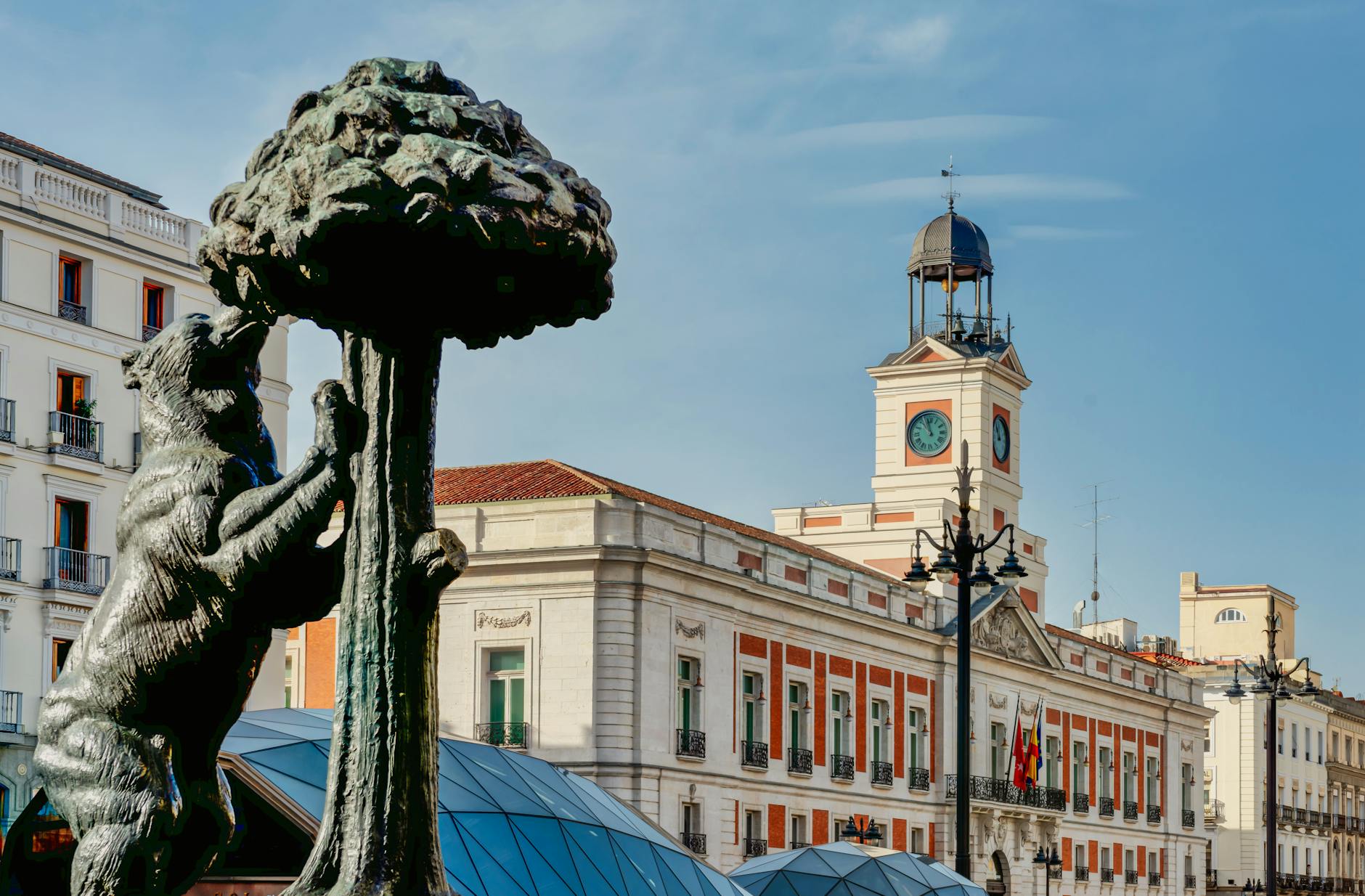
One of the most important additions during this time was the Casa de Correos (House of the Post Office), built in 1768. Designed by architect Jaime Marquet, this neoclassical building became the defining landmark of the square. Its elegant façade, adorned with statues and a clock tower, was a symbol of the growing importance of Madrid. The Casa de Correos would go on to play a central role in Spain’s history, from serving as a government headquarters to becoming a national symbol of resilience and continuity. The clock tower at the top of the building, which strikes at midnight on New Year’s Eve, remains one of the most iconic features of the Puerta del Sol.
The 18th century also saw the introduction of other neoclassical elements around the square, including new residential buildings and arcades. These changes gave Puerta del Sol a more cohesive and polished appearance, transforming it into a true urban center. The neoclassical style of the time emphasized symmetry, grandeur, and the importance of civic buildings, all of which became key elements in the square’s evolving architecture.
The 19th Century: Expansion and Modernization
As Madrid expanded during the 19th century, Puerta del Sol underwent further changes. The arrival of the Industrial Revolution and the modernization of the Spanish economy led to a wave of new construction in the city. In this period, the square’s role as a transportation hub became more pronounced, with major roads converging at the Puerta del Sol. This led to the development of additional buildings, such as hotels and stores, to cater to the increasing number of people passing through the square.
One of the key developments during this time was the construction of the Edificio Sol in 1854, an example of early 19th-century commercial architecture that further emphasized the square’s role as a center for business and commerce. The building’s design, which included a large ground-floor arcade, reflected the growing importance of retail spaces in the area. The 19th century also saw the introduction of public transportation, with the completion of Madrid’s first metro line in 1919, which included a station at Puerta del Sol. The integration of the metro system further transformed the square into a major urban hub.
The 20th Century: Urbanization and the Growth of Modern Architecture
The 20th century brought rapid urbanization and modernization to Madrid, and Puerta del Sol played a key role in this transformation. As the city continued to grow, the square became a key point in the development of Madrid’s infrastructure. The introduction of the metro system, as well as the expansion of roadways and public spaces, helped integrate Puerta del Sol into the broader urban fabric of Madrid.

During the early 20th century, the square was surrounded by a mix of traditional and modern buildings, reflecting the contrasts between Madrid’s historical past and its growing presence as a cosmopolitan capital. The architecture around the square underwent a mix of renovations and new construction projects, including the creation of office buildings and commercial spaces. During this time, the famous Bear and Strawberry Tree statue was placed in the square, adding a playful and symbolic element to the area. The statue, which depicts a bear reaching for a strawberry tree, is one of Madrid’s most recognized symbols and a favorite photo spot for tourists.
Contemporary Architecture and the Square’s Ongoing Evolution
In recent decades, Puerta del Sol has undergone significant urban renovation and development to accommodate the demands of modern life while preserving its historic character. The most notable changes include the construction of new commercial centers and the pedestrianization of the area to allow for more foot traffic. These changes have helped to maintain the square’s relevance in the 21st century, ensuring that it remains a central location for both locals and visitors.
The square’s architecture today is a blend of historic buildings and modern additions, creating a dynamic and ever-evolving urban space. The preservation of historical landmarks like the Casa de Correos and the Bear and Strawberry Tree statue, alongside newer commercial developments, demonstrates the balance between preserving Madrid’s heritage and embracing its future.
Puerta del Sol remains a key part of Madrid’s architectural identity, where history, culture, and modernity intersect. Its buildings, landmarks, and the square itself stand as a testament to the city’s adaptability and resilience over centuries. The square will undoubtedly continue to evolve as Madrid grows, but its role as the center of the city and its cultural significance will always remain intact.
Puerta del Sol as a Cultural Symbol: Identity, Iconography, and Traditions
Puerta del Sol is not only a geographical and historical landmark but also a powerful cultural symbol that represents Madrid’s identity. From its iconic clock tower to the famous Bear and Strawberry Tree statue, the square is deeply ingrained in the collective memory of both locals and visitors. Over the centuries, Puerta del Sol has become more than just a public space; it has evolved into a symbol of Madrid, Spain, and even broader aspects of Spanish culture.
The Bear and Strawberry Tree: A Symbol of Madrid
Perhaps the most recognizable symbol associated with Puerta del Sol is the Bear and Strawberry Tree statue (El Oso y El Madroño). This statue, located near the entrance to the square, depicts a bear reaching for the fruit of a strawberry tree, a reference to the city’s coat of arms. The bear is a common symbol in Madrid’s iconography, representing strength and resilience, while the strawberry tree is a nod to the natural environment surrounding the city in earlier times.
The Bear and Strawberry Tree has become an emblem of Madrid, frequently used on postcards, souvenirs, and even in political discourse. It stands as a reminder of Madrid’s deep connection to its land and its people, symbolizing the city’s historical roots and its ability to adapt to modernity. The statue’s location at Puerta del Sol, one of the city’s busiest squares, ensures that it is seen by thousands of people every day, reinforcing its status as an iconic cultural symbol.
For many, the Bear and Strawberry Tree also represents the unity of Madrid’s people. It embodies the city’s open spirit and willingness to embrace new ideas while staying grounded in tradition. As a cultural symbol, it plays an important role in fostering local pride and is often featured in Madrid’s tourism campaigns, further cementing its significance.
New Year’s Eve: A Cultural Tradition
Puerta del Sol is perhaps best known to Spaniards for its role in the New Year’s Eve celebration. Each year, the square hosts one of the most well-known and widely celebrated traditions in Spain: the eating of the Doce Uvas de la Suerte (Twelve Grapes of Luck). At midnight, when the clock tower chimes twelve times, people in the square and across the country eat one grape for each chime, making a wish for each one. This tradition, which is believed to bring good luck for the year ahead, is a central part of the New Year’s Eve celebrations in Madrid and in many other regions of Spain.
The campanadas (the ringing of the bells) from the clock tower of the Casa de Correos have become a hallmark of the event, and Puerta del Sol itself has become synonymous with this cultural moment. It is a time of immense celebration, with people gathering in the square, sharing in the excitement of the New Year. The celebrations are broadcast live across the country, allowing those who cannot attend in person to participate in the tradition from home.
For many Spaniards, the Doce Uvas tradition is not just a fun event; it is deeply embedded in the cultural fabric of the country. The celebration marks the passage of time, the end of one year and the beginning of another, and offers a moment of unity as the nation collectively looks forward to the future. The tradition has been celebrated for over a century, and today, the celebration in Puerta del Sol is one of the largest and most iconic New Year’s Eve events in Europe.
The Square as a Space for Protest and Expression
Another significant cultural role that Puerta del Sol has played is as a space for political expression and social activism. Throughout modern history, the square has been the site of various protests, demonstrations, and rallies, reflecting Spain’s evolving political and social landscape. One of the most notable recent movements to take place at the square was the Indignados movement in 2011, which saw thousands of people occupy the square to protest austerity measures and political corruption.
The Indignados movement symbolized a shift in political activism in Spain, and Puerta del Sol became a focal point for citizens voicing their concerns about Spain’s economic challenges. This protest movement was part of a larger European wave of dissatisfaction with government policies, and it had a lasting impact on Spain’s political discourse. The presence of the protesters in Puerta del Sol gave the square a new identity as a site for grassroots activism and political change.
Puerta del Sol has also hosted various other cultural and political demonstrations throughout the years, from labor strikes to calls for social justice. These protests highlight the square’s role as not just a space for celebration but also as a platform for societal engagement. Puerta del Sol, through its history, has become a symbol of free expression and a place where the people of Madrid—and of Spain—can make their voices heard.
The Puerta del Sol as a Meeting Point: Madrid’s Heart
Puerta del Sol’s role as a meeting point for the people of Madrid is central to its cultural significance. Locals and tourists alike use the square as a point of reference, often saying “Let’s meet at Sol†when arranging a place to gather. The square’s central location, surrounded by key streets and metro lines, makes it an easily accessible and highly recognizable space.
Beyond its practical function as a transportation hub, Puerta del Sol represents the concept of a shared urban space, where people of all walks of life can come together. Whether it’s to catch up with friends, admire the street performers, or simply take in the atmosphere, the square fosters a sense of community. Over time, the square has become a place for socialization and cultural exchange, symbolizing Madrid’s inclusive and welcoming spirit.
Tourism and Cultural Exchange
For international visitors, Puerta del Sol is often the first stop on their exploration of Madrid. As a key tourist destination, the square serves as a gateway to Madrid’s rich cultural history and vibrant city life. The square’s proximity to other major landmarks, such as the Royal Palace, Plaza Mayor, and the Gran VÃa, makes it an ideal starting point for sightseeing.
Tourists flock to Puerta del Sol to admire its historical architecture, photograph the Bear and Strawberry Tree, and experience the lively atmosphere. The square’s role in welcoming visitors from around the world enhances its cultural importance as a place where diverse cultures converge, share, and celebrate Madrid’s heritage. The square, in many ways, embodies the cosmopolitan spirit of the city, where people from all corners of the globe come to experience Spanish culture firsthand.
Puerta del Sol and its Role in Madrid’s Social and Economic Life
Puerta del Sol is not only an architectural and cultural icon of Madrid, but it also plays a significant role in the city’s social and economic life. As one of the most important public spaces in the capital, the square functions as both a marketplace and a central hub for business, commerce, and social interaction. Over the centuries, Puerta del Sol has been at the heart of the city’s social and economic development, evolving into a symbol of Madrid’s bustling urban life.
A Commercial and Economic Hub
Historically, Puerta del Sol has been a key site for commerce. In the 18th and 19th centuries, the area around the square was known for its market stalls, shops, and merchants who would gather there to sell goods. Madrid’s economic growth during these periods saw the square become a center for both local and international trade. The presence of the Casa de Correos (the Post Office building), with its important role in communication and logistics, was also vital for connecting the city with other parts of Spain and Europe.
In the 20th and 21st centuries, Puerta del Sol’s commercial landscape shifted in response to the growth of global business and the development of Madrid as a modern metropolis. The square became a prime location for major retail businesses, with luxury stores, international brands, and cafes lining the surrounding streets. The commercial focus of the area made it an attractive location for business investments and helped establish the square as a symbol of Madrid’s status as a global city.
The proximity of Puerta del Sol to key transportation hubs, including the city’s metro system, makes it an ideal location for business and commerce. The square’s accessibility contributes to the constant flow of people through the area, ensuring that shops, restaurants, and service-oriented businesses continue to thrive. Today, Puerta del Sol remains a commercial center, where the economic pulse of Madrid can be felt, and is a popular destination for both locals and tourists seeking a vibrant shopping experience.
Social Interaction and Community Life
In addition to its role in the economy, Puerta del Sol serves as an essential space for social interaction. Madrid, a city known for its active street life, relies heavily on public spaces for communal activities, and Puerta del Sol is a focal point for these interactions. The square acts as a meeting point for friends and families, as well as a space for spontaneous social gatherings. On any given day, one can witness people gathered around street performers, enjoying the sunshine, or simply passing through on their way to other parts of the city.
Puerta del Sol also hosts a range of social and cultural events throughout the year, from concerts and art exhibitions to festivals and public celebrations. These events foster a sense of community among Madrid’s residents and create a space for cultural exchange. Whether it’s a large-scale event such as the annual New Year’s Eve celebration or smaller local happenings, the square is a gathering place for people from all walks of life. It’s a dynamic space where individuals from diverse social backgrounds converge, contributing to the vibrancy and social fabric of the city.
Symbol of Modernity and Economic Growth
As Madrid has transformed into a global economic hub, Puerta del Sol has come to symbolize not only the city’s past but also its future. The square reflects Spain’s economic transition, from a traditional agrarian economy to a modern, service-oriented society. Over the years, Puerta del Sol has seen the rise of modern architecture and the expansion of retail spaces, which are indicative of the broader economic changes taking place in Madrid.
During Spain’s transition to democracy in the late 20th century, the square also played a key role in reflecting the country’s modernized image. The square became a central space for people to celebrate political milestones, economic growth, and social achievements. In particular, the Puerta del Sol represented Madrid’s role as the heart of Spain’s economic resurgence. Its commercial developments, from high-end shopping districts to emerging startup cultures, mirrored the prosperity that was beginning to be felt across the country.
Puerta del Sol’s evolution into a symbol of modernity is also connected to the rapid growth of the global tourism industry. As Spain’s capital, Madrid has become a popular destination for international visitors, and Puerta del Sol serves as an entry point to the city. The rise of the tourism sector has further fueled the economic importance of the square, making it an essential location for businesses catering to both the local population and tourists alike.
A Hub for Public Services
Puerta del Sol’s significance goes beyond commerce and social interaction; it also serves as an important center for public services. The Casa de Correos (Post Office building), originally built to house postal services, now serves as the regional headquarters for the Madrid Community. It is a key administrative building in the city, and its central location in Puerta del Sol ensures that government services are easily accessible to the public.
Additionally, the square’s proximity to the Gobierno Civil (Civil Government) building and other governmental offices highlights its importance as an administrative center. Puerta del Sol’s central location and its function as a meeting point for locals and visitors make it an ideal place for the exchange of information and the delivery of public services. Its role as a political and governmental space adds another layer of importance to its social and economic functions.
Tourism and Economic Impact
Tourism is one of the largest drivers of Madrid’s economy, and Puerta del Sol plays a critical role in attracting millions of visitors each year. The square serves as a starting point for many tourists, who visit to experience its historical landmarks, cultural symbols, and dynamic atmosphere. The tourism industry surrounding Puerta del Sol has brought economic benefits to the city, with restaurants, hotels, and retail outlets flourishing around the square.
Puerta del Sol’s economic impact extends beyond tourism, as it also serves as a vital point for business networking and exchange. The square has become a meeting place for professionals and entrepreneurs, where deals can be made, and ideas exchanged. The commercialization of the area has turned it into a business hub, drawing companies and multinational brands to establish a presence in the heart of Madrid.
While tourism is a major economic factor, the presence of businesses and professional services in the area has contributed to the broader economic development of Madrid. Puerta del Sol’s combination of commerce, culture, and public services creates a unique synergy that drives the city’s economy forward.
The Future of Puerta del Sol: Modernization and Preservation
As one of Madrid’s most iconic landmarks, Puerta del Sol is not just a relic of the past, but a living, evolving space that continues to shape the city’s urban landscape. With the demands of modernization, urban development, and tourism growth, the future of Puerta del Sol is both an exciting and challenging prospect. Balancing the preservation of its historical significance with the need for contemporary infrastructure and amenities will be key in maintaining its cultural importance while adapting to the needs of modern society.
Urban Development and Modernization
The pressures of modern urban life often necessitate significant changes to historical spaces like Puerta del Sol. Over the years, the square has undergone several transformations to meet the growing demands of the city’s infrastructure. In the early 2000s, a major renovation project sought to pedestrianize the area, removing traffic and creating a more accessible, walkable environment. The goal was to enhance the square’s role as a public space, ensuring that it remained a welcoming place for both locals and tourists, while improving safety and overall functionality.
As Madrid continues to grow, further modernization efforts will be necessary to keep Puerta del Sol relevant in the city’s dynamic urban environment. New technologies, such as smart city initiatives, could be integrated into the square to improve energy efficiency, mobility, and public services. These innovations would not only help the square adapt to the future but also contribute to Madrid’s broader goals of sustainability and urban innovation. However, it is crucial that any modernization efforts respect the square’s historical value and the unique architectural heritage that defines it.
The Balance Between Preservation and Progress
One of the most important challenges facing the future of Puerta del Sol is finding the balance between preservation and progress. As a historical site, the square is protected by various laws and regulations aimed at maintaining its cultural and architectural integrity. These include the preservation of key buildings, such as the Casa de Correos, and the maintenance of historical monuments, like the Bear and Strawberry Tree statue. Any future changes to the square must be carefully planned to avoid compromising its aesthetic value or its status as a national heritage site.
While modernization can help improve the square’s functionality, it must be done in a way that respects the spirit of the space. This includes ensuring that new constructions or renovations do not overshadow the historical landmarks or alter the square’s traditional appearance. The presence of the historic clock tower and the Bear and Strawberry Tree statue, for example, should always be preserved as central elements of the square’s identity.
Efforts to preserve the square’s history are not just a matter of maintaining old buildings; they also involve protecting the intangible cultural heritage of Puerta del Sol. The square has served as a space for social gatherings, political protests, and cultural celebrations for centuries. These activities contribute to the living history of the square and must be acknowledged as part of its ongoing legacy. Ensuring that Puerta del Sol remains a vibrant space for public expression and cultural exchange is just as important as preserving its physical form.
Sustainability and Environmental Considerations
As part of Madrid’s broader efforts to become a more sustainable and environmentally friendly city, the future of Puerta del Sol will likely involve a focus on green initiatives. Sustainability has become a central issue in urban planning worldwide, and Madrid is no exception. Future plans for Puerta del Sol could include the introduction of green spaces, the incorporation of sustainable building materials, and efforts to reduce the square’s environmental footprint.
One of the key areas where sustainability can be integrated into the future of Puerta del Sol is in transportation. With the growing demand for electric vehicles and the increased emphasis on public transport, future plans may involve enhancing the square’s accessibility by reducing the reliance on cars and promoting alternative modes of transport, such as cycling and electric scooters. Additionally, the implementation of energy-efficient lighting and waste reduction programs could help make the square more eco-friendly.
Incorporating green spaces into Puerta del Sol could also play a role in enhancing the square’s aesthetic appeal while contributing to the overall environmental health of the area. Urban greenery has been shown to improve air quality, reduce heat islands, and promote biodiversity. A well-balanced mix of historic preservation and modern environmental considerations could ensure that Puerta del Sol continues to thrive as both a cultural and ecological landmark.
The Role of Technology in Shaping the Future
Another crucial factor in the future of Puerta del Sol is the role that technology will play in the square’s development. As a hub of social, economic, and cultural activity, Puerta del Sol stands at the crossroads of the physical and digital worlds. Future improvements could include the installation of digital signage, interactive displays, and virtual guides that provide visitors with information about the history and significance of the square in real-time. Smart city technologies, such as sensors for monitoring air quality and crowd movement, could also be integrated to improve safety and enhance the visitor experience.
Moreover, the rise of augmented reality (AR) and virtual reality (VR) technologies could offer new ways to experience the history of Puerta del Sol. For example, visitors could use their smartphones or AR glasses to see historical events unfold before their eyes, bringing the past to life in an immersive and interactive way. These technologies would not only appeal to tourists but also enhance the educational value of the square, helping people of all ages connect with the history and culture of Madrid in a modern context.
However, as with any technological advancements, it is important that these innovations are introduced in a way that complements the historical significance of Puerta del Sol. The challenge will be to incorporate these modern elements without overwhelming the square’s traditional atmosphere. The integration of technology should be seamless and unobtrusive, enhancing the square’s role as a cultural and public space while preserving its historical essence.
Puerta del Sol as a Symbol for the Future
Ultimately, the future of Puerta del Sol lies in its ability to adapt to the needs of a rapidly changing world while staying true to its heritage. It will continue to be a focal point for Madrid, reflecting the city’s dynamic character as it evolves in response to new challenges and opportunities. The square will remain a place of cultural exchange, public celebration, and political expression, while also serving as a model for the integration of modernity, sustainability, and preservation.
As Madrid continues to grow, Puerta del Sol will remain a central point of reference, a place where the past and the future meet. With careful planning and a commitment to maintaining its historical significance, the square will continue to serve as a vibrant and vital part of the city for generations to come.