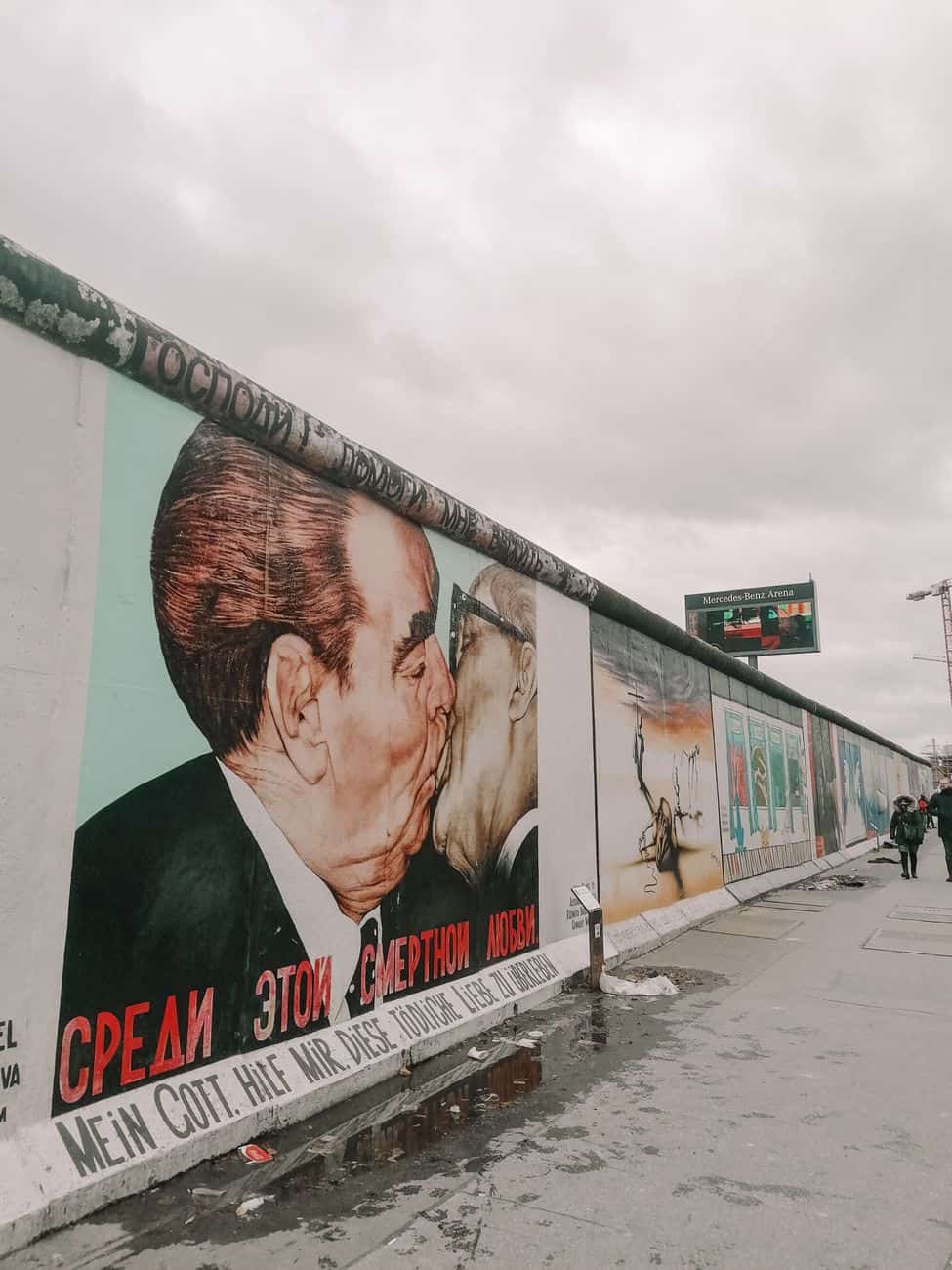
On the evening of November 9, 1989, an exhausted East German official named Günter Schabowski sat before an international press corps, fumbling with a stack of fresh policy notes. Live television cameras broadcast his squinting eyes across the globe as he attempted to explain minor adjustments to travel regulations. When a reporter pressed him on when these new rules allowing East Germans to travel abroad would take effect, Schabowski paused, adjusted his glasses, and uttered the most famous bureaucratic blunder in modern history: “Das tritt nach meiner Kenntnis… ist das sofort… unverzüglich.” (“As far as I know, it takes effect… immediately… without delay.”)
Within hours, tens of thousands of East Berliners descended upon border checkpoints, overwhelming baffled guards who had received zero military orders to open the gates. By midnight, strangers were embracing atop a 12-foot concrete barrier, popping cheap Soviet-bloc champagne, and hacking away at a symbol that had divided a city, a nation, and an entire global order for twenty-eight years.
The fall of the Berlin Wall was not an isolated midnight miracle. It was the explosive, chaotic culmination of decades of economic bankruptcy, Soviet imperial exhaustion, grassroots civil bravery, and staggering political miscalculation. To understand how a fortified 155-kilometer monster of steel, concrete, and attack dogs surrendered without a single bullet being fired, one must untangle the intricate Web of Cold War geopolitics, financial insolvency, and human courage that shattered the Iron Curtain.
The Anatomy of a Division: Why a Wall Was Built in the First Place
The Post-War Fracture: From Potsdam to Two Germanys (1945–1949)
To comprehend the destruction of the Berlin Wall, one must first understand the paranoia that constructed it. In the summer of 1945, at the ruined Cecilienhof Palace in Potsdam, the victorious Allied powers—the United States, Great Britain, France, and the Soviet Union—divided defeat-shattered Germany into four occupation zones. Berlin, sitting deep inside the Soviet-occupied east like an island in a red sea, was similarly carved into four administrative sectors.
What was intended as a temporary administrative setup quickly hardened into the front line of the Cold War. The Western Allies sought to rebuild a democratic, capitalist West Germany through the Marshall Plan and currency reform. Joseph Stalin’s Soviet Union sought to bleed its sector for war reparations while creating a compliant socialist buffer state. By May 1949, the Western zones coalesced into the Federal Republic of Germany (FRG, or West Germany). Five months later, in October 1949, the Soviet zone was rebranded as the German Democratic Republic (GDR, or East Germany).
West Berlin remained an anomaly: a thriving capitalist enclave nestled 110 miles inside a communist state. It was a glaring, neon-lit advertisement for Western democracy right in the backyard of Soviet power.
The Great Brain Drain: Republikflucht and the 3.5 Million Exodus
Throughout the 1950s, the border between East and West Germany was progressively fortified, closed, and patrolled. But Berlin remained a gaping loophole. In Berlin, an East German could simply step onto a subway car (S-Bahn) in the East sector and step off in the West sector.
This loophole sparked an existential demographic crisis for East Germany. Between 1949 and 1961, an estimated 3.5 million East Germans—roughly 20 percent of the entire population—fled to the West through Berlin. This migration was known as Republikflucht (desertion from the republic).
Crucially, those fleeing were not average citizens in random proportions. They were the lifeblood of the East German economy:
- Doctors and Dentists: Over 4,500 medical professionals fled, leaving entire hospital wings unstaffed.
- Engineers and Technicians: Thousands of industrial minds abandoned state-owned factories.
- Professors, Teachers, and Students: Over 20% of the university-educated workforce crossed the border.
East German leader Walter Ulbricht realized that his socialist utopia was bleeding to death. If the hemorrhage of human capital continued, the GDR would collapse from internal economic exhaustion before the decade was out.
   EAST GERMAN DEMOGRAPHIC DRAIN (1949-1961)
   ================================================
   Total Population: ~17.5 Million

   1949-1961 Migration to West: █ 3.5 Million (20%)

   Key Skilled Groups Lost:
   - Doctors/Dentists:    4,500+
   - Academics/Teachers:  15,000+
   - Skilled Engineers:   20,000+
   ================================================
Operation Rose: August 13, 1961, and the Architecture of Captivity
In June 1961, Walter Ulbricht famously declared at an international press conference: “Niemand hat die Absicht, eine Mauer zu errichten!” (“Nobody has the intention of building a wall!”). It remains one of history’s most brazen lies.
In the early hours of Sunday, August 13, 1961—under the secret code name Operation Rose—East German police, factory militia groups, and soldiers shut down the border surrounding West Berlin. Under the direction of Erich Honecker (then the SED Central Committee secretary for security), troops ripped up paving stones, strung hundreds of miles of barbed wire, and parked armored cars along the sector lines.
Families were split mid-sleep. Workers were cut off from their jobs. Transit lines were severed overnight. Over the next three decades, this crude wire barrier mutated into a terrifyingly sophisticated 155-kilometer border fortification known formally in East Germany as the Antifaschistischer Schutzwall (“Anti-Fascist Protection Rampart”)—a propaganda label suggesting it was designed to keep Western fascists out, though every gun was aimed strictly inward

The Wall evolved through four distinct generations:
- First-Generation Wall (1961): Wire entanglements and makeshift cinderblock walls with mortared brickwork.
- Second-Generation Wall (1962–1965): Improved concrete walling with steel girders and wooden posts.
- Third-Generation Wall (1965–1975): Concrete slabs set between steel H-beams.
- Fourth-Generation Wall (Grenzmauer 75): Constructed from 45,000 individual reinforced concrete segments, each standing 3.6 meters (11.8 feet) high, topped with smooth plastic pipe to prevent handholds.
Behind this outer wall lay the dreaded Death Strip (Todesstreifen): a wide swath of heavily guarded terrain featuring signal wire fences, anti-vehicle trenches, floodlights, 302 watchtowers, runs for attack dogs, and beds of sharp nails nicknamed “Stalin’s Lawn.” At least 140 people lost their lives trying to cross this death strip between 1961 and 1989, starting with Günter Litfin, who was shot dead on August 24, 1961, while trying to swim across the River Spree.
The Economic Engine of Implosion: Bankruptcy Behind the Iron Curtain
While political repression dominated the headlines, the ultimate undoing of East Germany was financial. By the late 1980s, the GDR was operating on a economic facade that was rapidly collapsing under the weight of its own internal contradictions.
The Illusion of the Wirtschaftswunder East
For decades, Soviet and East German propaganda touted the GDR as the “ninth or tenth largest industrial economy in the world.” On paper, the state-run Kombinate (industrial conglomerates) produced everything from microchips to heavy machinery. In reality, the state was trapped in a destructive economic cycle driven by central planning failures and unsustainable welfare promises.
To maintain social peace, the ruling Socialist Unity Party (SED) subsidized virtually every basic necessity:
- Housing: Rent was artificially frozen at 1936 prices (often costing just 20 to 30 Ostmarks a month).
- Staple Foods: A loaf of bread cost 1.04 Marks, while the state spent over 30 Marks in manufacturing and distribution subsidies per loaf.
- Transportation: Public transit fares were kept at pennies.
+-----------------------------------------------------------------------+| THE GDR SUBSIDY TRAP (1988 STATE BUDGET) |+-----------------------------------------------------------------------+| Total State Budget Expenditure: ~270 Billion Ostmarks || || [===================] Consumer Subsidies: 61 Billion Ostmarks (22.5%) || [=============] Industrial/Energy Subsidies: 45 Billion Ostmarks || [=======] Military & Stasi Budget: 25+ Billion Ostmarks || || Result: Infrastructure, housing repair, and technology updates were || starved of capital, leading to systemic decay across the nation. |+-----------------------------------------------------------------------+
By 1988, consumer subsidies consumed over 22% of the total state budget. To fund these subsidies, the regime starved its industrial base of modernization capital. Chemical factories in Bitterfeld spewed toxic sludge into rivers, historic city centers like Leipzig and Dresden literally crumbled into ruins, and citizens waited between 12 and 15 years just to buy a noisy, two-cylinder plastic-bodied Trabant automobile.
Secret Capitalism: Bereich Kommerzielle Koordinierung (KoKo)
Desperate for hard Western currency (Deutsche Marks and US Dollars) to service its debts and import high-tech goods, the East German regime turned to bizarre, covert economic operations.
Enter Alexander Schalck-Golodkowski, a Stasi colonel and state secretary who ran a secret commercial empire called the Bereich Kommerzielle Koordinierung (Department for Commercial Coordination, or KoKo). KoKo operated in the shadows of global finance:
How KoKo Cash Flows Worked:
- Human Trafficking for Hard Cash (Häftlingsfreikauf): Between 1963 and 1989, West Germany literally bought the freedom of 33,755 political prisoners and 250,000 of their family members from East Germany. The West German government paid over 3.4 billion Deutsche Marks to KoKo in cash, consumer goods, and oil.
- Smuggling & Antiquities: KoKo seized art, antique furniture, and gold coins from fleeing citizens or targeted wealthy East Germans, selling them via shell companies in Switzerland to Western dealers.
- Waste Dumping: East Germany took toxic Western chemical waste and municipal trash, charging West Berlin and West Germany millions in Deutsche Marks to dump it in Eastern landfills.
Despite these illicit revenue streams, the GDR’s hard-currency balance sheet remained catastrophically negative. In 1983 and 1984, the East German economy was only saved from sovereign default by two massive loans totaling 2 billion Deutsche Marks, brokered personally by the conservative Bavarian Minister-President, Franz Josef Strauß.
The Secret “Schürer Report” of October 1989
The true extent of East Germany’s financial insolvency was kept secret even from most members of the SED Central Committee. But on October 30, 1989—ten days before the Wall fell—Gerhard Schürer, head of the State Planning Commission, delivered a bombshell internal report to newly appointed leader Egon Krenz.
The Schürer Report presented a terrifying financial reality:
- The GDR’s hard-currency debt to Western nations had soared to 49 billion Deutsche Marks.
- Serving this debt required 86% of all East German export earnings in hard currency.
- To stabilize the debt by 1990, the living standard of East Germans would have to be slashed by 25 to 30 percent, or the state would have to borrow an additional 11 billion Marks annually—a scenario Western banks were no longer willing to fund.
Schürer’s conclusion was blunt: the East German socialist economy was financially terminal. As archival documents published by the Wilson Center Cold War International History Project reveal, East Germany was essentially bankrupt. The state could no longer afford to maintain its own borders or feed its economy without Western financial rescue.
Geopolitical Tectonic Shifts: Moscow, Washington, and the “Sinatra Doctrine”
The economic decay of East Germany occurred within a rapidly shifting international arena. Without the overarching protection of the Soviet military umbrella, the East German regime was a castle built on sand.
The Stagnation Era and the Rise of Mikhail Gorbachev
For decades, the Eastern Bloc was governed by the Brezhnev Doctrine: the explicit policy that Moscow would deploy military force to suppress any uprising or political reform that threatened communist rule in a Warsaw Pact nation—just as it had done in Hungary in 1956 and Czechoslovakia in 1968.
However, by the mid-1980s, the Soviet Union itself was unraveling. Entangled in a costly war in Afghanistan, burdened by a broken command economy, and struggling to match US President Ronald Reagan‘s Strategic Defense Initiative (SDI) defense spending, the Kremlin reached a turning point.
When 54-year-old Mikhail Gorbachev became General Secretary of the Communist Party of the Soviet Union in March 1985, he recognized that the USSR could no longer afford to subsidize and police its Eastern European satellite states.
       SOVIET REFORM STRATEGY UNDER GORBACHEV
       ======================================
              ┌──────────────────┐
              │ MIKHAIL GORBACHEV│
              └────────┬─────────┘
                       │
       ┌───────────────┴───────────────┐
       ▼                               ▼
  GLASNOST                        PERESTROIKA
  (Political Openness)            (Economic Restructuring)
  - Freedom of Speech             - Decentralized Control
  - Media Uncensored              - Market Elements
  - Historical Truths             - Reduced State Subsidies
       │                               │
       └───────────────┬───────────────┘
                       │
                       ▼
              SINATRA DOCTRINE
        "My Way": Satellite states must
         govern without Soviet tanks.
Gorbachev introduced two transformative concepts:
- Glasnost (Openness): Easing state censorship, permitting public criticism, and re-examining Soviet historical atrocities.
- Perestroika (Restructuring): Attempting to introduce market-based reforms into the rigid Soviet economic apparatus.
The “Sinatra Doctrine”: Farewell to Soviet Tanks
In October 1989, Soviet Foreign Ministry spokesman Gennady Gerasimov famously announced on American television that the Brezhnev Doctrine was dead. Gerasimov quipped that Moscow had adopted the “Sinatra Doctrine”—referencing Frank Sinatra’s signature song My Way. Satellite states were now free to chart their own political courses; Soviet tanks would no longer roll in to save failing communist dictatorships.
This was a terrifying development for East German dictator Erich Honecker. Honecker rejected Gorbachev’s reforms outright, banning Soviet news magazines like Sputnik because their articles on Glasnost were deemed too subversive for East German citizens. Honecker stubbornly insisted: “If your neighbor repapers his apartment, it doesn’t mean you have to re-paper yours.”
During his visit to East Berlin for the GDR’s 40th-anniversary celebrations in early October 1989, Gorbachev offered Honecker a prophetic warning: “Gefahren warten nur auf diejenigen, die nicht auf das Leben reagieren.” (“Dangers await only those who do not react to life”—often translated as “Life punishes those who come too late.”)
============================================================================= CHRONOLOGY OF THE 1989 EASTERN BLOC DOMINO EFFECT============================================================================= Date Country Event----------------------------------------------------------------------------- June 4, 1989 Poland Solidarność wins landslide in semi-free elections. June 27, 1989 Hungary Foreign Ministers border fence cut at Austria. Aug 19, 1989 Hungary/GDR Pan-European Picnic: 600+ East Germans escape. Sept 30, 1989 Prague/GDR Genscher announces West German Embassy refugees free. Oct 9, 1989 East Germany 70,000 march in Leipzig; forces stand down. Nov 9, 1989 East Germany Berlin Wall falls at Bornholmer Straße. Dec 25, 1989 Romania Ceaușescu regime overthrown and executed.=============================================================================
The Pan-European Picnic & The Prague Embassy Exodus
By the summer of 1989, the Iron Curtain began to fray at its edges. In May, Hungary’s reformist government started dismantling its electrified border fence with Austria.
On August 19, 1989, peace activists organized the Pan-European Picnic near the border town of Sopron, Hungary. For three hours, the border gates between Hungary and Austria were symbolically opened. More than 600 East Germans on vacation in Hungary surged through the wooden gates into Austria, fleeing to West Germany. It was the first massive breach in the Iron Curtain.
Simultaneously, thousands of desperate East Germans flooded into West German embassies across Eastern Europe—most notably the Lobkowicz Palace in Prague, Czechoslovakia. By late September, over 4,000 East Germans were camped in the muddy courtyard of the Prague embassy, living in tents in sanitation-challenged conditions.
On the evening of September 30, 1989, West German Foreign Minister Hans-Dietrich Genscher stepped onto the balcony of the Prague embassy. As thousands of refugees held their breath below, Genscher uttered what is widely considered the most famous incomplete sentence in German history:
“Wir sind zu Ihnen gekommen, um Ihnen mitzuteilen, dass heute Ihre Ausreise…”
(“We have come to you to inform you that today, your departure…”)
The rest of his sentence was swallowed by an explosion of cheers, sobs, and screams of joy. The refugees were allowed to travel to West Germany via sealed trains passing through East German territory. As those trains rattled through East German stations, thousands more citizens lined the tracks, fighting police to try and jump aboard. The myth of East German border control was shattered.
The Power of People Power: Leipzig, the Stasi, and the Peace Movement
While thousands fled abroad, millions more decided to stay and demand fundamental change at home. The heart of this internal resistance was not located in East Berlin, but in the industrial city of Leipzig.
Nikolaikirche and the Monday Demonstrations
In the early 1980s, Christian Führer, pastor of the 800-year-old Nikolaikirche (St. Nicholas Church) in Leipzig, opened the church doors every Monday evening for Friedensgebete (Prayers for Peace). These meetings provided a rare sanctuary from the ubiquitous gaze of the Stasi (the Ministerium für Staatssicherheit, East Germany’s secret police).
The Stasi was one of the most pervasive surveillance networks in human history. By 1989, the Stasi employed 91,000 full-time officers and utilized an estimated 173,000 unofficial informants (Inoffizielle Mitarbeiter or IMs). Roughly one out of every 6.5 East German citizens cooperated with the secret police at some level, creating an atmosphere of deep social paranoia.
+--------------------------------------------------------------------------+| THE STASI SURVEILLANCE MATRIX |+--------------------------------------------------------------------------+| Total GDR Population (1989): ~16.6 Million || Full-Time Stasi Officers: 91,000 || Unofficial Informants (IMs): 173,000 || || Ratio: ~1 out of every 63 citizens was directly monitored or reporting || to the secret police network. |+--------------------------------------------------------------------------+
Despite the constant threat of arrest, the Monday prayer meetings grew. Attended initially by dissidents, environmentalists, and peace activists, they transformed by September 1989 into massive nonviolent street marches. The protesters adopted a simple, profound chant: “Wir sind das Volk!” (“We are the people!”), a direct challenge to the SED regime’s claim that it spoke for the working class.
       GROWTH OF LEIPZIG MONDAY DEMONSTRATIONS (FALL 1989)
       ===================================================
       Oct 2:   [==] 20,000
       Oct 9:   [───────] 70,000  <-- THE CRITICAL TURNING POINT
       Oct 16:  [───────────────] 120,000
       Oct 23:  [──────────────────────────] 300,000
       ===================================================
October 9, 1989: The Miracle of Leipzig
The ultimate showdown occurred on Monday, October 9, 1989. Fresh off the GDR’s 40th-anniversary celebrations—where police had violently beaten protesters in Berlin—the regime prepared to crush the Leipzig movement by force.
Over 8,000 armed security personnel—including police, Stasi units, and combat troops equipped with live ammunition—were deployed around Leipzig’s city center. Hospitals were stocked with blood plasma, and local sports halls were prepared as makeshift detention camps. The regime was signaling its readiness to execute the “Chinese Solution,” referencing the Tiananmen Square massacre that had occurred in Beijing just four months earlier.
That evening, over 70,000 citizens stepped out of Nikolaikirche and marched onto Leipzig’s Ringstraße carrying lit candles. A candle requires two hands to shield the flame from the wind—making it impossible to carry a weapon or hit a police officer.
Panic spread through the local communist leadership. Should they order their troops to fire on tens of thousands of peaceful citizens, including mothers, grandmothers, and children?
                     LEIPZIG RINGSTRAßE SHOWDOWN
                     ===========================

      [70,000 PROTESTERS]                [8,000 ARMED TROOPS]
   Carrying candles & chanting          Positioned with live ammo
    "Wir sind das Volk!"               Awaiting orders from Berlin
             │                                   │
             └───────────────┬───────────────────┘
                             ▼
                    THE DECISION POINT
           Conductor Kurt Masur & local leaders
           broadcast appeals for non-violence.
                             │
                             ▼
                   THE COMMAND FAILS
             SED leadership in Berlin freezes.
            No command to open fire is issued.
                             │
                             ▼
                    SECURITY RETREATS
         Troops stand down. The movement triumphs.
In a crucial intervention, Kurt Masur, the world-renowned conductor of the Leipzig Gewandhaus Orchestra, along with three local SED officials and two dissidents, broadcast a joint appeal over public loudspeakers urging calm and non-violence.
Crucially, the central command in East Berlin froze. Honecker was paralyzed by indecision, and Moscow made it clear that Soviet forces garrisoned nearby would not leave their barracks. Faced with overwhelming numbers and carrying no order to fire, the police backed down.
As Stasi official Horst Böhm later admitted to his superiors: “We were prepared for everything, except candles and prayers.”
The Ouster of Honecker
The bloodless victory in Leipzig broke the regime’s iron grip. Nine days later, on October 18, 1989, Honecker’s own Politburo colleagues—led by his protege Egon Krenz and Minister President Willi Stoph—staged an internal party coup, forcing the 77-year-old dictator to resign on grounds of “ill health.”
Krenz assumed leadership, promising reforms and introducing the buzzword Wende (“turning point”). But Krenz was widely seen as a compromised hardliner who had publicly praised the Tiananmen Square crackdown months earlier. The public rejected his overtures; the protests spread to every major East German city. On November 4, over 500,000 people gathered at Alexanderplatz in East Berlin for the largest anti-government demonstration in GDR history.
The regime was burning through its options. It needed a political valve to release the mounting pressure, fast.
The Night the Gates Flew Open: November 9, 1989
What happened on the night of November 9 was a mixture of geopolitical momentum, civil pressure, and unbelievable administrative ineptitude.
The Paperwork Mishap: Günter Schabowski’s Press Conference
To stem the chaos caused by citizens fleeing through Czechoslovakia, the SED Politburo drafted a new, temporary regulation for travel permits. The policy was supposed to require East Germans to apply for a visa at a passport office, but visas were to be granted easily without prior requirements. It was intended to take effect the following morning, November 10, giving border guards time to prepare.
At around 6:00 PM on November 9, Günter Schabowski, the party boss of East Berlin and official regime spokesman, stepped into the press room at the International Press Center on Mohrenstraße. Crucially, Schabowski had not attended the full Politburo meeting earlier that day and had only been handed the draft document right before walking into the room. He had not read it carefully, nor had he been briefed on the implementation timeline.
For 50 minutes, the press conference was a dull affair detailing internal party committee meetings. Then, at 6:53 PM, Italian journalist Riccardo Ehrman (along with Bild reporter Peter Brinkmann) asked a question about travel laws.
============================================================================= TRANSCRIPT EXCERPT: SCHABOWSKI'S HISTORIC BLUNDER=============================================================================SCHABOWSKI: "Privatreisen nach dem Ausland können ohne Vorliegen von voraussetzungen – Reiseanlässe und Verwandtschaftsverhältnisse – beantragt werden. Die Genehmigungen werden kurzfristig erteilt..."(Private travel abroad can now be applied for without prerequisites... Permits will be issued at short notice...)JOURNALIST (Peter Brinkmann): "Wann tritt das in Kraft?"(When does that enter into force?)SCHABOWSKI: (Fumbles through his notes, adjusts glasses, looks bewildered)"Das tritt nach meiner Kenntnis… ist das sofort… unverzüglich."(As far as I know, it takes effect... immediately... without delay.)JOURNALIST: "Gilt das auch für Berlin-West?"(Does this also apply to West Berlin?)SCHABOWSKI: (Reads further) "Ja, ja... die Ausreise kann über alle Grenzübergangsstellen der DDR bzw. zur BRD erfolgen, einschließlich Berlin-West."(Yes, yes... departures can occur through all border crossings of the GDR or FRG, including West Berlin.)=============================================================================
Schabowski’s words dropped like an atomic bomb into the media ecosystem. Within minutes, Western news agencies flashed bulletins around the world: “EAST GERMANS ALLOWED TO TRAVEL ABROAD IMMEDIATELY.”
At 8:00 PM, West German public television’s flagship news program, ARD Tagesthemen, opened with anchor Hanns Joachim Friedrichs declaring: “Dieser 9. November ist ein historischer Tag. Die DDR hat erklärt, dass ihre Grenzen ab sofort für jedermann geöffnet sind. Die Tore in der Mauer stehen weit offen!” (“This November 9 is a historic day. The GDR has declared that its borders are open to everyone immediately. The gates in the Wall stand wide open!”)
The gates were not wide open—at least, not yet. But millions of television viewers in East Berlin, who routinely watched West German television, assumed they were.
The Surge at the Checkpoints
Driven by shock, curiosity, and disbelief, thousands of East Berliners put on their coats, left their apartments, and headed straight to the border checkpoints crossing into West Berlin: Checkpoint Charlie, Invalidenstraße, Sonnenallee, and Bornholmer Straße.
At the border stations, border guards and Stasi customs officials were in state of absolute panic. They had received no new orders from their superiors. Their instruction manuals stated clearly that anyone attempting to breach the border illegally was to be stopped, by force if necessary.
As the crowds swelled from dozens to hundreds, and then into thousands, guards made desperate phone calls up the chain of command. But the high-ranking officers at Stasi headquarters and the Ministry of Interior were either at dinner, out of reach, or unwilling to issue a fire order that would result in a massacre.
       BORN HOLMER STRAßE BORDER CHECKPOINT TIMELINE
       =============================================
       19:00 - Press conference broadcast ends.
       20:00 - Small crowds gather at Bornholmer Straße.
       21:30 - Crowd grows to thousands; chanting "Öffnet das Tor!"
       22:30 - Jäger tries "concession solution" (stamping out passports).
       23:00 - Crowd becomes uncontrollable; fear of a stampede/riot.
       23:30 - Lt. Col. Harald Jäger orders: "Open the barrier!"
       =============================================
The Hero of Bornholmer Straße: Lt. Col. Harald Jäger
At the Bornholmer Straße border crossing, the officer in charge of passport control was 46-year-old Stasi Lieutenant Colonel Harald Jäger. Jäger was a loyal, 28-year veteran of the border guard service.
By 10:30 PM, the crowd gathered outside his station had grown to over 20,000 angry, excited citizens, pressing against the steel turnstiles and shouting: “Öffnet das Tor!” (“Open the gate!”).
Jäger repeatedly called his superior, Colonel Ziegenhorn, asking for clear instructions. Ziegenhorn told him that Schabowski’s statement was a mistake, but gave no tactical support, eventually telling Jäger to handle the situation himself. Jäger realized he faced a stark, horrifying choice:
- Order his 14 guards to open fire with submachine guns, triggering a horrific bloodbath and an uncontrollable riot.
- Yield to the crowd and defy every standing military protocol he had sworn to uphold.
At 11:30 PM, Jäger made an executive decision. He turned to his subordinates and said: “Öffnet die Schranke!” (“Open the barrier!”).
The heavy steel beam was raised. The tidal wave of humanity surged across the bridge into the West Berlin district of Wedding. No passports were checked, no shots were fired.
The Midnight Carnival at the Brandenburg Gate
Once Bornholmer Straße broke open, a chain reaction tore through the remaining border checkpoints across Berlin. The Wall, which had stood as an impenetrable barrier for 10,316 days, collapsed in a matter of hours.
West Berliners flooded to the border crossings to welcome their Eastern neighbors with flowers, chocolate, and tearful hugs. West Berlin bars opened their doors, handing out free beer. Complete strangers embraced in the streets.
Thousands converged on the iconic Brandenburg Gate, climbing atop the 12-foot concrete wall. People brought hammers, chisels, and pickaxes, hacking away pieces of the monument—these people were dubbed Mauerspechte (“wall woodpeckers”).
Cellist Mstislav Rostropovich rushed to Berlin and played an impromptu Bach suite amidst the rubble of Checkpoint Charlie. The Cold War, which had defined international affairs for nearly half a century, ended not with a nuclear bang, but with a street party.
Financial, Political, and Social Shockwaves
The fall of the Wall was an emotional triumph, but it immediately triggered immense practical challenges. Transforming two fundamentally different political and economic systems into a unified nation required a whirlwind of financial engineering and diplomatic negotiation.
Economic Unification: The 1:1 Currency Exchange Controversy
Following the collapse of the Wall, East Germany’s economy eroded completely. Thousands of citizens were leaving daily for West Germany, putting enormous pressure on Western social welfare infrastructure.
West German Chancellor Helmut Kohl realized that to keep East Germans in East Germany, he had to bring the Western currency to them. On July 1, 1990, the Monetary, Economic, and Social Union (Währungs-, Wirtschafts- und Sozialunion) took effect. The West German Deutsche Mark (DEM) replaced the worthless East German Ostmark as the official tender of the GDR.
       CURRENCY CONVERSION TERMS (JULY 1, 1990)
       ========================================
       Rate 1:1 (East Mark to West German DM):
       - Personal savings up to 4,000 Marks (adults)
       - Personal savings up to 2,000 Marks (children)
       - Wages, salaries, and rents

       Rate 2:1 (East Mark to West German DM):
       - Savings over 4,000 Marks
       - Corporate debts and liabilities
       ========================================
While the 1:1 conversion rate was a populist political triumph for Kohl’s government—instantly boosting the purchasing power of East German households—it proved economically ruinous for East German industry.
Overnight, East German state-owned enterprises (Kombinate) saw their wage costs redenominated in hard Deutsche Marks, while their product quality remained vastly inferior to Western imports. Furthermore, their primary export partners in the Soviet Union and Eastern Europe could not afford to pay in hard currency. Virtually the entire East German manufacturing sector became uncompetitive overnight.
The Treuhandanstalt and the Great Deindustrialization
To handle the massive task of privatizing East Germany’s state-owned economy, the federal government established the Treuhandanstalt (Trustee Agency).
The Treuhand took control of:
- 14,000 state-owned enterprises
- 4 million jobs
- 2.4 million hectares of agricultural land and forests
- Real estate accounting for nearly half of the total area of East Germany
+--------------------------------------------------------------------------+| THE TREUHANDANSTALT BALANCE SHEET |+--------------------------------------------------------------------------+| Enterprises Privatized / Liquidated: ~14,000 || Initial Asset Value Estimated (1990): 600 Billion DM || Final Deficit upon Closure (1994): -256 Billion DM || Industrial Jobs Lost (1990-1994): 2.5 Million+ |+--------------------------------------------------------------------------+
The Treuhand’s mission was summarized as: “Privatize quickly, restructure resolutely, liquidate cautiously.” In practice, privatization turned into a fire sale. Thousands of outdated factories, steel mills, and chemical plants were closed.
By the time the Treuhand dissolved in December 1994, it had accumulated a massive deficit of 256 billion Deutsche Marks. Over 2.5 million industrial jobs in the former GDR had disappeared—a systemic deindustrialization that created deep economic scars, high structural unemployment, and resentment across Eastern Germany that persists today.
Political Unification: The Two-Plus-Four Treaty
On the international diplomatic stage, Chancellor Helmut Kohl and his Foreign Minister Hans-Dietrich Genscher moved at breakneck speed to secure full German reunification before Moscow’s political winds could shift.
The diplomatic process was governed by the Two-Plus-Four Treaty (officially titled the Treaty on the Final Settlement with Respect to Germany), signed in Moscow on September 12, 1990.

The treaty was a diplomatic masterpiece:
- US President George H.W. Bush strongly supported rapid German unification within NATO.
- British Prime Minister Margaret Thatcher and French President François Mitterrand were deeply wary of a reunited, powerful German nation in the heart of Europe. They only relented after Kohl promised that Germany would abandon the Deutsche Mark and integrate fully into a single European currency—giving birth to the Euro.
- Soviet Leader Mikhail Gorbachev accepted German unification and NATO membership in exchange for billions of Deutsche Marks in economic aid to build housing for Soviet soldiers returning from Germany.
On October 3, 1990—less than eleven months after the fall of the Wall—Germany was officially reunited. October 3 is celebrated today as the German national holiday: Tag der Deutschen Einheit (Day of German Unity).
Social Integration: Ostalgie and the “Mauer im Kopf”
Physical walls can be torn down with sledgehammers in a weekend; mental walls take generations to crumble. In the years following reunification, Germans frequently spoke of the “Mauer im Kopf” (“Wall in the head”)—the persistent cultural, social, and psychological rift between Westerners (Wessis) and Easterners (Ossis).
Easterners often felt treated as second-class citizens, subjected to what many perceived as an economic takeover by Western managers, politicians, and carpetbaggers. This gave rise to the complex cultural phenomenon of Ostalgie (a portmanteau of Ost [East] and Nostalgie [nostalgia]).

Ostalgie was not a desire to return to a Stasi police state, but a nostalgic longing for the shared social bonds, security, and everyday cultural markers of East German life:
- Products: Spreewald pickles, Rotkäppchen sparkling wine, and Halloren Schokoladenkugeln.
- Pop Culture: Iconic TV figures like Sandmännchen (the Little Sandman).
- Symbols: The beloved red and green Ampelmännchen (pedestrian traffic light signals), which were saved from removal by popular public campaigns and remain a symbol of Berlin today.
7. Mythbusting the Fall of the Wall: Deconstructing Historical Fallacies
The history of the Berlin Wall has been shrouded in myth, Hollywood storytelling, and political simplification. A rigorous historical examination dismantles four major misconceptions.
Myth 1: Ronald Reagan’s 1987 Speech Single-Handedly Brought Down the Wall
The Popular Narrative: On June 12, 1987, US President Ronald Reagan stood at the Brandenburg Gate and uttered his famous command: “Mr. Gorbachev, tear down this wall!” Two years later, the Wall fell as a direct result.
The Historical Reality: Reagan’s speech was a masterpiece of political rhetoric, but its immediate impact inside East Germany was minimal. The fall of the Wall was driven by internal factors: the structural bankruptcy of the GDR economy, Soviet policy changes under Gorbachev, the border openings in Hungary and Czechoslovakia, and the immense courage of 70,000 nonviolent protesters in Leipzig. To credit a single Western speech for the collapse of East German communism ignores the grassroots civil movement that actually broke the regime’s control.
Myth 2: Günter Schabowski Was a Heroic Reformer Secretly Opening the Border
The Popular Narrative: Schabowski was a reform-minded leader who deliberately slipped the travel announcement into his press conference to force the regime’s hand and grant freedom to East Germans.
The Historical Reality: Schabowski’s announcement was an epic bureaucratic error. The Politburo intended to issue a controlled, highly bureaucratic visa system that would require citizens to apply at passport offices starting the next morning. Schabowski had not read the document before stepping onto the stage, missed the embargo line, and stumbled through questions under pressure from international reporters. It was an accident of political fatigue, not an act of heroism.
Myth 3: The Wall Was Just a Single Stone Fence Running Through Berlin
The Popular Narrative: The Berlin Wall was simply a long concrete wall separating East and West Berlin.
The Historical Reality: The Berlin Wall was a 155-kilometer (96-mile) complex border defense system. Only 43 kilometers actually divided East and West Berlin; the remaining 112 kilometers completely encircled West Berlin, cutting the Western enclave off from the surrounding East German countryside of Brandenburg. Furthermore, it was not a single wall, but two parallel walls separated by a 100-to-150-meter wide Death Strip containing watchtowers, tripwires, anti-tank trenches, floodlights, and attack dogs.

Myth 4: Germany Reunified Overnight on November 9, 1989
The Popular Narrative: When the Wall fell on November 9, East Germany vanished and a unified German nation was instantly born.
The Historical Reality: The fall of the Wall was the beginning of an intricate eleven-month political and economic transition. The GDR continued to exist as a sovereign state under a new, democratically elected government led by Lothar de Maizière until October 3, 1990. Unification required intense diplomatic negotiations across Washington, Moscow, London, Paris, and Bonn, as well as complex legal integrations of monetary, legal, and social systems.
8. Primary Sources & Further Reading
To explore the primary historical records, archival documents, and scholarly analyses detailing the rise and fall of the Berlin Wall, consult these international repositories:
- Wilson Center Cold War International History Project (CWIHP) – Exceptional repository of translated, declassified Soviet, East German, and Warsaw Pact secret documents.
- German Historical Institute (GHI) Washington – In-depth research papers, primary source collections, and scholarly essays on German-American relations and 20th-century German history.
- Bundesarchiv (The German Federal Archives) – Official state records, photographs, and media holdings covering the GDR, SED Politburo records, and reunification files.
- Federal Agency for Civic Education (Bundeszentrale für politische Bildung / bpb) – Comprehensive analytical articles and historical documentation regarding the Wende, the Stasi, and German inner-city division.
- U.S. National Archives and Records Administration (NARA) – Declassified diplomatic cables, National Security Council briefings, and presidential papers from the Reagan and Bush administrations.
- Smithsonian Institution Magazine – Engaging historical essays and archival visual histories detailing daily life along the Cold War border.
Conclusion
The fall of the Berlin Wall stands as one of the most remarkable narrative shifts in human history—a moment when the rigid architecture of totalitarian control dissolved under the weight of its own absurdities and the quiet courage of ordinary people. What began as a desperate military gamble in August 1961 to turn a country into a prison ended twenty-eight years later in an avalanche of misplaced paperwork, lifted border gates, and joy.
The concrete slabs that once divided neighbor from neighbor are now scattered across the globe, displayed in museums, public parks, and private collections as quiet relics of a bygone era. Yet the ultimate legacy of November 9, 1989, remains deeply vibrant: it offers enduring proof that no wall, no secret police network, and no oppressive economic system can permanently suppress the human desire for dignity, connection, and freedom.
Leave a Reply