Introduction
The Royal Palace of Madrid, one of Europe’s largest and most ornate royal residences, has been a symbol of Spain’s grandeur and resilience for centuries. Originally built upon the remnants of a Moorish fortress and later transformed from a medieval Alcázar, the palace has witnessed Spain’s political shifts and artistic achievements since its early days. Constructed in the mid-18th century following a devastating fire, this architectural marvel combines classical grandeur with Spanish elegance. Today, the Royal Palace stands as both a historical monument and a cultural symbol, preserving Spain’s royal heritage while opening its doors to visitors from around the world.
Founding and Initial Constructions: The Alcázar of Madrid
The origins of the Royal Palace of Madrid trace back to the early medieval period, when Madrid was under Moorish control. A fortress, or “Alcázar,” was constructed on the hill where the palace now stands, providing a strategic vantage point over the Manzanares River. This initial structure, built in the 9th century during the Emirate of Córdoba, served as a defensive stronghold. Madrid’s Alcázar symbolized the region’s contested history, changing hands multiple times during the Reconquista—the centuries-long struggle between Muslim and Christian forces in Spain.
After Christian forces, led by King Alfonso VI of Castile, reconquered Madrid in 1083, the Alcázar was repurposed as a royal residence. Over time, Spanish monarchs expanded and renovated the fortress, incorporating Gothic, Renaissance, and Mudéjar styles, as seen in many Spanish castles of the period. By the reign of the Habsburg dynasty in the 16th century, the Alcázar had evolved into a grand palace complex known for its opulent decoration and extensive art collection, reflecting Spain’s growing influence as a global empire.
During the reign of King Philip II in the late 16th century, Madrid was declared the capital of Spain, significantly increasing the prominence of the Alcázar. Philip II expanded the palace to accommodate the royal court and displayed Spain’s wealth and power by filling it with an impressive array of art and treasures, including works by Titian and other European masters. The Alcázar became both a royal residence and a representation of Spain’s imperial ambitions, hosting important state functions, diplomatic receptions, and ceremonies that underscored Spain’s position as a dominant world power.
Throughout the 17th century, the Alcázar continued to serve as the primary residence for the Spanish monarchs, although its aging structure required frequent renovations and improvements. Its sprawling corridors and rooms were witness to numerous historical events, from royal weddings to the signing of important treaties. However, by the early 18th century, the palace had begun to show signs of structural decline, making it increasingly unfit for the grandeur expected of Spain’s ruling family. Yet, it was the catastrophic fire of 1734 that would ultimately seal the Alcázar’s fate, marking the end of an era and setting the stage for a new chapter in Madrid’s architectural history.
The Great Fire of 1734 and Plans for a New Palace
On the night of December 24, 1734, tragedy struck the Alcázar of Madrid. A devastating fire broke out in the royal chapel and quickly spread throughout the aging wooden structure, fueled by strong winds. Despite the best efforts of the palace guards and townspeople, the blaze raged for four days, reducing the ancient palace and many of its treasures to ashes. This fire not only obliterated the primary residence of the Spanish monarchy but also destroyed countless works of art, including paintings by Titian, Velázquez, and other masterpieces collected over generations.
The fire’s impact on Spain’s royal legacy was profound. King Philip V, the first Bourbon king of Spain, was deeply affected by the loss of the Alcázar, viewing it as a significant blow to Spain’s cultural and historical heritage. However, Philip V saw an opportunity to replace the outdated fortress-palace with a grand structure that would reflect both the ambitions of the Bourbon dynasty and the aesthetic values of the Enlightenment. Thus, the decision was made to build a new royal palace on the site of the Alcázar, one that would stand as a testament to Spain’s resilience and artistic vision.
To oversee this ambitious project, Philip V enlisted Italian architect Filippo Juvarra, renowned for his expertise in the Baroque style. Although Juvarra’s initial plans were never fully realized due to his untimely death, his vision of an opulent, palace that embraced classical symmetry and grandeur set the tone for what would become the Royal Palace of Madrid. The project was later entrusted to Juvarra’s disciple, Giovanni Battista Sacchetti, who adapted his mentor’s designs to suit the Spanish context, emphasizing both monumentality and elegance.
The construction of the new palace began in 1738, and it took nearly three decades to complete. While the devastation of the fire marked the end of the historic Alcázar, it also paved the way for an architectural masterpiece that would become an enduring symbol of Spain’s royal legacy. Built from granite and limestone, the new palace was designed to withstand the test of time, with spacious halls and ornate chambers befitting the majesty of the Spanish crown. The decision to build such an imposing structure reflected the Bourbons’ desire to convey stability and power during a period of significant political change in Europe.
Architectural Vision: Building the New Royal Palace
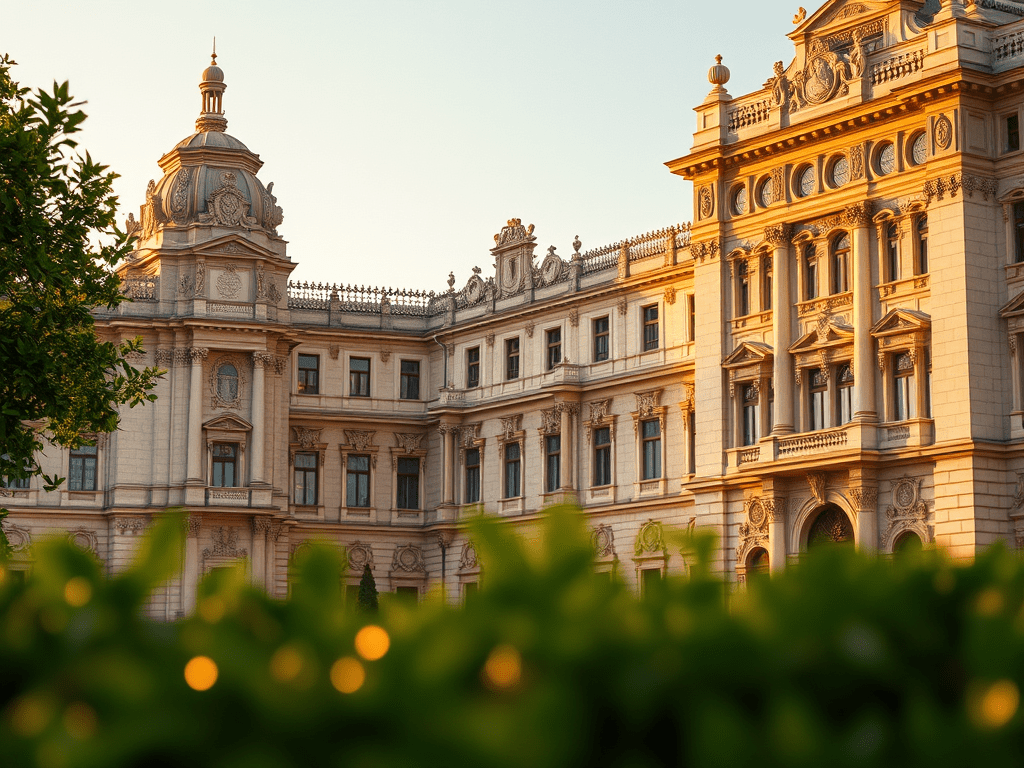
The architectural style of the Royal Palace of Madrid reflects a blend of Italian Baroque and French classicism, designed to communicate both grandeur and harmony. The palace, a collaboration between architects and artists from various European backgrounds, showcases the influence of the Bourbon dynasty, with its focus on elegance and opulence in royal residences. Architect Giovanni Battista Sacchetti’s design prioritized a sense of balance, creating a symmetrical, U-shaped structure with courtyards, grand staircases, and spacious salons.
One of the architectural highlights is the palace’s grand entrance, framed by imposing columns and statues that celebrate Spain’s imperial heritage. Sacchetti’s successor, Francesco Sabatini, contributed significantly to the palace’s interiors, designing elaborate rooms with intricate stucco work, frescoes, and gold leaf accents that reflect the Rococo style favored by the Bourbons. The Throne Room, with its red velvet walls, gilded mirrors, and chandeliers, epitomizes the palace’s luxurious design, showcasing the skill of Spanish artisans and the influence of European decorative trends.
The Royal Chapel, another masterpiece within the palace, features marble altars and religious paintings that emphasize the spiritual authority of the monarchy. This emphasis on religious art and architecture illustrates the Bourbon dynasty’s commitment to reinforcing its legitimacy through displays of piety and devotion. Furthermore, the palace grounds were designed to include expansive gardens inspired by French landscaping, further adding to its sense of royal grandeur and providing a serene space for the royal family and their guests.
One of the most ambitious aspects of the Royal Palace was its scale. Intended to house not only the royal family but also numerous courtiers, officials, and servants, the palace boasted over 3,000 rooms. Its size and layout were designed to accommodate the elaborate rituals of court life, from banquets and diplomatic receptions to state ceremonies and private gatherings. The palace’s architectural details, from its grand marble staircase to its gilded halls, reflected the Bourbon monarchy’s desire to assert its position as one of Europe’s leading powers.
The Royal Palace’s architectural design served not only to impress but also to symbolize a new era for Spain under Bourbon rule. The construction of the palace demonstrated the monarchy’s commitment to modernization and cultural refinement, establishing the palace as a physical representation of the dynasty’s aspirations and achievements. Today, the Royal Palace stands as a testament to the artistic and architectural achievements of the 18th century, a historic treasure that continues to captivate visitors with its beauty and grandeur.
Historical Moments: From Royal Residences to National Heritage
The Royal Palace of Madrid has been both a silent witness and a central player in the significant historical events that shaped Spain over the centuries. For nearly two centuries, it functioned as the primary residence of the Spanish monarchy and a key venue for royal and state events. The palace has seen royal weddings, coronations, banquets, and diplomatic receptions, each adding layers of political and cultural significance to its walls. The palace grounds served as a nexus of power, where alliances were formed, treaties were signed, and celebrations showcased Spain’s royal heritage.
The 19th century was a particularly transformative period for the Royal Palace, mirroring Spain’s own political upheavals. The era was marked by a series of monarchic transitions, as the country oscillated between absolutist monarchy, constitutional monarchy, and brief attempts at republican governance. These shifts in power directly impacted the royal palace and its symbolic role. During the turbulent years of the Napoleonic Wars, for example, the palace witnessed the brief occupation of Madrid by French forces and the subsequent abdication of the Spanish king, Charles IV. These events plunged Spain into turmoil, with the palace standing as a reminder of the monarchy’s past stability amid growing national instability.
In 1868, the “Glorious Revolution” forced Queen Isabella II into exile, sparking a period of political experimentation that further distanced the palace from its original function. Although the monarchy was restored in 1874, the symbolic nature of the palace had begun to evolve, becoming not just a royal residence but also a symbol of Spain’s historical continuity. The palace’s role continued to shift throughout the 20th century as Spain grappled with modernization, social changes, and political divisions. By the time Alfonso XIII ascended the throne in the early 1900s, the palace had transitioned into a place of tradition amidst rising political unrest and the challenges of industrialization.
The outbreak of the Spanish Civil War in 1936 marked another dramatic shift for the palace, with the monarchy abolished in 1931 and replaced by the Second Spanish Republic. During Franco’s dictatorship, the palace no longer served as a royal residence, becoming instead a symbol of the nation’s heritage. Franco opened the palace to the public as a museum, intending to cultivate a sense of Spanish pride by showcasing the palace’s art and treasures. This shift represented the palace’s transformation from a symbol of royal power to a historical site accessible to the general public.
With the restoration of the monarchy in 1975 under King Juan Carlos I, the palace regained some of its royal functions. However, it was decided that the royal family would reside in the more modest Zarzuela Palace, with the Royal Palace of Madrid designated as a ceremonial space and a heritage site. Today, the palace is used for state receptions, diplomatic ceremonies, and other official events, while also operating as one of Spain’s most visited museums. This historical journey has cemented the Royal Palace as both a monument to Spain’s royal past and a national treasure celebrating its cultural legacy.
The Modern Role of the Royal Palace and Its Cultural Legacy
Today, the Royal Palace of Madrid stands as one of Spain’s premier cultural landmarks, offering visitors a glimpse into the opulence of Spain’s past while serving a variety of contemporary purposes. Although it remains the official residence of the Spanish monarchy, the palace is used exclusively for state ceremonies and receptions, such as hosting foreign dignitaries, national celebrations, and royal weddings. The decision for the royal family to reside elsewhere reflects modern preferences for a less opulent lifestyle, but it also aligns with the palace’s evolving identity as a cultural site.
The palace’s modern role as a museum attracts millions of visitors each year, who come to admire its vast collection of art, tapestries, and historical artifacts. The Royal Palace of Madrid houses one of the most comprehensive collections of decorative arts in Europe, including antique clocks, furniture, ceramics, and armor. These artifacts provide insight into the lifestyles, tastes, and values of Spain’s historical monarchs, making the palace not only an architectural marvel but also a cultural repository. One of the highlights of the palace’s collection is the Royal Armory, which contains a vast array of armor and weapons dating back to the 13th century, representing Spain’s military history and craftsmanship.
The palace’s interiors, with their richly decorated rooms and elaborate frescoes, serve as a testament to the artistic achievements of various periods in Spanish history. For instance, the Throne Room, adorned with crimson velvet, chandeliers, and gold accents, showcases the grandeur that characterizes Spain’s regal aesthetic. The Hall of Mirrors and the Royal Chapel similarly reflect the influence of European artistic movements, blending Baroque, Rococo, and Neoclassical elements. The Royal Pharmacy and the Royal Library add another dimension to the palace, revealing the intellectual pursuits and scientific interests that were encouraged within the Spanish court.
The palace grounds and its adjacent Sabatini Gardens also play a significant role in the site’s cultural appeal. Designed in the early 20th century, the gardens provide a tranquil green space that contrasts with the palace’s grandeur, allowing visitors to enjoy a peaceful retreat while taking in views of the imposing structure. Public events such as military parades and national celebrations often take place on the palace grounds, integrating the palace into Madrid’s cultural and civic life.
In addition to its function as a museum and ceremonial space, the Royal Palace is a source of national pride, attracting both Spanish citizens and international visitors. Its historical significance, coupled with its artistic and architectural splendor, makes it a symbol of Spain’s royal heritage. The palace’s role as a cultural institution has preserved it as a living piece of history, bridging the past and the present by making the splendor of Spain’s monarchy accessible to all. Through its preservation and continued use, the Royal Palace of Madrid remains a testament to the endurance and cultural richness of Spanish history.
Conclusion
The Royal Palace of Madrid encapsulates the grandeur and history of the Spanish monarchy, standing as a remarkable tribute to Spain’s past while serving as a national symbol in the present. Originally born from the ashes of the Alcázar and transformed by centuries of monarchic ambition, the palace is an emblem of resilience, artistry, and historical continuity. It now functions not only as a ceremonial space for Spain’s monarchy but also as a cultural landmark that celebrates and preserves Spain’s royal heritage. This dual role enriches Spain’s identity and makes the palace a cherished icon, inviting visitors to experience the legacy and pride of a nation’s remarkable history.