Introduction
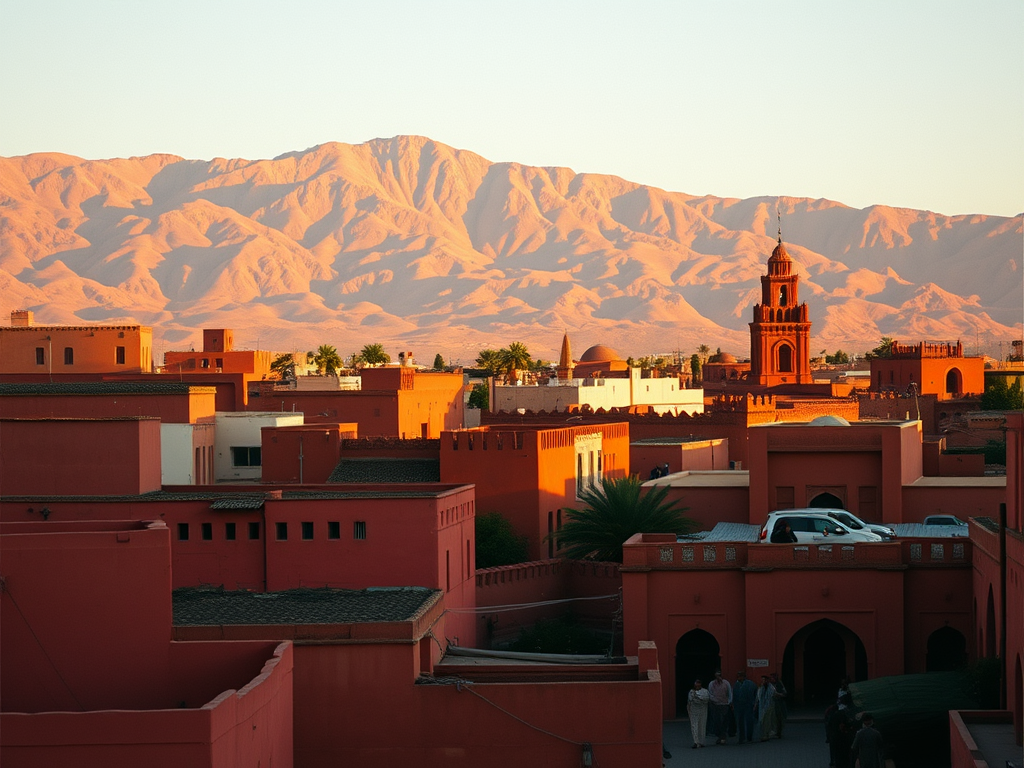
Marrakesh, often referred to as the “Red City” due to its distinctive red sandstone buildings, is one of the most iconic cities in Morocco. Situated at the foothills of the majestic Atlas Mountains, Marrakesh has been a cultural, religious, and commercial hub in North Africa for almost a millennium. From its foundation in the 11th century to its modern-day allure as a global tourist destination, the city has played a pivotal role in shaping the history of Morocco and the broader Maghreb region. This article explores the rich history of Marrakesh, from its founding, through its golden ages, periods of decline, and eventual resurgence.
The Foundation of Marrakesh
The Almoravid Dynasty and the Birth of the City (1070-1147)
The city of Marrakesh was founded in 1070 by the Almoravid dynasty, a Berber Muslim empire that controlled a large part of the Maghreb and Al-Andalus (Muslim Spain). The Almoravids, originally a nomadic people from the Sahara, established Marrakesh as their capital under the leadership of Abu Bakr ibn Umar and his cousin Yusuf ibn Tashfin, who is often credited with completing the initial construction of the city.
The strategic location of Marrakesh made it a crucial hub for trade and communication between the Sahara Desert and the Mediterranean, as well as between sub-Saharan Africa and Europe. The city quickly grew into a major center for commerce, culture, and learning. The Almoravids built mosques, palaces, and military fortifications, many of which still stand today, though often in altered form. Notably, they introduced an innovative system of underground irrigation known as the khettara, which allowed the city to flourish in the otherwise arid environment.
One of the most famous landmarks from this era is the Koutoubia Mosque, whose original structure was begun by the Almoravids and later completed by the Almohads. Though the Almoravid version of the mosque was demolished, it remains a symbol of the city’s long Islamic heritage.
The fall of the Almoravid dynasty came at the hands of the Almohads, a rival Berber Muslim group that overthrew them in 1147. The Almohads, under the leadership of Abd al-Mu’min, seized control of Marrakesh and made it their capital, marking the beginning of a new era of expansion and development for the city. The Almohads, like the Almoravids before them, were deeply religious and sought to reform the Islamic practices of the region.
The Rise of the Almohads (1147-1269)
Marrakesh continued to grow under Almohad rule, reaching new heights of architectural and cultural splendor. The Almohads were responsible for much of the city’s iconic architecture, including the aforementioned Koutoubia Mosque, which was rebuilt in its current form under their rule. The mosque, with its towering minaret, remains one of the most famous symbols of the city and is a quintessential example of Almohad architecture.
The Almohads also established a network of schools and madrasas (Islamic schools) in Marrakesh, turning the city into a center of religious scholarship. Their empire extended from Morocco to modern-day Tunisia and even into parts of Spain, making Marrakesh a political and intellectual capital of the western Islamic world.
However, by the late 13th century, the Almohad empire began to weaken, and the city fell into a period of decline as the political landscape of the Maghreb shifted.
The Marinid and Saadian Dynasties: Decline and Revival
The Marinid Era (1269-1554)
Following the fall of the Almohads, Marrakesh was eclipsed by the rise of the Marinid dynasty, who chose to establish their capital in Fez. During the Marinid period, Marrakesh experienced a significant decline in political importance, as Fez became the new center of power in Morocco. While the Marinids did contribute to the architectural and cultural landscape of Morocco, they largely neglected Marrakesh in favor of their northern capital.
Marrakesh, however, remained an important city, sustained by its role as a center for trade. The city’s markets and caravan routes continued to attract merchants from across North Africa and sub-Saharan Africa. Despite its diminished status, Marrakesh retained its cultural vibrancy and religious significance, though it was no longer the political powerhouse it had been under the Almoravids and Almohads.
The Saadian Revival (16th Century)
The fortunes of Marrakesh began to improve dramatically in the 16th century with the rise of the Saadian dynasty. The Saadians were a Berber dynasty that came to power after defeating the Portuguese and other European forces during the battle of Ksar El Kebir in 1578, marking a pivotal moment in Moroccan history. Under the Saadians, Marrakesh once again became the capital of Morocco.
The Saadians are perhaps best known for their lavish architectural projects, which included the construction of the Saadian Tombs, a stunning funerary complex that remains one of Marrakesh’s most popular historical sites today. They also built the El Badi Palace, a magnificent structure that was meant to showcase the power and wealth of the Saadian rulers. Though much of the palace was later looted and destroyed, its ruins still inspire awe.
During this period, Marrakesh re-established itself as a thriving cultural and economic center, with the Saadians fostering trade with Europe, the Middle East, and sub-Saharan Africa. The city’s prominence was further enhanced by its strategic location at the crossroads of these major trade routes.
The Saadian era marked a renaissance for Marrakesh, but it would prove to be short-lived. By the late 17th century, the Saadians were overthrown by a new dynasty, the Alaouites, who moved the capital once again, this time to Meknes.

The Alaouite Dynasty and French Colonialism
The Alaouite Period (17th-19th Century)
The Alaouite dynasty, which came to power in the mid-17th century and continues to rule Morocco today, shifted the political focus away from Marrakesh. While Meknes, and later Rabat, became the new centers of power, Marrakesh remained an important regional hub, though it no longer served as the imperial capital.
During the Alaouite period, Marrakesh continued to play a role as a commercial and religious center. The city’s famous souks (markets) thrived, attracting traders and artisans from across the region. The city’s distinctive red buildings, constructed from local clay, became its trademark during this era, lending Marrakesh the nickname “the Red City.”
Though the city’s political importance had waned, the Alaouite sultans did invest in the restoration of several key monuments and mosques, helping to preserve the city’s architectural heritage. The dynasty’s commitment to maintaining the city’s status as a religious center ensured that Marrakesh remained an essential part of Moroccan identity.
French Colonial Period (1912-1956)
In 1912, Morocco was formally divided into French and Spanish protectorates, with the French taking control of most of the country, including Marrakesh. The French colonial authorities saw the city as a valuable cultural and economic asset, and they sought to modernize it while preserving its historic charm.
One of the most significant figures during this period was French Resident-General Hubert Lyautey, who developed a vision for modernizing Moroccan cities while respecting their traditional architectural styles. In Marrakesh, this led to the development of the Ville Nouvelle (New City), which included wide boulevards, European-style buildings, and modern infrastructure. At the same time, the historic medina (old city) was preserved as a cultural and tourist attraction.
The French presence also brought new economic opportunities to Marrakesh. The city became a popular destination for European tourists, drawn by its exoticism, warm climate, and historical significance. Marrakesh’s growing reputation as a tourist destination laid the groundwork for the city’s modern economy.
Despite these changes, the French colonial period was marked by political unrest, as many Moroccans sought independence from foreign rule. Marrakesh, like other cities in Morocco, became a focal point for nationalist movements. In 1956, Morocco gained its independence, and Marrakesh, along with the rest of the country, embarked on a new chapter in its history.
Post-Independence Marrakesh: A Modern Cultural Hub
The Rebirth of Marrakesh (1956-Present)
After Morocco gained independence from France in 1956, Marrakesh underwent a period of transformation and modernization. The city remained an important cultural center, attracting artists, writers, and musicians from around the world. During the 1960s and 1970s, Marrakesh became a haven for countercultural figures, including the likes of Yves Saint Laurent and the Rolling Stones, who were drawn to the city’s exotic allure and relaxed atmosphere.
The city’s economy, now largely driven by tourism, began to flourish. Tourists from around the world flocked to Marrakesh to experience its rich history, bustling markets, and vibrant street life. The city’s medina, with its narrow alleyways, traditional souks, and iconic Jemaa el-Fnaa square, became a UNESCO World Heritage Site in 1985, cementing Marrakesh’s status as one of the most important cultural destinations in the world.
The Modern City and Global Influence
Today, Marrakesh is a city that seamlessly blends the old with the new. The historic medina remains at the heart of the city, while the Ville Nouvelle has continued to expand, featuring modern hotels, restaurants, and shopping centers that cater to both tourists and locals. Marrakesh has also become a center for contemporary art and fashion, with events such as the Marrakesh International Film Festival and the Marrakesh Biennale drawing global attention.
In recent years, the city has seen significant investment in infrastructure, with the development of new airports, roads, and public spaces aimed at accommodating its growing population and tourist base. The city’s reputation as a luxury destination has only grown, with high-end resorts, spas, and cultural institutions offering visitors a taste of both traditional Moroccan life and modern luxury.
Conclusion: Marrakesh – A City of Timeless Appeal
Marrakesh’s long and storied history, from its founding by the Almoravids in the 11th century to its modern-day status as a global cultural hub, reflects its unique role in shaping the identity of Morocco and the wider Maghreb. Throughout the centuries, the city has been a center for trade, religion, and learning, as well as a crossroads for diverse cultures and civilizations.
As one of Morocco’s most iconic cities, Marrakesh continues to captivate visitors with its blend of ancient history and modern vibrancy. The city’s architectural wonders, bustling markets, and rich cultural heritage stand as a testament to its enduring appeal and importance. Whether as the capital of empires, a colonial stronghold, or a global tourist destination, Marrakesh remains a jewel of North Africa, its red walls bearing witness to nearly a thousand years of history.