Introduction
Nestled in northern Italy, Verona is a city of timeless charm and historical significance. Known globally as the setting for Shakespeare’s “Romeo and Juliet,” the history of Verona spans millennia, from its Roman origins to its present-day vibrancy. Declared a UNESCO World Heritage Site, the city is a tapestry of well-preserved architecture, artistic legacies, and cultural landmarks. Verona’s strategic location along the Adige River made it a focal point for trade, power, and artistic endeavors throughout history. This article explores the rich narrative of Verona, tracing its evolution through pivotal historical periods. From its foundation as a Roman stronghold to its flourishing under Venetian rule and its resilience in the face of modern conflicts, Verona’s past reveals a city that embodies both tradition and innovation. Join us as we uncover the layers of history that have shaped this Italian jewel.
Ancient Origins: Verona in the Roman Era
Verona’s origins can be traced back to ancient times, with evidence of human settlements dating as far back as the Neolithic period. However, its transformation into a significant urban center began with the Romans in the 1st century BCE. The city’s strategic location at the intersection of major Roman roads, including the Via Postumia and the Via Claudia Augusta, positioned it as a critical hub for commerce and military operations.
Under Roman rule, Verona flourished as a municipium, boasting impressive infrastructure and architectural advancements. The construction of the Verona Arena, an amphitheater completed around 30 CE, stands as a testament to the city’s importance within the Roman Empire. This colossal structure, capable of holding up to 30,000 spectators, hosted gladiatorial games, public spectacles, and theatrical performances, cementing Verona’s status as a cultural and entertainment center.
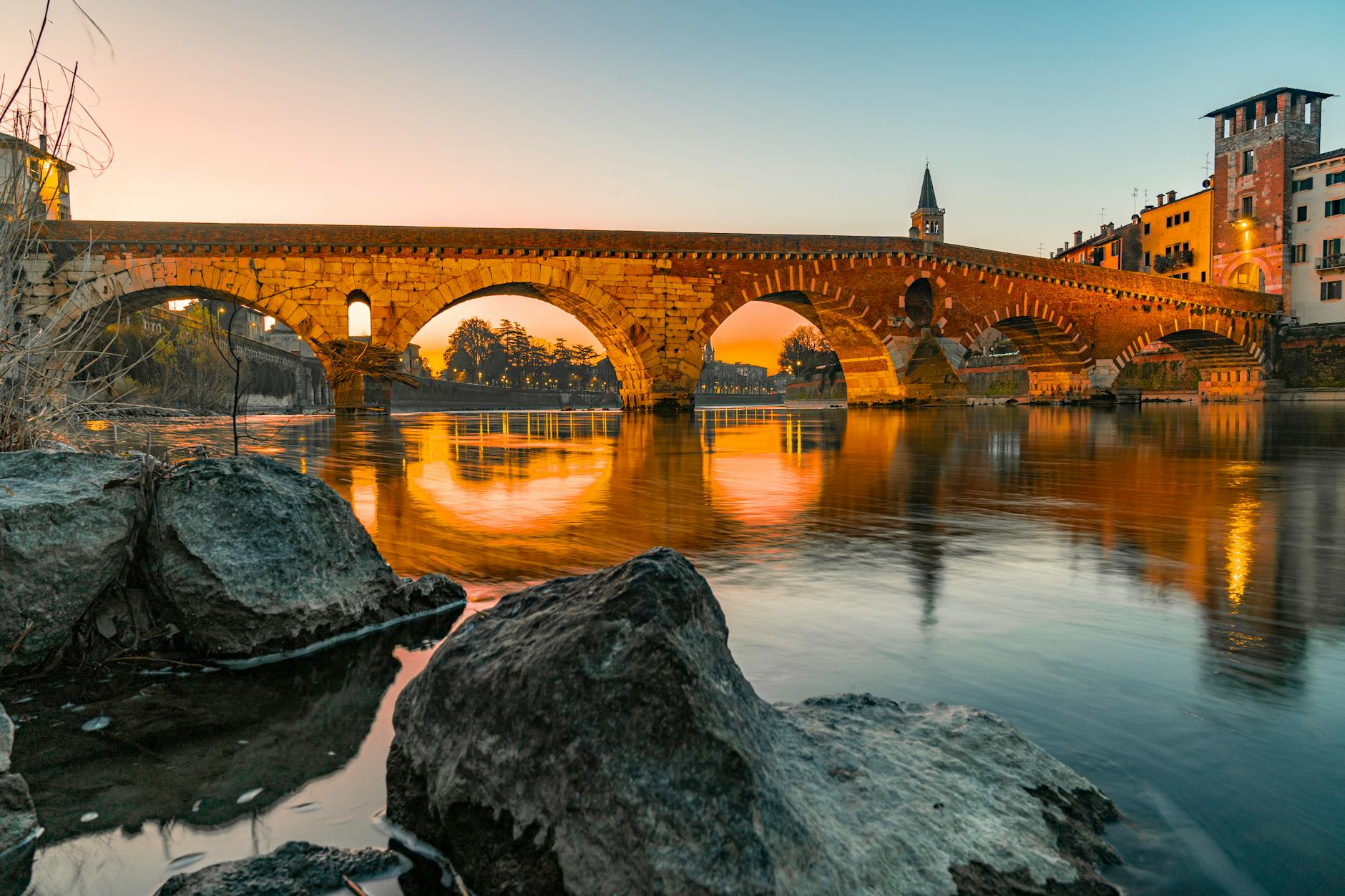
Beyond the arena, Roman Verona was adorned with bridges, gates, and public baths that showcased the engineering prowess of the era. The Ponte Pietra, a stone bridge spanning the Adige River, and the Porta Borsari, a grand city gate, are enduring symbols of Roman ingenuity. These structures not only facilitated trade and communication but also served as markers of Verona’s prominence.
Verona’s urban layout reflected the typical Roman grid plan, with a central forum serving as the heart of civic life. The forum’s remnants, now part of Piazza delle Erbe, reveal a vibrant marketplace and meeting point for citizens. The city also became an early center for Christianity, with Verona’s bishops playing influential roles in the spread of the religion across northern Italy.
As the Roman Empire began to decline in the 4th and 5th centuries CE, Verona faced invasions and political upheaval. Yet, its strategic importance ensured its survival and adaptation to changing times. The city’s Roman heritage laid the foundation for its enduring significance, with many ancient structures still standing as integral parts of Verona’s identity today.
The Middle Ages: The Rise of the Scaliger Family
The fall of the Western Roman Empire marked the beginning of a turbulent yet transformative era for Verona. During the early Middle Ages, the city experienced a series of invasions, including those by the Ostrogoths and Lombards, which reshaped its political and cultural landscape. By the 12th century, Verona emerged as a powerful commune, gaining autonomy and asserting its influence in the region.
The turning point in Verona’s medieval history came with the rise of the Scaliger family, also known as the Della Scala dynasty. Beginning with Mastino I in the early 13th century, the Scaligers established a rule that would last for nearly 125 years, transforming Verona into one of the most prosperous and culturally vibrant cities in northern Italy.
Under the Scaligers, Verona became a center of art, architecture, and political ambition. The family’s patronage of artists and scholars fostered a cultural renaissance that predated the larger Italian Renaissance. Notable figures such as Dante Alighieri found refuge in Verona, and the city’s courts became hubs of intellectual exchange.
The Scaligers’ architectural legacy is particularly striking. The Castelvecchio, a fortified castle built by Cangrande II, exemplifies the family’s commitment to both defense and grandeur. The castle’s adjoining bridge, the Ponte Scaligero, remains a symbol of medieval engineering and strategic prowess. Additionally, the Scaliger Tombs, a series of ornate Gothic funerary monuments, stand as a testament to the family’s influence and artistic vision.
However, the Scaligers’ reign was not without conflict. Internal rivalries and external pressures from neighboring states, such as Milan and Venice, eventually led to the dynasty’s decline. By the late 14th century, Verona fell under the control of the Visconti of Milan and subsequently the Republic of Venice. Despite this, the Scaliger era left an indelible mark on Verona, shaping its identity as a city of culture and resilience.
Verona in the Renaissance: A Cultural Awakening
The Renaissance era ushered in a period of renewed creativity and intellectual fervor across Europe, and Verona was no exception. Following its integration into the Republic of Venice in 1405, Verona benefited from the stability and prosperity that Venetian rule provided. This era saw the city emerge as a thriving center for art, architecture, and humanist thought.
One of the defining features of Renaissance Verona was its architectural transformation. Inspired by classical antiquity, architects such as Michele Sanmicheli introduced a new aesthetic that blended symmetry, proportion, and grandeur. Sanmicheli’s works, including the Porta Nuova and the Porta Palio, exemplify the harmonious balance between form and function that characterized Renaissance design. These structures not only enhanced Verona’s defenses but also underscored its status as a sophisticated urban center.
Verona’s artistic achievements during the Renaissance were equally remarkable. The city became a canvas for painters such as Paolo Veronese, whose vibrant frescoes and altarpieces adorned churches and palaces. The Basilica di San Zeno Maggiore, a masterpiece of Romanesque and early Renaissance architecture, attracted pilgrims and art enthusiasts alike. Its intricate facade and stunning interior frescoes remain a highlight of Verona’s cultural heritage.
The influence of humanism permeated Verona’s intellectual life, with scholars and writers contributing to the dissemination of Renaissance ideals. Libraries and academies flourished, fostering an environment of learning and innovation. The city’s strategic location along trade routes further facilitated the exchange of ideas and goods, reinforcing its role as a bridge between northern and southern Europe.
Despite the challenges posed by periodic outbreaks of plague and economic fluctuations, Verona’s Renaissance legacy endures as a testament to its resilience and creativity. The period solidified the city’s reputation as a cultural beacon, attracting visitors and admirers from around the world.
The Venetian Influence: Integration into the Republic of Venice
In 1405, Verona became part of the Republic of Venice, a political transition that heralded a new chapter in the city’s history. Under Venetian rule, Verona enjoyed a period of relative stability and economic growth, benefiting from the Republic’s expansive trade networks and maritime dominance. The integration into Venice also brought administrative and cultural changes that left a lasting imprint on Verona’s identity.
The Venetian period saw the reinforcement of Verona’s defensive structures, as the city occupied a strategic position on the Republic’s western frontier. Renowned architects and military engineers, such as Michele Sanmicheli, were commissioned to design and enhance fortifications, including city gates and bastions. These efforts ensured that Verona remained a formidable stronghold against external threats, particularly during the turbulent years of the Italian Wars.
Culturally, Verona thrived as Venetian influence introduced new artistic and architectural styles. The Republic’s patronage extended to local artists and craftsmen, fostering a vibrant cultural scene. Venetian Gothic and Renaissance elements began to blend with Verona’s existing architectural heritage, creating a unique aesthetic that can still be seen in buildings such as Palazzo Maffei and various churches.
Economically, Verona flourished as part of Venice’s extensive trade network. The city became a hub for the exchange of goods such as silk, grain, and wine, bolstering its prosperity. This economic vitality supported the growth of urban infrastructure, including markets, bridges, and public spaces that catered to a burgeoning population.
The Venetian era also brought administrative reforms that streamlined governance and integrated Verona more closely with the Republic’s centralized system. While local elites retained some influence, the Doge’s representatives ensured that Venetian interests were upheld. This balance of local autonomy and centralized control allowed Verona to maintain its distinct identity while benefiting from the stability and resources of the Republic.
Napoleonic and Austrian Rule: Verona in the Modern Era
The dawn of the 19th century marked a period of upheaval for Verona, as the city became embroiled in the geopolitical struggles that defined Europe in the Napoleonic era. In 1797, Napoleon Bonaparte’s campaigns led to the fall of the Republic of Venice, and Verona was ceded to the French-controlled Cisalpine Republic under the Treaty of Campo Formio.
During the Napoleonic period, Verona underwent significant administrative and social changes. The French introduced modern governance structures, secularized religious institutions, and
confiscated church properties. These reforms were aimed at aligning Verona with the ideals of the French Revolution, promoting a centralized and secular state. The city’s ancient walls and fortifications, which had been maintained under Venetian rule, were repurposed and enhanced to serve Napoleon’s military strategies.
However, Napoleon’s dominance was short-lived. In 1814, following his defeat, Verona was incorporated into the Austrian Empire under the Congress of Vienna. This ushered in nearly five decades of Austrian rule as part of the Kingdom of Lombardy-Venetia. During this time, Verona became a critical node in Austria’s network of military fortresses known as the Quadrilatero, alongside Mantua, Peschiera del Garda, and Legnago. The Austrians fortified the city further, constructing barracks, arsenals, and defensive structures that significantly altered its urban landscape.
Under Austrian administration, Verona’s economy and infrastructure saw modernization. Railways were introduced, connecting the city to other parts of the empire and fostering trade and communication. However, Austrian rule was marked by tensions between the local population and their foreign rulers. The spirit of Italian nationalism grew steadily, fueled by cultural pride and a desire for independence.
Verona played an active role in the Risorgimento, the 19th-century movement for Italian unification. The city was a site of uprisings and clashes between Austrian forces and Italian patriots, culminating in its liberation during the Third Italian War of Independence in 1866. With the annexation of Veneto to the Kingdom of Italy, Verona became part of a unified nation, marking the end of foreign dominance and the beginning of a new era.
World War II and Reconstruction: Verona’s Resilience
Verona’s strategic location once again brought it to the forefront of history during World War II. The city was a key transportation hub and a significant target for Allied bombing campaigns. These air raids caused extensive damage to Verona’s infrastructure, including its historical landmarks. The Ponte Pietra, an ancient Roman bridge, was destroyed, and many buildings were reduced to rubble.
During the Nazi occupation of Italy in 1943, Verona became a center of German military operations and a site of political persecution. The city housed a notorious tribunal where individuals accused of anti-fascist activities were tried and sentenced. The hardships of war were felt deeply by the local population, who endured food shortages, displacement, and repression.
Despite these challenges, Verona’s spirit of resilience shone through in the aftermath of the war. Reconstruction efforts focused on restoring the city’s architectural and cultural heritage. The Ponte Pietra was painstakingly rebuilt using original materials retrieved from the river, symbolizing the city’s determination to preserve its past while moving forward. Other historical sites, including the Verona Arena and various churches, were also restored to their former glory.
Verona’s post-war recovery extended beyond physical reconstruction. The city embraced modernization, improving its infrastructure and economy. Industries such as winemaking, agriculture, and tourism flourished, bringing prosperity and growth. Verona’s inclusion in UNESCO’s World Heritage list in 2000 further underscored its significance as a city that had overcome adversity to become a beacon of cultural and historical preservation.
Contemporary Verona: A City of Heritage and Innovation
Today, Verona is a vibrant city that seamlessly blends its historical legacy with modern innovation. Its well-preserved Roman, medieval, and Renaissance architecture attracts millions of tourists annually, making it one of Italy’s most visited cities. The Verona Arena, now a venue for opera and music festivals, continues to be a centerpiece of cultural life, drawing audiences from around the world.
Contemporary Verona is also a hub for commerce and industry. The city is renowned for its wine production, particularly Valpolicella and Amarone, which have gained international acclaim. Verona hosts the annual Vinitaly wine fair, one of the largest and most prestigious events in the global wine industry, highlighting the city’s role as a leader in this field.
Education and innovation thrive in Verona, with universities and research institutions contributing to advancements in fields such as engineering, agriculture, and the arts. The city has embraced sustainability initiatives, focusing on preserving its environment and enhancing the quality of life for its residents.
Verona’s identity as the setting for Shakespeare’s “Romeo and Juliet” adds a romantic allure to its historic charm. Visitors flock to Juliet’s House, the alleged setting of the famous balcony scene, to experience the magic of the timeless love story. While this connection to literature has become a cornerstone of Verona’s global image, the city’s true essence lies in its rich history and dynamic present.
Conclusion
Verona’s journey through history is a testament to its resilience, adaptability, and cultural richness. From its origins as a Roman stronghold to its flourishing under Venetian rule and its endurance through modern conflicts, Verona has continually reinvented itself while preserving its heritage. The city’s architectural marvels, artistic achievements, and strategic importance have made it a focal point of Italian and European history.
Today, Verona stands as a bridge between the past and the future. Its commitment to cultural preservation, economic innovation, and environmental sustainability ensures that it remains a city of global significance. Whether exploring ancient ruins, attending an opera in the Verona Arena, or savoring the region’s world-class wines, visitors to Verona encounter a city that embodies the best of Italy’s history and spirit. As a timeless jewel of northern Italy, Verona continues to inspire and captivate all who experience its enduring magic.