
Introduction
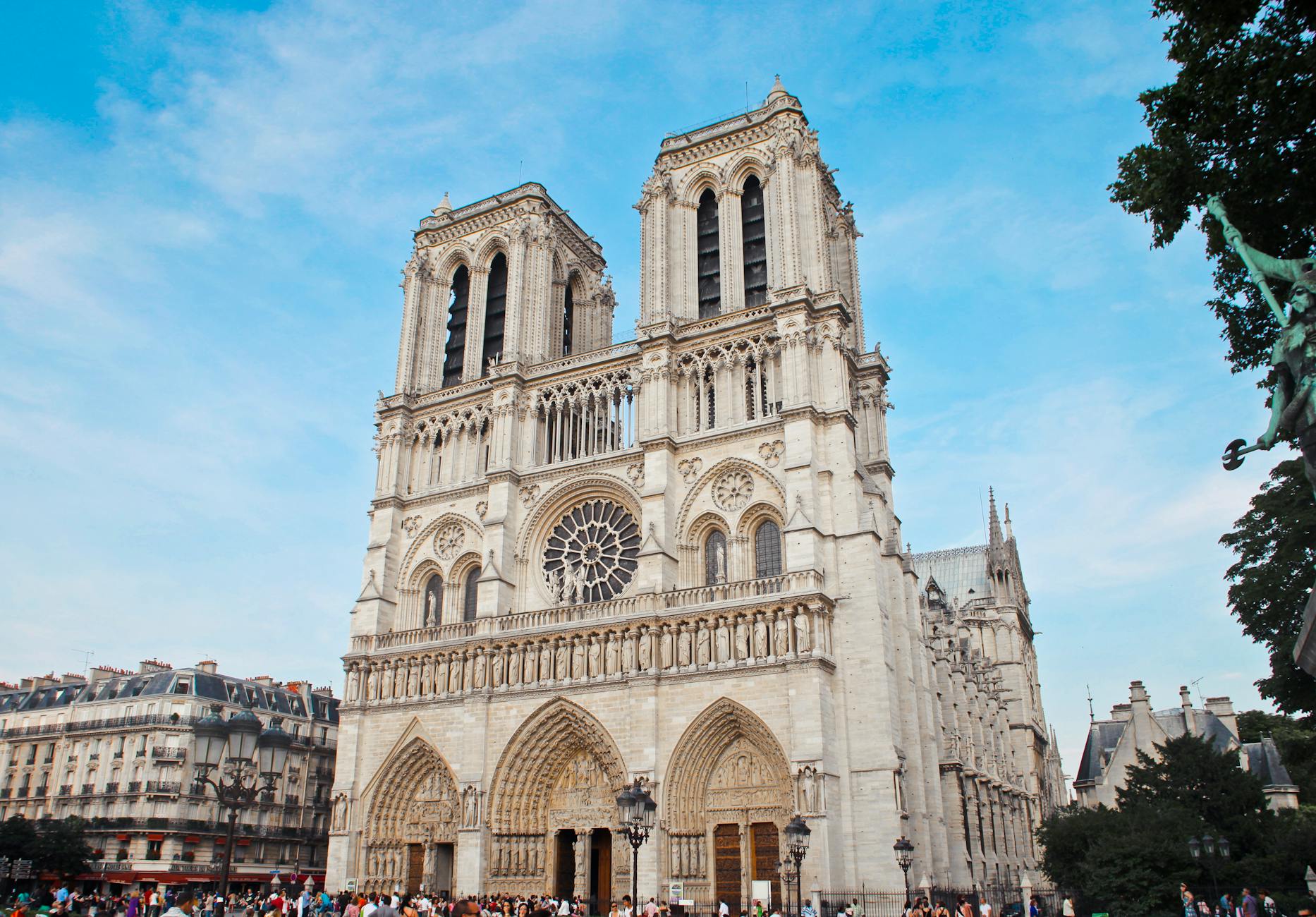
The Notre Dame Cathedral in Paris stands as a timeless symbol of faith, artistry, and resilience. Constructed over the course of nearly 200 years, this architectural masterpiece has witnessed centuries of historical change, serving as a spiritual, cultural, and political cornerstone of French heritage. From its inception in the 12th century to its devastation in the tragic fire of April 2019, Notre Dame has captured the imagination of millions and inspired movements for preservation and renewal.
Throughout its history, the cathedral has been a silent witness to revolutions, wars, and the ebb and flow of Parisian life. Its iconic Gothic architecture, breathtaking rose windows, and spiritual significance have cemented its place in global history. The ongoing reconstruction efforts following the fire are not merely an act of repair but a profound commitment to ensuring that Notre Dame remains a symbol of resilience and inspiration for generations to come.
The Origins of Notre Dame: Architectural Beginnings (12th–14th Century)
Notre Dame de Paris, or “Our Lady of Paris,” was conceived during an era of monumental change in medieval Europe. Its construction began in 1163, under the reign of King Louis VII and the supervision of Bishop Maurice de Sully, who envisioned a grand cathedral that would symbolize the power of the Catholic Church and the growing prominence of Paris as a cultural and political hub.
The cathedral was designed in the Gothic architectural style, which had emerged in the mid-12th century and revolutionized medieval construction. This style was characterized by innovations such as pointed arches, ribbed vaults, and flying buttresses, allowing for taller, more luminous buildings with expansive stained-glass windows. The foundation stone of Notre Dame was laid in the presence of Pope Alexander III, marking the beginning of a project that would span nearly two centuries.
Early Construction and Architectural Marvels
The first phase of construction focused on the choir and apse, completed around 1182. The cathedral’s nave, its long central hall, was finished by the early 13th century. The two massive towers on the western façade were completed by 1250, while the final touches, including additional sculptural decorations, continued into the early 14th century.
The iconic flying buttresses of Notre Dame were one of its most groundbreaking features. Introduced in the 13th century, these external supports allowed the cathedral walls to be thinner and higher, accommodating the large stained-glass windows that bathed the interior in vibrant light. The rose windows, particularly the North and South Roses, are masterpieces of medieval craftsmanship, showcasing intricate designs and vivid colors that tell biblical stories.
Symbolism and Religious Significance
From its earliest days, Notre Dame was more than just a building; it was a spiritual beacon. Dedicated to the Virgin Mary, it became a central place of worship for Parisians and a pilgrimage site for the devout. The cathedral hosted significant religious ceremonies, including the coronation of Henry VI of England in 1431 during the Hundred Years’ War.
Notre Dame’s design also reflected medieval theological principles. Its soaring spires and intricate carvings were intended to lift the eyes—and the soul—toward heaven. The façade was adorned with hundreds of sculptures, including gargoyles and chimeras, which served both functional and symbolic purposes. While some acted as rain spouts, others represented the spiritual battle between good and evil, reinforcing the cathedral’s role as a sacred space.
Cultural and Civic Importance
In addition to its religious significance, Notre Dame quickly became a centerpiece of Parisian life. Situated on the ÃŽle de la Cité, it stood at the heart of medieval Paris, serving as a gathering place for public events and a marker of the city’s identity. The cathedral’s construction coincided with the consolidation of Paris as the political and intellectual capital of France, further cementing its status as a symbol of national pride.
By the time construction was completed in the early 14th century, Notre Dame had already established itself as one of the most magnificent architectural achievements of its time—a testament to human ingenuity and devotion.
Notre Dame in the Middle Ages: Spiritual and Cultural Center
During the Middle Ages, Notre Dame de Paris was not only a sacred space but also a cultural, social, and intellectual hub for the city of Paris. As the cathedral’s grandeur grew, it became deeply intertwined with the life of medieval Parisians and held a central role in both religious and civic affairs.
A Beacon of Faith
From its consecration, Notre Dame served as the spiritual heart of Paris. Daily Masses, solemn processions, and elaborate religious ceremonies were integral to life within its walls. The cathedral was a centerpiece for Christian observances, such as Easter, Christmas, and the Feast of the Assumption, drawing thousands of worshippers. It also played a role in significant state events, including royal marriages and coronations, cementing the alliance between the French monarchy and the Catholic Church.
Notre Dame housed several important religious relics, including the Crown of Thorns, believed to have been worn by Jesus Christ during his crucifixion. King Louis IX, who acquired the relic in 1239, ensured its placement within the cathedral. Such treasures elevated Notre Dame’s significance, transforming it into a site of pilgrimage for believers across Europe.
The cathedral also became a center for Marian devotion, emphasizing its dedication to the Virgin Mary. Artistic depictions of Mary adorned its architecture, including the stunning sculptures on the western façade and the luminous rose windows, which symbolized her purity and grace.
A Hub of Knowledge and Art
During the High Middle Ages, Paris emerged as a leading center of education and intellectual life, particularly through the establishment of the University of Paris. Located nearby, the university contributed to Notre Dame’s significance by hosting theological debates, academic ceremonies, and religious lectures. Scholars from the university often collaborated with cathedral clergy, enhancing Notre Dame’s role as a seat of learning.
The Gothic art and architecture of Notre Dame also influenced generations of artisans, architects, and stonemasons. Its elaborate carvings, such as the Gallery of Kings—depicting biblical monarchs—served as both decoration and visual storytelling. These elements educated an illiterate population through vivid depictions of biblical narratives and saints’ lives.
Notre Dame’s choral music further enriched its cultural legacy. The cathedral became known for fostering the development of polyphony, an early form of multi-voiced music. Composers from the Notre Dame School of Polyphony, such as Léonin and Pérotin, revolutionized medieval music by introducing intricate harmonies and rhythmic structures. Their contributions spread across Europe, solidifying Notre Dame’s influence in the evolution of Western music.
A Center for Civic Life
In medieval Paris, Notre Dame functioned as more than a place of worship—it was a civic landmark. The parvis, or plaza, in front of the cathedral served as a gathering place for public meetings, markets, and even judicial proceedings. As the cathedral stood on the Île de la Cité, the political and geographical heart of Paris, it became a natural venue for addressing the public.
In times of war and hardship, Notre Dame symbolized hope and unity. It stood as a physical and spiritual anchor for the city, offering solace to Parisians during the uncertainties of the Middle Ages. The cathedral’s bells, particularly the iconic Emmanuel bell, rang out to mark important events, summon the faithful, and warn of danger, weaving it further into the fabric of daily life.
Legacy of the Medieval Era
By the end of the Middle Ages, Notre Dame had firmly established itself as a cornerstone of Parisian identity. It was not merely a structure of stone and glass but a living testament to the city’s faith, creativity, and resilience. The cathedral’s role during this period laid the foundation for its enduring cultural and spiritual significance, which would resonate far beyond the medieval era.
The French Revolution and Notre Dame: Decline and Transformation
The French Revolution (1789–1799) marked a tumultuous period for Notre Dame Cathedral, as the political and social upheavals that swept France brought about profound changes to the church’s role and physical state. Once a symbol of religious and royal authority, the cathedral became a target for revolutionary fervor, leading to its decline and transformation during this era.
Notre Dame’s Fall from Grace
As the revolutionaries sought to dismantle the old order, institutions associated with the monarchy and the Catholic Church were stripped of their influence. Notre Dame, a towering emblem of both, found itself at the center of this ideological conflict. In 1793, the cathedral was officially secularized and rededicated as the Temple of Reason, reflecting the revolutionary shift towards Enlightenment ideals and the rejection of traditional religious practices.
Religious artifacts and symbols within Notre Dame were systematically destroyed or removed. Statues of biblical kings on the western façade, mistakenly identified as French monarchs, were decapitated by revolutionaries. The interior was desecrated, with altars, statues, and relics either vandalized or removed. The iconic Crown of Thorns, one of Christianity’s most revered relics, was seized and transferred to the national library for safekeeping. Even the bells of Notre Dame, except for the great Emmanuel bell, were melted down and repurposed to produce cannons for the revolutionary army.
Transformation and Rededication
During the height of the revolution, Notre Dame became a stage for political propaganda. In November 1793, the cathedral hosted the Festival of Reason, an event intended to promote secular values. A statue symbolizing Liberty replaced the Virgin Mary on the altar, and revolutionary leaders used the space to convey their vision of a rational, secular republic. While these ceremonies were short-lived, they left an indelible mark on Notre Dame’s history.
By 1794, the revolutionary government adopted a more moderate stance, and some religious practices were reinstated. However, the damage inflicted upon Notre Dame during this period was immense, leaving the cathedral in a state of disrepair. Its symbolic status as a house of worship and as a civic landmark had been deeply shaken, reflecting the broader societal shifts of the revolution.

The Cathedral’s Near-Demise
After the revolution, Notre Dame faced an uncertain future. The dechristianization movement had left the building neglected, and it narrowly avoided being dismantled entirely. Napoleon Bonaparte’s rise to power in 1799 brought some relief, as he sought to reconcile with the Catholic Church to stabilize France. In 1801, the Concordat of 1801 between Napoleon and the Pope restored Notre Dame to the Church, reopening it for religious services. Napoleon himself contributed to its legacy by holding his coronation as Emperor of the French in Notre Dame in 1804, an event immortalized by Jacques-Louis David’s famous painting.
Legacy of Revolutionary Turmoil
The French Revolution fundamentally altered Notre Dame’s identity. Once a beacon of religious and royal power, it emerged from the revolutionary period scarred but resilient. Its survival through such upheaval stands as a testament to its enduring significance, not only as a physical structure but as a symbol of France’s complex history. The damage inflicted during this era would later spur efforts to restore the cathedral, leading to one of the most famous revival projects of the 19th century.
The 19th-Century Restoration by Viollet-le-Duc
The 19th century marked a turning point in the history of Notre Dame Cathedral, as the scars left by the French Revolution led to widespread calls for its restoration. Spearheaded by the French architect Eugène Viollet-le-Duc, the ambitious restoration project not only repaired the physical damage but also reimagined the cathedral as a symbol of Gothic revival and national pride.
A Call for Preservation
By the early 19th century, Notre Dame had fallen into a state of neglect and disrepair. Decades of vandalism, secularization, and lack of maintenance had left the cathedral’s structure weakened, with many of its iconic features damaged or missing. Public sentiment toward the cathedral began to shift following the publication of Victor Hugo’s novel Notre-Dame de Paris in 1831, which brought attention to the cathedral’s plight. The novel, a passionate ode to Gothic architecture, sparked widespread admiration for Notre Dame and underscored the need to preserve France’s architectural heritage.
In 1844, King Louis-Philippe declared Notre Dame’s restoration a priority. The French government commissioned Eugène Viollet-le-Duc and Jean-Baptiste Lassus, two leading proponents of the Gothic revival movement, to undertake the monumental task of restoring the cathedral to its former glory.
The Restoration Project
Viollet-le-Duc and Lassus approached the restoration with a mix of historical fidelity and creative reinterpretation. Their goal was not simply to repair the cathedral but to enhance its Gothic character, adhering to the principles of the Gothic revival movement.
One of the most iconic additions during this restoration was the reconstruction of Notre Dame’s central spire, which had been removed in the 18th century due to structural concerns. Viollet-le-Duc designed a new spire that blended seamlessly with the existing Gothic architecture, adorned with intricate sculptures, including the famous statues of the twelve apostles. Notably, one of the statues—a representation of Saint Thomas—bears the face of Viollet-le-Duc himself, a subtle nod to the architect’s dedication to the project.
The restoration also involved repairing the cathedral’s western façade, which had been severely damaged during the French Revolution. Viollet-le-Duc and his team meticulously recreated missing statues and sculptures, drawing inspiration from surviving medieval designs. The Gallery of Kings, a row of statues depicting biblical monarchs, was painstakingly reconstructed to restore the grandeur of the façade.
Stained Glass and Gargoyles
The restoration extended to Notre Dame’s stunning stained glass windows, including the three iconic rose windows. While much of the original glass had been destroyed or removed, Viollet-le-Duc’s team recreated the windows using 19th-century techniques, maintaining the vibrant colors and intricate designs that defined the originals.
Another significant aspect of the restoration was the addition of the cathedral’s famous gargoyles and chimeras. Though not part of the original medieval design, these grotesque sculptures became one of Notre Dame’s defining features. Viollet-le-Duc envisioned them as both decorative and functional elements, channeling rainwater away from the building while adding a sense of mystery and drama to the cathedral’s exterior.
Controversy and Legacy
While the restoration was widely celebrated, it was not without controversy. Critics argued that Viollet-le-Duc’s creative liberties, such as the addition of the spire and gargoyles, strayed from the historical authenticity of the original structure. However, supporters praised his vision, emphasizing the importance of reviving Notre Dame as a symbol of France’s cultural and architectural heritage.
Viollet-le-Duc’s restoration, completed in 1864, was a triumph of the Gothic revival movement. It not only saved Notre Dame from ruin but also cemented its status as one of the most iconic landmarks in Paris. The restoration transformed the cathedral into a cultural and historical treasure, ensuring its place at the heart of French identity for generations to come.
Notre Dame in the 20th Century: A Beacon of Resilience
The 20th century was a period of profound change and challenges for Notre Dame Cathedral. From surviving two world wars to hosting momentous events that defined French and global history, Notre Dame emerged as a symbol of resilience and continuity. However, it also faced the pressures of modernization and conservation, which would set the stage for the challenges of the 21st century.
World War I: A Symbol of Hope
During World War I (1914–1918), Notre Dame stood as a steadfast symbol of hope amidst the chaos and destruction engulfing Europe. Although Paris faced bombardment and air raids, the cathedral itself escaped significant damage. Its bells rang out on November 11, 1918, to celebrate the signing of the Armistice, marking the end of the war. This moment underscored Notre Dame’s enduring presence as a beacon of spiritual and national unity during times of crisis.
World War II: Survival and Liberation
Notre Dame’s resilience was again tested during World War II (1939–1945). Paris fell under Nazi occupation in 1940, and while the city’s historic landmarks, including Notre Dame, were spared the widespread destruction that befell other European cities, the cathedral became a silent witness to the oppression and turmoil of the occupation. Its bells remained silent for much of the war, a poignant reminder of the loss of freedom.
As the war drew to a close, Notre Dame played a significant role in the celebrations of liberation. On August 26, 1944, just days after the liberation of Paris, a Te Deum—a traditional hymn of thanksgiving—was sung in the cathedral to honor the city’s freedom. The ceremony, attended by General Charles de Gaulle, symbolized the triumph of resilience and hope over tyranny. The sight of de Gaulle walking down the nave of Notre Dame amidst a jubilant yet chaotic crowd remains an enduring image of France’s liberation.
Notre Dame as a Cultural and National Icon
Throughout the 20th century, Notre Dame continued to serve as a stage for significant cultural and national events. It hosted numerous state funerals, including those of President Charles de Gaulle in 1970 and President François Mitterrand in 1996. These ceremonies highlighted the cathedral’s role as a unifying space where French history and identity could be honored and remembered.
In addition to its religious and national significance, Notre Dame became an increasingly popular tourist destination during the 20th century. Millions of visitors from around the world came to admire its architectural beauty and spiritual atmosphere. This surge in popularity brought both opportunities and challenges, as the cathedral faced growing concerns over the preservation of its aging structure.
Conservation Efforts
The latter half of the 20th century saw increased efforts to address Notre Dame’s structural issues. The effects of pollution, weathering, and time took a toll on the cathedral’s stonework, prompting numerous restoration campaigns. In the 1960s, cleaning efforts were launched to remove centuries of grime from the façade, revealing its original brightness and detail.
The need for ongoing maintenance and restoration underscored Notre Dame’s delicate balance between preserving its historical integrity and adapting to the demands of the modern era. These efforts were critical in ensuring that the cathedral could withstand the test of time, setting the stage for its enduring role in the 21st century.
A Witness to Change
By the end of the 20th century, Notre Dame had firmly established itself as more than just a place of worship. It stood as a symbol of resilience, unity, and cultural heritage, having weathered the storms of war, political change, and environmental challenges. Its ability to adapt and endure through the trials of the 20th century solidified its place as one of the most treasured landmarks in human history.
The Tragic Fire of 2019: A Global Wake-Up Call
On the evening of April 15, 2019, the world watched in horror as a devastating fire engulfed Notre Dame Cathedral, threatening one of humanity’s most cherished architectural and cultural treasures. The fire, which started in the attic, caused catastrophic damage to the roof and central spire, collapsing these iconic features and jeopardizing the stability of the entire structure. This tragic event marked a pivotal moment in Notre Dame’s history, rallying global support for its preservation and highlighting the vulnerabilities of historic monuments.
The Fire and Its Immediate Impact
The fire broke out around 6:30 PM local time and quickly spread through the cathedral’s ancient wooden framework, known as the “forest†due to its dense interwoven beams. Constructed in the 13th century, the framework was highly flammable, and despite the rapid response of more than 400 firefighters, the fire proved difficult to contain. As flames consumed the roof, the iconic central spire, a masterpiece added by Viollet-le-Duc during the 19th-century restoration, collapsed dramatically, sending shockwaves across the globe.
Inside the cathedral, the damage was extensive but uneven. The stone vaults of the ceiling largely contained the fire, preventing it from reaching the lower levels where invaluable artifacts, artworks, and relics were stored. However, significant portions of the roof and upper structures were destroyed, leaving the interior exposed to the elements.
Miraculously, many of Notre Dame’s most treasured items were saved. Firefighters and cathedral staff worked tirelessly to rescue the Crown of Thorns, believed to have been worn by Christ, and other relics, as well as irreplaceable artworks and furnishings. The famous rose windows, though at risk from heat and debris, also survived with minimal damage, preserving their place as symbols of Notre Dame’s enduring beauty.
A Global Outpouring of Grief and Solidarity
As images of the fire spread across news and social media, the world reacted with profound sorrow and solidarity. Notre Dame was not just a French icon but a global cultural and spiritual landmark, representing centuries of history, art, and human achievement. Leaders from around the world, including Pope Francis and then-President Donald Trump, expressed their condolences and offered support. In Paris, thousands gathered along the Seine River to sing hymns and pray as they watched the fire consume the cathedral.
French President Emmanuel Macron addressed the nation that same evening, vowing to rebuild Notre Dame and preserve it for future generations. “We will rebuild this cathedral together,†he declared, “because that is what the French people expect, and because it is our history.â€
The Challenges of Reconstruction
In the aftermath of the fire, efforts to assess the damage and stabilize the structure began immediately. Engineers and preservationists faced enormous challenges, from removing the charred debris to reinforcing weakened walls and buttresses. The collapse of the spire and roof had also exposed the cathedral to potential water damage, necessitating swift action to protect the interior from rain.
Financial support poured in from across the globe. Within days, more than €1 billion was pledged by individuals, corporations, and governments, including significant contributions from French billionaires such as François-Henri Pinault and Bernard Arnault. However, questions arose about how these funds would be managed and whether the reconstruction should faithfully replicate the original design or incorporate modern elements.
Symbolism and Reflection
The 2019 fire was more than a physical disaster; it was a profound reminder of the fragility of cultural heritage. Notre Dame, a survivor of wars, revolutions, and centuries of wear, had been vulnerable to a single accidental fire caused by renovation work. The tragedy highlighted the importance of investing in the maintenance and preservation of historic monuments worldwide.
The fire also underscored Notre Dame’s role as a unifying force. In an era marked by political and social divisions, the global response to the fire demonstrated the shared human connection to art, history, and faith. For France, it became a rallying point for national identity and pride, symbolizing resilience in the face of adversity.
A New Chapter
The fire of 2019 marked a turning point in Notre Dame’s story, ushering in a new era of restoration and renewal. While the physical scars were immense, the event galvanized a worldwide commitment to ensuring the cathedral’s survival for generations to come. It was a tragic yet transformative moment, reaffirming Notre Dame’s place at the heart of global cultural and spiritual life.
The Ongoing Restoration: Reviving a Global Icon
The fire of 2019 left Notre Dame Cathedral in a perilous state, but it also set in motion one of the most ambitious restoration projects in history. Under the leadership of French President Emmanuel Macron, the commitment to rebuild Notre Dame became a national and global priority. With a deadline set for 2024, coinciding with the Paris Olympics, the project has combined cutting-edge technology, traditional craftsmanship, and international expertise to restore the cathedral to its former glory.
Assessing the Damage and Securing the Structure
The first step in the restoration process was to assess the extent of the damage and stabilize the remaining structure. The fire had destroyed the roof, the central spire, and much of the timber framework, while the stone vaulting had suffered significant cracks due to the intense heat and falling debris. Engineers worked meticulously to remove tons of debris, including melted lead from the roof, while ensuring that the remaining walls, buttresses, and towers were structurally sound.
A critical milestone was the installation of a temporary wooden “umbrella†over the cathedral to protect the interior from further weather damage. This structure allowed conservators to work on preserving the cathedral’s priceless artifacts and artworks, many of which had been moved offsite during the fire.
Recreating the Spire and Roof
One of the most iconic features lost in the fire was the central spire, designed by 19th-century architect Eugène Viollet-le-Duc. After much debate, it was decided that the spire would be rebuilt exactly as it had been before the fire, honoring Viollet-le-Duc’s vision and maintaining the cathedral’s historic integrity. The reconstruction process required sourcing oak trees for the framework, many of which were carefully selected from French forests to match the original materials.
Craftsmen from across Europe have contributed to the project, using traditional techniques to replicate the original design. The roof reconstruction has also involved the use of lead sheeting, despite concerns over its environmental impact, to maintain the authenticity of Notre Dame’s silhouette.
Innovations in Restoration
While the restoration has adhered closely to historical accuracy, modern technology has played a crucial role in speeding up and enhancing the process. 3D laser scanning and digital modeling, conducted before and after the fire, have provided invaluable data for recreating intricate details. These tools have ensured precision in replicating the cathedral’s Gothic features, from the carved gargoyles to the ornate tracery of the windows.
The project has also incorporated sustainability practices, with efforts to minimize waste and energy consumption. For example, scaffolding used in the restoration has been designed for reuse in future projects, reflecting a broader commitment to environmental responsibility.
The Workforce Behind the Revival
The restoration of Notre Dame has brought together an extraordinary team of skilled artisans, architects, engineers, and historians. From stone masons and carpenters to stained-glass restorers, these professionals have demonstrated unparalleled dedication and expertise. Their work not only honors the craftsmanship of the past but also ensures that future generations can appreciate the cathedral’s magnificence.
A Symbol of Renewal
As the 2024 deadline approaches, the restoration of Notre Dame has become a symbol of resilience and unity. The project has captured the world’s imagination, inspiring hope and reminding us of the enduring power of cultural heritage. It is a testament to humanity’s ability to come together in the face of adversity, blending tradition and innovation to preserve a shared legacy.
While challenges remain, the progress made so far has been remarkable. The reopening of Notre Dame will mark not just the restoration of a historic monument but also the revival of a spiritual and cultural icon that continues to inspire millions around the globe.
Conclusion: Notre Dame, A Testament to Human Spirit and Heritage
The history of Notre Dame Cathedral reflects the enduring legacy of human creativity, devotion, and resilience. From its construction in the 12th century to the devastation of the 2019 fire, the cathedral has stood as a symbol of faith, culture, and architectural brilliance. Each chapter in its story, from medieval innovations to 19th-century restorations and the ongoing reconstruction, underscores its importance as a global treasure.
The 2019 fire, while a moment of profound loss, also united the world in a shared determination to restore Notre Dame to its former glory. The ambitious restoration project blends traditional craftsmanship with modern technology, ensuring the cathedral remains a beacon of inspiration for future generations.
As Notre Dame rises again, it embodies humanity’s ability to overcome adversity and preserve our shared cultural heritage. It is not merely a building but a living testament to the enduring power of faith, art, and human ingenuity.







[…] Notre-Dame Cathedral is one of the most famous Gothic cathedrals in the world, standing proudly on ÃŽle de la Cité in the heart of Paris. Construction began in 1163 and continued for nearly two centuries, resulting in an architectural masterpiece that has witnessed centuries of French history. With its towering spires, intricate sculptures, and stunning rose windows, Notre-Dame remains an awe-inspiring site. […]