

Introduction
In this article, we will delve into the history of the Colosseum, the circumstances surrounding its creation, and explore the intricacies of its construction and architectural design. From its inception under Emperor Vespasian to its completion under Titus, we will look at the role the Colosseum played in Roman society and the technological marvels that made such an ambitious project possible. The Colosseum, also known as the Flavian Amphitheatre, is one of the most iconic landmarks of ancient Rome and a testament to the engineering prowess and architectural ingenuity of the Roman Empire. Situated in the heart of Rome, the Colosseum has stood the test of time, surviving earthquakes, fires, and even the ravages of human intervention over the centuries. It has been a symbol of Roman grandeur and an enduring legacy of the empire’s power, culture, and entertainment.
The Roman Empire and Public Spectacles
In the first century AD, the Roman Empire was at the height of its power, and public spectacles were an integral part of Roman culture. These events were a tool for emperors to showcase their power and provide entertainment for the masses. Gladiatorial contests, animal hunts, and mock naval battles were some of the most popular forms of entertainment, attracting citizens from all walks of life.
Before the construction of the Colosseum, such events were typically held in temporary wooden structures or other arenas scattered throughout the city. The Emperor Nero, infamous for his extravagant and controversial rule, had built a large private palace known as the Domus Aurea (“Golden House”) in the center of Rome following the Great Fire of 64 AD, which had devastated large parts of the city. This had not endeared him to the Roman populace, as many believed Nero had taken advantage of the fire to build his luxurious palace on public land.
The Flavian Dynasty
After Nero’s death in 68 AD, Rome was plunged into a period of instability known as the Year of the Four Emperors, where multiple claimants to the throne vied for power. It was not until 69 AD, when Vespasian, a general from the eastern provinces, emerged victorious and founded the Flavian dynasty, that stability was restored. Vespasian sought to distance himself from Nero’s excesses and reestablish trust with the Roman people. One of his most significant acts in this regard was the decision to build the Colosseum on the site of Nero’s artificial lake, symbolically returning the space to the people.
Planning and Design of the Colosseum
The construction of the Colosseum began under Emperor Vespasian around 70-72 AD. Vespasian’s vision was clear: the Colosseum was to be a grand amphitheater, surpassing anything that had come before it in terms of size and grandeur. The Flavian Amphitheatre was designed to hold a capacity of over 50,000 spectators, making it the largest amphitheater in the Roman world.
The Colosseum was part of a broader plan to revitalize the city and build public works that would benefit the citizens of Rome. By constructing a monumental space for public games and events, Vespasian aimed to gain favor with the people and solidify his rule.
Labor Force and Materials
A massive labor force was required for the construction of the Colosseum, which included not only skilled Roman architects and engineers but also thousands of slaves and prisoners of war from the Jewish Revolt. Many of these laborers worked under harsh conditions to bring Vespasian’s vision to life.
The primary materials used in the construction were travertine limestone for the outer walls, tuff (a type of volcanic rock) for the core structures, and brick-faced concrete for the foundations and arches. The travertine was quarried from the nearby Tivoli region and transported to the construction site. Lead clamps were used to bind the massive stone blocks together, and marble was used for the seating areas and decorative elements.
Engineering and Architectural Innovations
The Romans were master engineers, and the construction of the Colosseum exemplifies their advanced understanding of building techniques and materials. The structure is a marvel of both design and functionality, combining aesthetic beauty with practical purpose.
One of the key features of the Colosseum is its elliptical shape, which measures 189 meters in length and 156 meters in width, with a height of 48 meters. The elliptical design ensured that spectators had excellent sightlines from every seat in the arena. The arena itself measured approximately 87 meters by 55 meters and was surrounded by a high wall to protect the spectators from wild animals and gladiators.
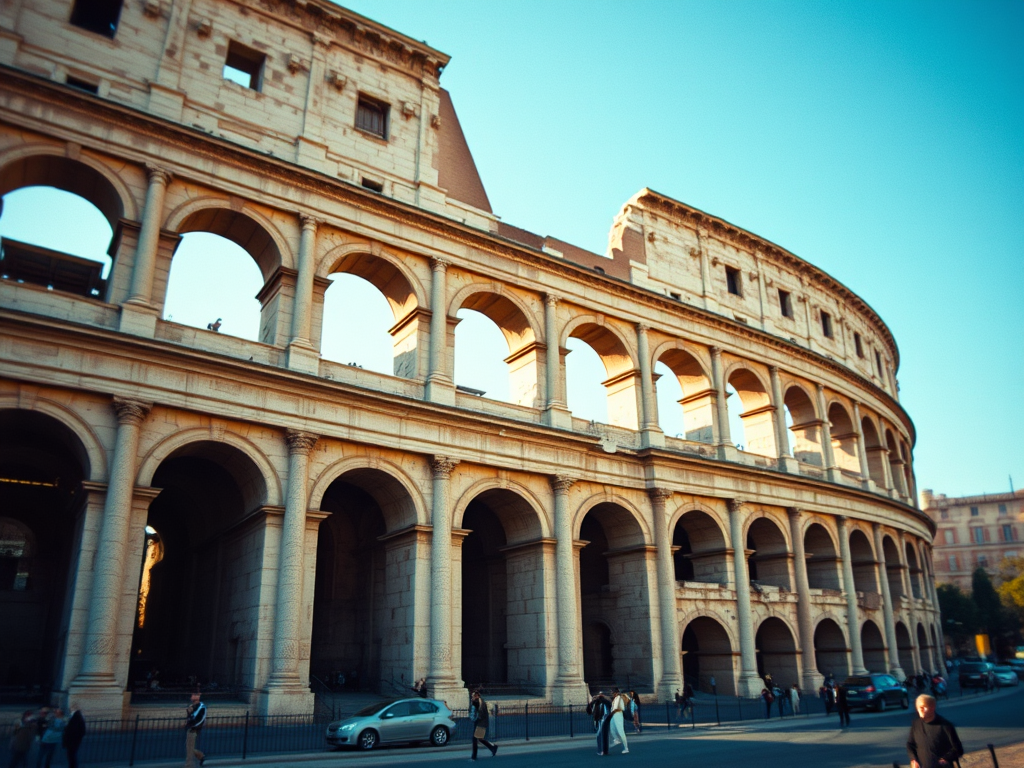
The Colosseum’s design was also influenced by earlier Greek theaters, but Roman amphitheaters were larger, fully enclosed, and free-standing structures, unlike the semicircular theaters built into hillsides in Greece. The Colosseum was one of the first buildings to combine arches and vaults systematically, using them to create strong, stable structures. The building was divided into four main levels, each with its own distinct architectural features.
Architectural Details
The Colosseum’s outer facade is perhaps its most recognizable feature. It consists of three tiers of arches topped by a solid attic level. Each of the lower three levels is made up of 80 arches supported by semi-columns. These arches are a hallmark of Roman architecture, providing both structural strength and aesthetic harmony.
The semi-columns that flank the arches are decorated in the three classical orders of architecture:
- Doric on the ground floor, known for its simplicity and strength;
- Ionic on the second level, more decorative and graceful;
- Corinthian on the third level, the most ornate and elaborate of the three.
The attic level, which does not feature arches, is adorned with Corinthian pilasters and originally had large statues placed between each pilaster. The combination of different architectural orders on the facade was not just a matter of aesthetics but also symbolized the hierarchy and diversity within Roman society.
The Seating Arrangements
The seating arrangement inside the Colosseum reflected the rigid social stratification of Roman society. The arena was surrounded by a podium, where the most privileged individuals sat. The emperor and other high-ranking officials had special boxes with the best views of the arena.
The first tier of seating, known as the maenianum primum, was reserved for senators and other members of the elite class. The second tier, the maenianum secundum, was divided into two sections: the lower section for the non-elite wealthy citizens and the upper section for the lower classes. The third tier, known as the maenianum summum, was for the general populace, including women and slaves. The highest level, the maenianum summum in ligneis, was a wooden platform that provided standing room for the poorest citizens.
The Hypogeum
One of the most remarkable engineering features of the Colosseum is the hypogeum, a vast underground complex beneath the arena floor. The hypogeum consisted of a series of tunnels and chambers used to house gladiators, animals, and stage sets. It was also equipped with elaborate machinery, such as elevators and trapdoors, which allowed for dramatic entrances and exits during the games.
The hypogeum was essential for the organization and execution of the spectacles, as it allowed for the swift and seamless movement of participants and animals without the spectators being aware of the logistical complexity behind the scenes. This underground network also enabled the Colosseum to stage a wide variety of events, from gladiatorial contests to animal hunts and even mock naval battles, which required the arena to be flooded with water.
The Role of the Colosseum in Roman Society
The Colosseum was primarily used for gladiatorial games, which were a central form of entertainment in Roman society. These games, often violent and bloody, involved armed combatants known as gladiators who fought to the death for the amusement of the spectators. While some gladiators were slaves or prisoners of war, others were free men who chose to fight for fame and fortune.
The games were not limited to gladiatorial combat. Animal hunts, known as venationes, were also a major feature of the Colosseum’s events. Exotic animals from across the Roman Empire, including lions, elephants, and bears, were brought to Rome to fight against each other or be hunted by gladiators. These events were intended to demonstrate the emperor’s ability to control the natural world and the vast resources of the empire.
The Colosseum was not just a place for entertainment; it was also a tool of political propaganda. By hosting grand spectacles, emperors could demonstrate their wealth, power, and generosity to the people. The games were often funded by the state or wealthy individuals as a way of gaining favor with the public.
The Colosseum also served as a venue for celebrating military victories and other important events. For example, after the conquest of Jerusalem in 70 AD, thousands of Jewish prisoners were paraded in the arena during a grand triumphal procession. The Colosseum thus became a symbol of Roman dominance and imperial power.
The spectacles held at the Colosseum had a profound impact on Roman culture and social life. For the citizens of Rome, attending the games was not only a form of entertainment but also a way to participate in the collective identity of the empire. The Colosseum was a space where social hierarchies were visible, with the seating arrangements reflecting the strict divisions between different classes.
However, the games were not without controversy. Some Romans, particularly philosophers and early Christians, criticized the violence and brutality of the spectacles. The Christian martyrs who were killed in the Colosseum during the persecutions under emperors like Nero and Domitian became symbols of resistance, and over time, the Colosseum would come to be associated with the Christian faith.
Decline and Legacy of the Colosseum
As the Roman Empire began to decline in the 3rd and 4th centuries AD, so too did the grandeur of the Colosseum. The last recorded gladiatorial games were held in 404 AD, after which the rise of Christianity and changing social attitudes led to the decline of such violent spectacles. However, animal hunts continued for several more centuries before being completely banned.
The Colosseum also suffered from natural disasters, including earthquakes in the 5th century that caused significant damage to the structure. The outer facade was partially destroyed, and much of the building was reduced to ruins.
During the medieval period, the Colosseum was repurposed for various uses. Parts of it were converted into a fortress by noble families, and its stones were quarried for other building projects. In the Renaissance, the Colosseum was seen as a valuable source of marble and stone for the construction of churches and other buildings in Rome.
Despite the degradation of the Colosseum over the centuries, it remained a symbol of the city’s ancient glory. In the 18th century, Pope Benedict XIV declared the Colosseum a sacred site in honor of the Christian martyrs who had died there, which helped to preserve the remaining structure.
Conclusion
The Colosseum is more than just a relic of the past; it is a symbol of the enduring legacy of Roman engineering, culture, and history. Its construction was a monumental achievement, showcasing the ingenuity of Roman architects and engineers. The Colosseum’s architectural design, with its complex system of arches, vaults, and seating arrangements, reflected the grandeur and social hierarchy of Roman society.
As a center for public spectacles, the Colosseum played a crucial role in Roman political and social life, providing a space for the emperor to demonstrate his power and for citizens to engage in the shared identity of the empire. Though the Colosseum has suffered from the ravages of time, it remains one of the most iconic and well-preserved monuments of ancient Rome, attracting millions of visitors each year.
Today, the Colosseum stands as a reminder of the might of the Roman Empire and the complex legacy of its cultural and political institutions.
Also read our article about Unforgettable 5 Days in Rome: A Guide to Art, Food, and History.







[…] whispers tales of glory, power, and sometimes treachery. The day typically begins at the iconic Colosseum, a marvel of engineering that has stood for nearly 2,000 years. As you step inside, you can’t […]