

Introduction
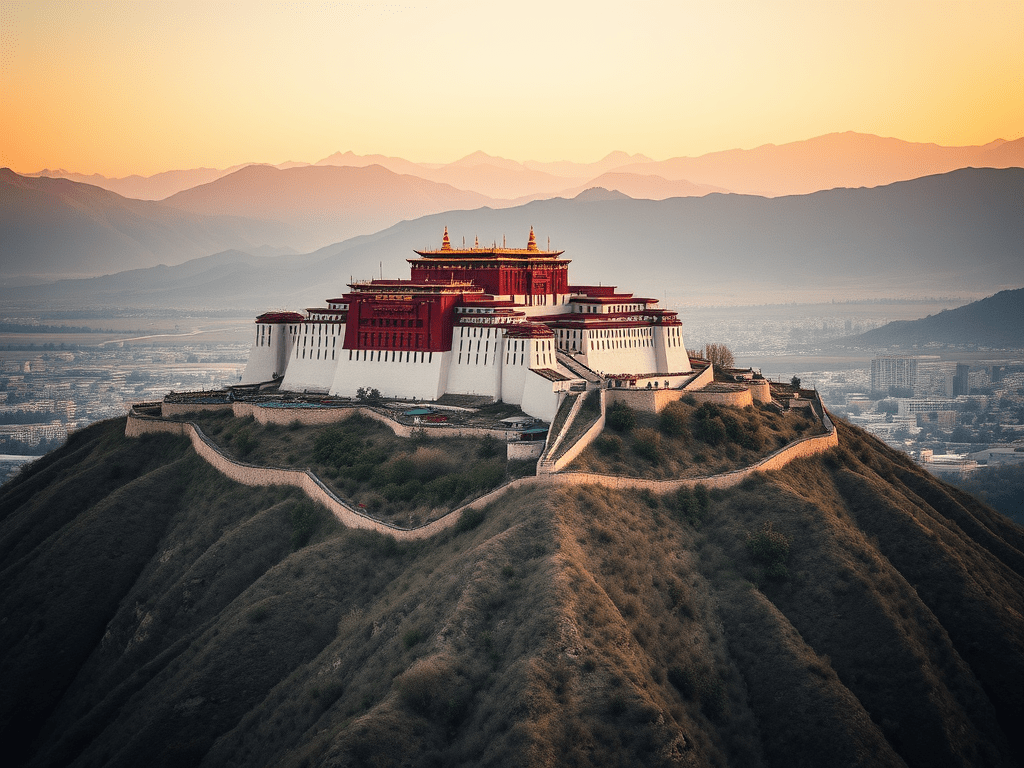
Perched atop the Marpo Ri hill at an altitude of 3,700 meters (12,100 feet) above sea level, the Potala Palace is one of the most iconic symbols of Tibet and Tibetan Buddhism. This ancient structure, dominating the skyline of Lhasa, has served not only as the residence of the Dalai Lamas but also as a sacred site of immense religious and political significance. Its unique blend of spiritual, political, and architectural marvels has made the Potala Palace a UNESCO World Heritage Site and one of the most revered landmarks in Asia.
The palace, a monumental structure built with stunning Tibetan engineering and design, reflects centuries of cultural evolution. In this article, we will delve into the rich history of the Potala Palace, exploring the details of its construction, its architectural features, and the deep symbolism that defines its place within Tibetan and global history.
Early Beginnings: Foundations in Tibetan History
The history of the Potala Palace begins in the 7th century during the reign of King Songtsen Gampo, one of Tibet’s most influential and revered monarchs. Songtsen Gampo is credited with uniting the Tibetan plateau under a centralized government, establishing Buddhism as the state religion, and introducing a written script to the Tibetan people. His rule marked the beginning of what is considered the Tibetan Empire’s golden age.
Legend has it that after Songtsen Gampo’s marriage to Princess Wencheng of China and Princess Bhrikuti of Nepal, he decided to build a fortress on the Red Hill (Marpo Ri) in Lhasa, where the Potala Palace stands today. The choice of location was strategic and symbolic: the Red Hill was not only defensible but also held spiritual significance, with many Tibetan myths and legends associating it with divine power. The site was believed to be blessed by Avalokiteshvara, the Bodhisattva of Compassion, whose earthly embodiment is believed to be the Dalai Lama.
This early construction, however, bore little resemblance to the grandiose structure we know today. Songtsen Gampo’s palace, though impressive for its time, was much smaller in scale and served primarily as a fortress and royal residence. Over the centuries, it fell into disrepair and was largely abandoned as the Tibetan capital shifted to other regions.
The Vision of the Fifth Dalai Lama
The modern incarnation of the Potala Palace owes its existence to the Fifth Dalai Lama, Ngawang Lobsang Gyatso, who rose to power in the mid-17th century. Known as the “Great Fifth,” he was a leader of immense political and spiritual influence, consolidating the fragmented Tibetan states and firmly establishing the Gelug school of Tibetan Buddhism as the dominant religious and political authority in Tibet.
In 1645, the Fifth Dalai Lama initiated the construction of the Potala Palace on the ruins of Songtsen Gampo’s fortress. His vision was grander than that of any previous ruler: he sought to create a spiritual and political center that would symbolize the unity of Tibet under the rule of the Dalai Lama. The Potala Palace was to be the home of the Dalai Lama, the seat of the Tibetan government, and a major pilgrimage site for Buddhists from across the region.
Construction of the Potala Palace: A Monumental Undertaking
The construction of the Potala Palace on the steep and rocky slopes of Red Hill posed immense challenges. At an altitude of 3,700 meters, the thin air and harsh climate made the task difficult for the thousands of workers and artisans involved. The steep terrain required careful planning to ensure the stability of the structure, and materials had to be sourced from far and wide. Stone, wood, and earth were used as the primary building materials, with most of the labor done by hand.
Despite these challenges, the construction of the White Palace (Potrang Karpo), the first phase of the project, was completed relatively quickly by 1648. This section of the palace served as the administrative center and the living quarters of the Dalai Lama. However, the construction of the more elaborate Red Palace (Potrang Marpo), dedicated to religious functions, continued long after the Fifth Dalai Lama’s death in 1682. His death was kept a secret for several years to ensure the completion of the palace, a testament to the importance placed on finishing this monumental project.
Traditional Tibetan Building Techniques
The construction of the Potala Palace employed traditional Tibetan building techniques that had been refined over centuries. Stone masonry was used to create thick, sturdy walls, with layers of earth packed between stones to provide insulation and stability. The palace’s walls, some of which are over 5 meters (16 feet) thick at the base, were designed to withstand earthquakes, a common occurrence in the region.
Wood was another crucial material, used for beams, floors, and roofs. Tibetan builders were experts in carpentry, and they used intricate wooden frameworks to support the palace’s multi-story structure. The palace’s roofs are flat and covered with gilded tiles, a common feature in Tibetan architecture, designed to reflect the intense sunlight and protect the interior from the elements.
The labor force that worked on the Potala Palace consisted of thousands of workers, many of whom were monks and laypeople who saw their work as a form of spiritual service. The construction process itself was infused with religious significance, with rituals and ceremonies performed at key stages to ensure the palace’s divine protection.
The White Palace and the Red Palace: A Duality of Function and Symbolism
The Potala Palace is divided into two main sections: the White Palace (Potrang Karpo) and the Red Palace (Potrang Marpo). Each section serves a distinct purpose and reflects different aspects of Tibetan religious and political life.
The White Palace, the older of the two sections, served as the residence of the Dalai Lama and the administrative center of the Tibetan government. It is characterized by its whitewashed walls, which symbolize purity and peace in Tibetan culture. The simplicity of the White Palace’s exterior belies the complexity of its interior, which houses the Dalai Lama’s private living quarters, offices, and meeting rooms.
One of the most significant rooms in the White Palace is the East Hall, where the Dalai Lama would conduct important meetings with Tibetan officials and foreign dignitaries. The hall is richly decorated with murals depicting scenes from Tibetan history and Buddhist cosmology. These murals are not only works of art but also serve as visual records of Tibetan religious and political life.
The White Palace also contains several chapels and shrines where the Dalai Lama and his attendants would perform daily prayers and rituals. These sacred spaces are adorned with thangkas (Buddhist scroll paintings), statues of deities, and other religious artifacts, creating an atmosphere of reverence and devotion.
The Red Palace: A Sacred Space for Spirituality
The Red Palace, built after the completion of the White Palace, is the spiritual heart of the Potala complex. Its deep red walls are symbolic of power and protection, and they house the most sacred spaces within the palace. The Red Palace is dedicated to religious functions and contains numerous chapels, shrines, and tombs of the Dalai Lamas.
One of the most important features of the Red Palace is the Hall of Stupas, which contains the tombs of several Dalai Lamas, including the Fifth Dalai Lama. These stupas, which are large, elaborately decorated structures, are covered in gold and encrusted with jewels. The stupa of the Fifth Dalai Lama, in particular, is a masterpiece of Tibetan art, standing over 12 meters tall and adorned with nearly 4,000 kilograms of gold.
The Red Palace also contains numerous meditation rooms, where monks and visitors come to pray and meditate. The Great West Hall, the largest room in the Red Palace, is adorned with beautiful murals depicting the life of the Fifth Dalai Lama and other important events in Tibetan history. These murals are a testament to the artistic skill of Tibetan painters and the spiritual significance of the events they depict.
The Potala Palace as a Symbol of Tibetan Buddhism
The Potala Palace is not just an architectural wonder; it is also a powerful symbol of Tibetan Buddhism and the spiritual authority of the Dalai Lama. Every aspect of the palace’s design is imbued with religious symbolism, from the layout of the building to the colors of its walls.
The elevation of the palace, towering over Lhasa, reflects the spiritual elevation of the Dalai Lama, who is regarded as the earthly embodiment of Avalokiteshvara. The palace’s location on Red Hill symbolizes the Dalai Lama’s role as a protector of the Tibetan people and their spiritual leader. The White Palace and Red Palace represent the balance between the temporal and spiritual realms, with the White Palace serving as the seat of government and the Red Palace as the center of religious activity.
The Potala Palace is also closely associated with the concept of the “Pure Land,” a Buddhist idea of a spiritual realm where beings can attain enlightenment. The palace is considered a physical representation of Avalokiteshvara’s Pure Land, and it is believed that those who visit the palace with pure intentions can receive spiritual blessings and progress on their path to enlightenment.
Historical Significance and the Role of the Dalai Lamas
The Potala Palace has played a central role in Tibetan religious and political life for centuries. As the residence of the Dalai Lama, it was the seat of Tibetan government from the 17th century until 1959, when the 14th Dalai Lama fled to India following the Chinese invasion of Tibet.
Throughout this period, the Potala Palace was not only a religious center but also a political hub, where important decisions regarding the governance of Tibet were made. The Dalai Lama, as both a spiritual and temporal leader, presided over meetings with Tibetan officials, foreign dignitaries, and representatives of Buddhist sects. The palace also served as a repository of Tibetan cultural and religious knowledge, with its vast library of sacred texts, scriptures, and historical documents.
In addition to its political and religious functions, the Potala Palace was also a destination for pilgrims from all over Tibet and beyond. Pilgrims would travel great distances to visit the palace, which they considered a holy site. The pilgrimage to the Potala Palace was seen as a way to accumulate merit and seek spiritual guidance from the Dalai Lama.
The Potala Palace in Modern Times
The 20th century brought significant challenges to the Potala Palace, particularly in the wake of the Chinese occupation of Tibet in 1950 and the subsequent Tibetan uprising in 1959. The departure of the 14th Dalai Lama to India marked the end of the Potala Palace’s role as the political center of Tibet. However, despite these challenges, the palace has remained a symbol of Tibetan identity and spiritual resilience.
In the years following the Chinese occupation, the Potala Palace, like many other religious sites in Tibet, faced the threat of destruction during the Cultural Revolution. Many monasteries, temples, and religious artifacts across Tibet were destroyed by the Red Guards, but the Potala Palace was spared, reportedly due to the personal intervention of Premier Zhou Enlai.
Recognizing the cultural and historical importance of the Potala Palace, the Chinese government has undertaken efforts to preserve and restore the structure. In 1989, a major restoration project was launched, and in 1994, the palace was inscribed as a UNESCO World Heritage Site. The palace is now protected as part of China’s national heritage, and further restoration efforts have been carried out to ensure its preservation for future generations.
Despite these efforts, there remain concerns about the long-term preservation of the Potala Palace, particularly due to the increasing number of tourists and the effects of climate change. The high altitude and harsh weather conditions, combined with the pressures of modern infrastructure, pose significant challenges to the palace’s preservation.
Conclusion: The Enduring Legacy of the Potala Palace
The Potala Palace stands as a remarkable testament to Tibetan spirituality, architectural innovation, and cultural endurance. Its history, steeped in religious significance and political power, continues to captivate visitors and scholars alike. The palace’s unique design, blending traditional Tibetan architecture with religious symbolism, has made it one of the most iconic structures in the world.
Though the political landscape of Tibet has changed dramatically over the centuries, the Potala Palace remains a symbol of Tibetan identity and resilience. Its towering presence over Lhasa serves as a reminder of the rich cultural and spiritual heritage of Tibet, and its preservation ensures that future generations can continue to draw inspiration from its profound history.








[…] ancient settlements that narrate the story of its past inhabitants. The Göreme Open-Air Museum, a UNESCO World Heritage site, is a prime example of this cultural richness, featuring rock-cut churches adorned with […]
[…] of the highlights of an Alaskan cruise is Glacier Bay National Park, a UNESCO World Heritage site that showcases magnificent glaciers and vast wildlife. As ships enter the bay, passengers can […]
[…] Baikal, the world’s deepest freshwater lake, is a highlight that captivates many travelers. This UNESCO World Heritage Site is surrounded by stunning mountains and offers opportunities for exploration, reflection, and […]
[…] unique trulli houses, which are an architectural marvel and a symbol of the region. Recognized as a UNESCO World Heritage Site, Alberobello is characterized by its charming whitewashed stone houses with conical roofs, which […]
[…] century as people rediscovered the Camino’s spiritual, historical, and cultural significance. UNESCO recognized the Camino as a World Heritage site in 1993, elevating its profile globally and drawing […]
[…] a UNESCO World Heritage site, is famed for its wooden stage that juts out over the hillside, offering panoramic views of […]
[…] Itzá, a UNESCO World Heritage site, stands as one of the most iconic remnants of the ancient Maya civilization. Located in the […]
[…] travelers and historians flocked to see the lost city for themselves. The site was designated as a UNESCO World Heritage Site in 1983, recognizing its cultural and historical […]
[…] palatial fortress that showcases the architectural brilliance of the Moorish civilization. This UNESCO World Heritage site is not only a symbol of the rich cultural heritage of Spain but also a remnants of the nation’s […]