Introduction
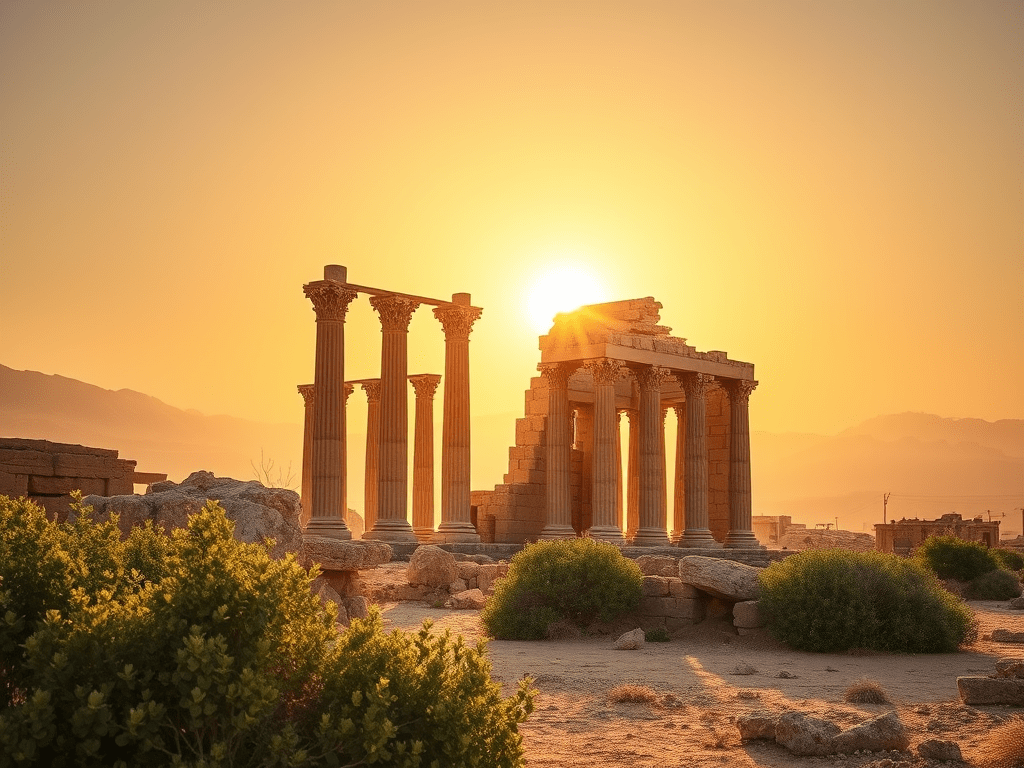
Palmyra, often referred to as the \”Desert Bride,\” is a historical gem nestled in the heart of the Syrian desert. Once a thriving metropolis, it served as a crucial nexus connecting the East and the West from antiquity through the Roman Empire. This ancient city, with its remarkable blend of Hellenistic, Roman, and Persian influences, played a pivotal role in the economic and cultural exchanges that shaped civilizations. Despite the ravages of time and modern conflict, Palmyra’s ruins continue to stand as a testament to its rich history and the diverse cultures that converged here. This article delves into the Palmyra history, exploring its geographical advantages, the vibrant trade routes that passed through it, the political endeavors of its leaders, the architectural brilliance evident in its structures, and the impact of its decline. Together, these elements highlight why Palmyra is celebrated as not just a city of historical importance, but as a symbol of unity among diverse civilizations.
The Geographical Significance of Palmyra
Palmyra\’s geographical location is one of the most compelling aspects of its historical significance. Situated in modern-day Syria, it lies at the crossroads of several vital trade routes that linked the Mediterranean Basin with the Arabian Peninsula and the Silk Road to the East. This strategic positioning allowed Palmyra to flourish as a major trade hub, where merchants from various cultures met, exchanged goods, and shared ideas.
The city was traversed by the renowned Incense Route, which facilitated the transportation of valuable commodities such as frankincense and myrrh from Arabia to the Roman Empire. As a result, Palmyra became an essential stop for caravans, offering rest and supplies to traders who relied on its rich resources. The surrounding desert provided natural caravan paths that facilitated travel and commerce, making Palmyra an indispensable link between the East and West.
The geological features of Palmyra further enhanced its significance. Its proximity to fertile oasis lands, alongside an underground aqueduct system that supplied water, allowed for agriculture and sustenance of the populace, supporting both trade and local commerce. The abundance of resources made Palmyra not only a bustling urban center but also a self-sufficient community.
Moreover, the city\’s location provided it with defensive advantages. Surrounded by mountains and desert, its topography created natural barriers against potential invaders, enhancing its strategic security. This contributed to the consolidation of power within Palmyra, allowing it to extend its influence over neighboring regions.
Additionally, the diverse populations within Palmyra reflected its geographical melting pot nature. Trade brought in people from various cultures, including Greek, Roman, Jewish, and various Arabian tribes, each contributing to a unique blend of traditions, languages, and religions. This cultural diversity was not just a byproduct of trade but also a catalyst for innovation and collaboration, enabling the city to thrive in ways few other ancient metropolises could.
Throughout its history, several empires sought to control Palmyra due to its strategic significance. The Romans recognized the city\’s importance and incorporated it into their empire, allowing it to grow even further. Under Roman influence, Palmyra maintained its unique identity, blending local customs with Roman governance and architecture, leading to its renowned architectural achievements.
In summary, the geographical significance of Palmyra laid the foundational groundwork for its emergence as a critical node in ancient trade networks, a hub of cultural exchange, and a focal point of political power. Understanding this geographic context allows us to appreciate the multifaceted role Palmyra played in uniting diverse ancient civilizations and the lasting impact it has had through the ages.
The Cultural Melting Pot of Trade
The bustling trade in Palmyra was not merely a conduit for the exchange of goods; it was a rich tapestry of cultures interweaving through commerce. Traders from various regions brought their wares, ideas, and practices, creating a vibrant cultural landscape that reflected this confluence of influences. The role of Palmyra as a cultural melting pot can be understood through various dimensions, from the diversity of goods traded to the interchange of ideas and traditions.
At its peak, Palmyra was renowned for its luxurious goods, including silks from the East, spices, and precious metals. Merchants from far-flung places came to the city, contributing to a bustling marketplace that attracted visitors and settlers alike. The trade routes that converged at Palmyra were not solely for the exchange of commodities; they were also pathways for cultural and technological diffusion.
The merchant classes in Palmyra played a pivotal role in this cultural interchange. They were not just businessmen; many were also influential patrons of the arts and philosophy. Their wealth allowed them to sponsor projects that celebrated the architectural prowess of the city, incorporating designs and styles from various cultures, particularly Hellenistic and Roman influences. The result was a unique architectural style evident in the colonnades, temples, and the famous Agora.
In addition to architecture, the interplay of languages greatly enriched the city’s cultural fabric. Aramaic became the local lingua franca due to its widespread use in trade, while Greek and Latin remained prominent among the educated elite, particularly in administrative and commercial contexts. This linguistic diversity allowed for a blending of ideas and practices, fostering creativity and collaboration across cultural boundaries.
Palmyra also served as a significant religious center. The coexistence of multiple religious practices—paganism, Judaism, and the early stirrings of Christianity—manifested in various temples and sanctuaries scattered throughout the city. The Temple of Bel is perhaps the most notable example, symbolizing the fusion of religious practices and the influence of the various cultures that converged here. With pilgrims and worshippers coming from various regions, Palmyra became a spiritual epicenter alongside its commercial prominence.
Furthermore, the festivals and public events hosted in Palmyra were occasions for cultural exchange and celebration. These gatherings often featured music, dance, and storytelling that drew on influences from the myriad of cultures represented in the city. Such events fostered a sense of community among the diverse population, reinforcing social bonds despite differences in ethnicity and belief.
In essence, Palmyra’s status as a cultural melting pot was a reflection of its vibrant trade ecosystem. The exchange of goods, ideas, and cultural practices significantly influenced the social dynamics of the city and set the stage for a unique historical experiment in coexistence. The legacy of this cultural interchange is evident in the archaeological remains of Palmyra today, which continue to captivate the interest of historians and travelers alike, offering insights into how trade can shape civilizations.
Political Alliances and Power Dynamics
Throughout its history, Palmyra was not only a hub of trade and culture but also a significant player in the political landscapes of the ancient world. The city\’s strategic importance attracted attention from various empires, leading to a complex web of political alliances and power dynamics that influenced its trajectory. Understanding the political landscape of Palmyra provides insight into how its leaders navigated relationships with powerful neighbors and maintained autonomy amidst external pressures.
Initially, Palmyra functioned as an independent city-state, leveraging its economic wealth derived from trade to assert its influence over surrounding regions. Its rulers, known as the \”Sultans of Palmyra,\” managed to maintain a degree of autonomy, particularly during the early empire\’s expansion. The leaders of Palmyra recognized the significance of maintaining good relations with both regional and imperial powers, skilled in diplomacy and negotiations to balance their interests.
One of the most critical phases of Palmyra\’s political history was its relationship with the Roman Empire. As Rome expanded its influence in the East, Palmyra became a vital ally, offering resources and trade routes in exchange for protection and stability. The partnership allowed the city to flourish under Roman rule while retaining a unique cultural identity. However, the power dynamics were not always one of easy cooperation. Tensions occasionally arose as Palmyra sought to maintain its sovereignty while navigating Rome\’s imperial ambitions.
A turning point in Palmyra\’s political history came with the rise of Queen Zenobia in the early third century CE. As a powerful and strategic leader, she crafted a new political vision for Palmyra that sought to extend its influence beyond its traditional borders. Zenobia famously led a rebellion against Roman rule, declaring Palmyra an independent empire. Under her leadership, the city expanded its territory, encompassing parts of Egypt and Asia Minor. This bold bid for independence highlighted the ambition and resourcefulness of Palmyra\’s leaders, positioning the city as a formidable player on the global stage.
During Zenobia\’s reign, the concept of political alliances shifted dramatically. She forged strategic alliances with neighboring powers and sought to integrate various cultures and peoples into her realm, promoting a model of governance that prioritized mutual benefit and cooperation. This period of expansion fostered a sense of unity and purpose among the diverse inhabitants of Palmyra, leading to a flourishing of arts, culture, and scholarship that has left an enduring legacy.
However, the rise of Palmyra\’s significance also provoked the ire of the Roman Empire. The delicate balance of power shifted as Rome perceived Palmyra\’s ambitions as a threat. Eventually, the Romans responded decisively, sending legions to quell the rebellion and reestablish control over the city. Zenobia\’s defeat marked the end of an era for Palmyra and the reassertion of Roman dominance, resulting in significant changes in the political landscape.
In the aftermath of Zenobia\’s reign, Palmyra\’s political significance diminished as control shifted back to Rome. The city became a provincial settlement, losing much of its former influence. However, the political alliances and power dynamics established during its height laid the groundwork for future interactions between Eastern and Western civilizations.
Thus, the political history of Palmyra is marked by periods of independence, ambition, and eventual subjugation. Its leaders\’ ability to navigate the complexities of regional politics and forge alliances significantly impacted the city\’s legacy, shaping its identity as a cultural and commercial center of great importance in the ancient world.
Architectural Marvels: A Testament to Innovation
Palmyra is famed not only for its rich history and cultural fusion but also for its outstanding architectural feats. The city\’s urban landscape is marked by remarkable structures that reflect its status as a thriving trade hub and a cultural melding ground. Examining Palmyra\’s architectural innovations provides insight into the engineering prowess and artistic ingenuity of ancient civilizations while also showcasing the blend of styles from various cultures.
The architectural legacy of Palmyra is most noticeably captured in its iconic temples, colonnades, and monumental archways. Among these, the Temple of Bel remains one of the most distinguished examples, symbolizing both religious devotion and architectural achievement. Constructed under the Roman Emperor Tiberius, the temple stands as a testimony to the blend of local and Roman architectural styles. Its grand facade, adorned with intricate carvings and a monumental entryway, exemplifies the aesthetics popularized by Hellenistic architecture while incorporating elements unique to the Palmyrene style.
The use of local materials was a distinctive feature of Palmyrene architecture. Builders expertly harnessed the local limestone, shaping it into intricate columns and decorative elements that adorned public structures. The wealth generated through trade allowed for the procurement of more lavish materials, including marble from distant quarries, which further enhanced the grandeur of Palmyra\’s buildings. This access to resources contributed to an architectural language that was both opulent and expressive of Palmyrene identity.
Moreover, the city\’s layout reflects advanced urban planning, with a well-organized grid that facilitated commerce and movement. The Colonnade, a central street lined with columns, served as the main artery of trade, connecting various parts of the city and showcasing a blend of cultural influences through its design. It was adorned with shops, marketplaces, and spaces for public gatherings, creating a vibrant social environment.
In addition to its temples and public spaces, Palmyra featured elaborate burial sites that indicate its sophisticated funerary practices. The Tower Tombs, monumental structures constructed for the elite, illustrate a blend of Greek and local styles, incorporating elaborate carvings and inscriptions that tell the stories of those interred within. These tombs not only showcase the architectural skill of the builders but also underline the cultural importance placed on burial practices and the afterlife in Palmyrene society.
Furthermore, the city’s agora served as a public gathering space for commerce and social interaction, heavily influenced by Roman architectural principles. The Forum, with its expansive layout, was strategically designed to accommodate large numbers of people, hosting market activities, political gatherings, and religious ceremonies. Its construction symbolizes the melding of local traditions and Roman influences, showcasing Palmyra\’s adaptability and innovation in architectural design.
As archaeological discoveries continue to unveil the grandeur of Palmyra, the impact of its architecture remains palpable. The city served as a template for future generations of builders and architects across the region. Elements originating from Palmyra can be observed in subsequent building styles and structures, highlighting its lasting legacy as a center of architectural excellence.
Ultimately, Palmyra’s architectural marvels stand as a testament to its historical significance and cultural richness. The innovative designs and grand structures bear witness to the city’s thriving commerce, its cultural melting pot identity, and the artistic vision of its builders. The ruins of Palmyra continue to inspire and educate people today, reminding us of the incredible human capacity for creativity and collaboration across time and space.
The Fall of Palmyra and Its Lasting Legacy
The decline of Palmyra marks a poignant chapter in its long and storied history. Once a thriving center of trade, culture, and political power, the city faced immense challenges that ultimately led to its downfall. This section will explore the factors contributing to Palmyra\’s decline, the events surrounding its fall, and the enduring legacy it has left on the world.
The rise of Palmyra as an independent power under Queen Zenobia in the third century CE signaled a new chapter for the city. However, the very ambitions that propelled its growth also made it vulnerable to external threats. The Roman Empire, alarmed by Zenobia\’s attempts at expansion and her declaration of independence, sought to reassert its control over this key location.
The decisive moment came when Emperor Aurelian mobilized Roman legions to quell the growing power of Palmyra. The conflict intensified, culminating in a siege that would ultimately determine the fate of the city. In 273 CE, Aurelian\’s forces successfully ousted Zenobia from power, leading to the recapture of Palmyra. The once-great city was reduced, witnessing widespread destruction and depopulation as Rome reasserted its dominance.
The fall of Palmyra had lasting repercussions for its inhabitants and the broader region. Many of Palmyra\’s elite were executed or exiled, marking the end of an era of autonomy and cultural flourishing. The city, stripped of its political influence and economic power, began to decline, transitioning from a vibrant metropolitan center to a provincial outpost within the Roman system.
Moreover, the looting and destruction of Palmyra\’s architectural marvels during the Roman conquest laid waste to many of its cultural treasures. The monumental structures that once symbolized the city\’s significance were left in ruins, diminishing the physical reminders of Palmyra\’s greatness. The subsequent centuries saw it fall into obscurity, eventually becoming a mere relic of a once-thriving civilization.
Despite the tragedy of its decline, Palmyra\’s legacy endured. The city\’s rich history and architectural achievements continued to capture the imagination of scholars and travelers. The ruins of Palmyra have become a symbol of resilience and cultural heritage, representing the interconnectedness of civilizations throughout history. They stand as a reminder of the achievements of the ancient world, evoking admiration and fascination even centuries after its fall.
In modern times, Palmyra has faced new challenges, particularly during the Syrian civil war when its archaeological treasures were threatened by conflict and destruction. However, efforts to preserve and protect its remains continue, highlighting the importance of safeguarding cultural heritage for future generations.
In conclusion, the fall of Palmyra serves as a powerful reminder of the transient nature of power and the profound impact of historical events on the cultural landscape. While the city may no longer thrive as it once did, its legacy resonates through art, architecture, and the stories of those who once walked its streets. The lessons gleaned from Palmyra\’s rise and fall offer valuable reflections on the fragility of civilizations, the importance of cultural exchange, and the enduring capacity for human ingenuity.
Conclusion
Palmyra\’s history as the \”Desert Bride\” that united ancient civilizations is a testament to the intricate tapestry of trade, culture, and politics that characterized this remarkable city. Its strategic geographical location allowed it to flourish as a vital trade hub, fostering exchanges that enriched its cultural landscape. The blend of diverse influences is evident in its architectural marvels, which stand as enduring symbols of innovation and resilience.
Political dynamics played a significant role in shaping Palmyra\’s destiny, with its leaders navigating complex relationships with surrounding nations and empires. The ambition of figures like Queen Zenobia illustrated the city\’s potential as a formidable power, even as external pressures ultimately led to its decline.
Despite its fall, Palmyra\’s legacy continues to inspire awe and admiration. The archaeological remains, now more crucial than ever to preserve, remind us of the significant intersections of human civilization. As we reflect on the history of Palmyra, we recognize its role not merely as an ancient city but as an essential chapter in the broader narrative of our shared human experience. The cultural exchanges and innovations that emerged from Palmyra have left a lasting impact on the world, enduring as a symbol of unity among diverse civilizations throughout history.