

Introduction
The voyage of Charles Darwin aboard the HMS Beagle from 1831 to 1836 is one of the most famous scientific expeditions in history. It was during this journey that Darwin gathered observations and evidence that would later form the basis for his groundbreaking theory of evolution by natural selection. The five-year voyage provided Darwin with a unique opportunity to study diverse ecosystems, collect specimens, and observe geological phenomena that challenged contemporary scientific thought.
In this article, we will explore the historical context of Charles Darwin’s voyage, the significant discoveries he made, and how his experiences led to the development of the theory of evolution. We will also examine the long-term impact of Charles Darwin’s work on science and society.
Historical Context: The State of Science Before Darwin
Early Life of Charles Darwin
Charles Darwin was born on February 12, 1809, in Shrewsbury, England, into a wealthy and intellectual family. His father, Robert Darwin, was a prominent physician, and his grandfather, Erasmus Darwin, was a well-known naturalist and philosopher. Despite this scientific lineage, Darwin initially showed little interest in academic study and struggled with traditional schooling.
In 1825, Darwin entered the University of Edinburgh to study medicine, but he found the field unappealing. Instead, he became fascinated with natural history and geology, joining student societies that allowed him to explore his growing interest in the natural world. In 1828, Darwin transferred to the University of Cambridge with the intention of becoming a clergyman, a career that would still afford him time to pursue his scientific passions.
While at Cambridge, Charles Darwin’s interest in natural history deepened under the mentorship of renowned botanist John Stevens Henslow, who encouraged him to read widely and introduced him to leading scientists of the time. It was Henslow who recommended Darwin for the position of naturalist aboard the HMS Beagle, setting the stage for the journey that would change the course of Charles Darwin’s life and the history of science.
Prevailing Scientific Ideas Before Darwin
Before Charles Darwin’s voyage, the dominant view in Europe was that species were immutable, meaning they had been created in their present form and had remained unchanged since their creation. This view, rooted in religious doctrine, was supported by natural theologians like William Paley, whose writings argued that the complexity of living organisms was evidence of a divine designer.
In geology, the prevailing theory was catastrophism, which posited that Earth’s features were shaped by sudden, short-lived events like floods and volcanic eruptions. This idea was championed by Georges Cuvier, a prominent French naturalist. In contrast, uniformitarianism, as proposed by geologists James Hutton and Charles Lyell, suggested that Earth’s geological features were the result of slow, gradual processes such as erosion and sedimentation over long periods. This emerging view, though still controversial, would greatly influence Darwin during his voyage.
The HMS Beagle: Preparing for the Journey
The Mission of the HMS Beagle
The HMS Beagle was a Royal Navy ship tasked with conducting a survey of the South American coast, particularly the coasts of Argentina and Chile. The ship’s captain, Robert FitzRoy, was a skilled sailor and a devout Christian who sought a companion with scientific expertise to accompany him on the voyage. FitzRoy hoped that this individual could help with the ship’s geological and biological observations and provide intellectual companionship during the long journey.
Charles Darwin was invited to join the voyage after Henslow recommended him to FitzRoy. Although Darwin was initially hesitant, concerned about his lack of formal training in the sciences, he eventually accepted the offer. He was 22 years old when the HMS Beagle set sail from Plymouth, England, on December 27, 1831. The journey, originally planned to last two years, would stretch into a five-year expedition that covered vast regions of South America, the Pacific Islands, and even Australia.
Darwin’s Role and Preparations
Before the voyage, Charles Darwin received training in geology and field observation techniques from leading geologists like Lyell and Adam Sedgwick. Lyell’s ideas, particularly those related to uniformitarianism, would later play a crucial role in shaping Charles Darwin’s thinking. Darwin also read widely on natural history, including Alexander von Humboldt’s Personal Narrative, which chronicled the Prussian explorer’s travels in South America and offered insights into tropical ecosystems.
Darwin’s role aboard the Beagle was unofficial, as the ship already had an official naturalist. However, FitzRoy made Darwin a key member of the scientific team, giving him the freedom to conduct independent research. Darwin brought with him an array of scientific instruments, including microscopes, specimen jars, and notebooks, which he would use to document his findings throughout the voyage.
The Voyage: Key Stops and Observations
South America: Geology and Fossils
The Beagle’s first major stop was in South America, where Charles Darwin made several important discoveries that began to challenge his understanding of the natural world. One of his early geological observations occurred along the coast of Argentina, where he studied sedimentary rock formations and fossilized remains of extinct mammals, including giant armadillos and sloths. These fossils, which resembled modern animals but were significantly larger, prompted Darwin to question the immutability of species. Why, he wondered, would these massive creatures go extinct, while their smaller relatives persisted?
In Chile, Charles Darwin experienced a major earthquake, which dramatically raised the coastline. This event further confirmed his growing belief in Lyell’s uniformitarianism—that Earth’s features were shaped by gradual, continuous processes. He began to see the Earth’s geological history as being far older than previously thought, providing a much longer timescale for natural processes to operate.
The Galápagos Islands: A Turning Point
The most famous stop on the Beagle’s voyage was the Galápagos Archipelago, a group of volcanic islands located about 600 miles off the coast of Ecuador. Charles Darwin arrived at the Galápagos in September 1835 and spent several weeks exploring the islands. It was here that he made some of his most significant observations, particularly regarding the islands’ unique flora and fauna.
The Galápagos Islands are home to many species found nowhere else in the world, and Charles Darwin quickly noticed that the animals on different islands seemed to be related but were adapted to their specific environments. The most famous example of this are the Galápagos finches, a group of birds with varying beak shapes and sizes, each suited to different food sources on the islands. Darwin also observed differences in the tortoises, mockingbirds, and other animals that appeared to have evolved differently depending on the specific conditions of each island.
Though Darwin did not immediately understand the full significance of these observations, the Galápagos Islands would later become central to his theory of natural selection. The diversity of life on the islands suggested to Charles Darwin that species were not fixed but could change over time, adapting to their environment.
Australia and Other Stops
The Beagle’s voyage took Darwin to several other regions, including New Zealand, Australia, and the islands of the Pacific. In Australia, Darwin was struck by the stark differences between the native marsupial mammals and the placental mammals he had seen elsewhere. The presence of these unique animals in such an isolated region provided further evidence that species could evolve differently depending on geographic isolation and environmental factors.
In Tahiti and other Pacific islands, Charles Darwin continued to collect specimens and make detailed notes on plant and animal life. He also studied coral reefs and developed a theory on their formation, which he would later publish in a monograph. His observations of volcanic islands, coral atolls, and other geological formations reinforced his belief in the slow, gradual processes described by Lyell.
Charles Darwin’s Return to England and Development of the Theory of Evolution
Organizing His Findings
When Darwin returned to England in October 1836, he brought with him thousands of specimens, including fossils, plants, and animals, as well as a wealth of notes and observations. Over the next several years, Darwin worked tirelessly to organize and analyze the data he had collected during the voyage.
Darwin’s reputation as a naturalist grew rapidly after his return. He published a popular account of the voyage, The Voyage of the Beagle, which detailed his discoveries and provided vivid descriptions of the lands he had visited. He also worked with leading scientists of the day, including Richard Owen and Joseph Dalton Hooker, to describe and classify his collections.
However, it was the puzzle of species variation that occupied most of Darwin’s attention. The observations he had made in the Galápagos and elsewhere suggested that species were not static but could change over time. Yet, Darwin struggled to find a mechanism to explain how such changes occurred.
Influences on Darwin’s Thinking
Several key influences helped Darwin develop his theory of evolution by natural selection. In 1838, Darwin read An Essay on the Principle of Population by the British economist Thomas Malthus, which argued that human populations grow faster than food supplies, leading to competition for resources. This idea of competition and “struggle for existence” struck Darwin as a possible explanation for how species might evolve.
Charles Darwin realized that in nature, individuals with traits that gave them an advantage in survival and reproduction would be more likely to pass those traits on to the next generation. Over time, these advantageous traits would become more common in the population, leading to the gradual evolution of species. This process, which Darwin called natural selection, provided a powerful mechanism for evolution.
Darwin was also influenced by the work of breeders who selectively bred plants and animals to produce desirable traits. He saw natural selection as a similar process, but one driven by environmental pressures rather than human intervention.
The Development of the Theory of Natural Selection
By the early 1840s, Charles Darwin had developed a coherent theory of evolution by natural selection, but he was reluctant to publish it. He spent the next two decades gathering further evidence and refining his ideas. During this time, he corresponded with other scientists, conducted experiments, and wrote extensively on topics related to evolution.
It wasn’t until 1858, when the British naturalist Alfred Russel Wallace independently developed a similar theory of natural selection, that Darwin was spurred into action. Wallace’s manuscript, sent to Darwin for his opinion, outlined a theory that closely mirrored Darwin’s own ideas. To avoid being pre-empted, Darwin and Wallace presented their findings jointly at a meeting of the Linnean Society of London in July 1858.
In 1859, Darwin published On the Origin of Species, which laid out his theory of evolution by natural selection in detail. The book was a sensation, sparking widespread debate and controversy. While many scientists embraced Darwin’s ideas, others, particularly those with strong religious convictions, rejected the notion that species could change over time or that humans shared a common ancestry with other animals.
The Impact of Darwin’s Work
Scientific Legacy
Darwin’s theory of evolution by natural selection revolutionized biology and provided a unifying framework for understanding the diversity of life on Earth. It challenged traditional views of species as fixed and unchanging, offering instead a dynamic vision of life that was constantly evolving in response to environmental pressures.
The theory of evolution has since been supported by a vast body of evidence from fields as diverse as genetics, paleontology, and molecular biology. Darwin’s work laid the foundation for the modern synthesis of evolutionary biology, which integrates natural selection with Mendelian genetics.
Social and Cultural Impact
Darwin’s ideas had a profound impact not only on science but also on society. The theory of evolution challenged deeply held religious beliefs about the origin of life and humanity’s place in the natural world. It raised questions about the relationship between science and religion, and sparked debates that continue to this day.
Darwin’s theory also had far-reaching implications for fields such as psychology, anthropology, and sociology. It influenced thinkers such as Sigmund Freud and Karl Marx, who saw Darwinian concepts as relevant to their own work on human behavior and society.
In the late 19th and early 20th centuries, Darwin’s ideas were misused by proponents of social Darwinism, a discredited ideology that sought to apply the principles of natural selection to human societies. Social Darwinism was used to justify imperialism, racism, and eugenics, leading to some of the darkest chapters in modern history.
Conclusion: Darwin’s Enduring Legacy
The voyage of the HMS Beagle was the catalyst for Charles Darwin’s revolutionary theory of evolution by natural selection. Over the course of five years, Darwin gathered evidence from around the world that challenged the prevailing scientific ideas of his time and laid the groundwork for a new understanding of life on Earth.
Darwin’s work transformed biology and continues to shape our understanding of the natural world. His theory of evolution remains one of the most important scientific concepts ever developed, offering insights into everything from the development of antibiotic resistance in bacteria to the diversity of species in tropical rainforests.
More than a century after his death, Darwin’s legacy endures, not only in the field of biology but in the broader scientific and cultural landscape. His voyage on the HMS Beagle stands as a testament to the power of observation, curiosity, and the relentless pursuit of knowledge.







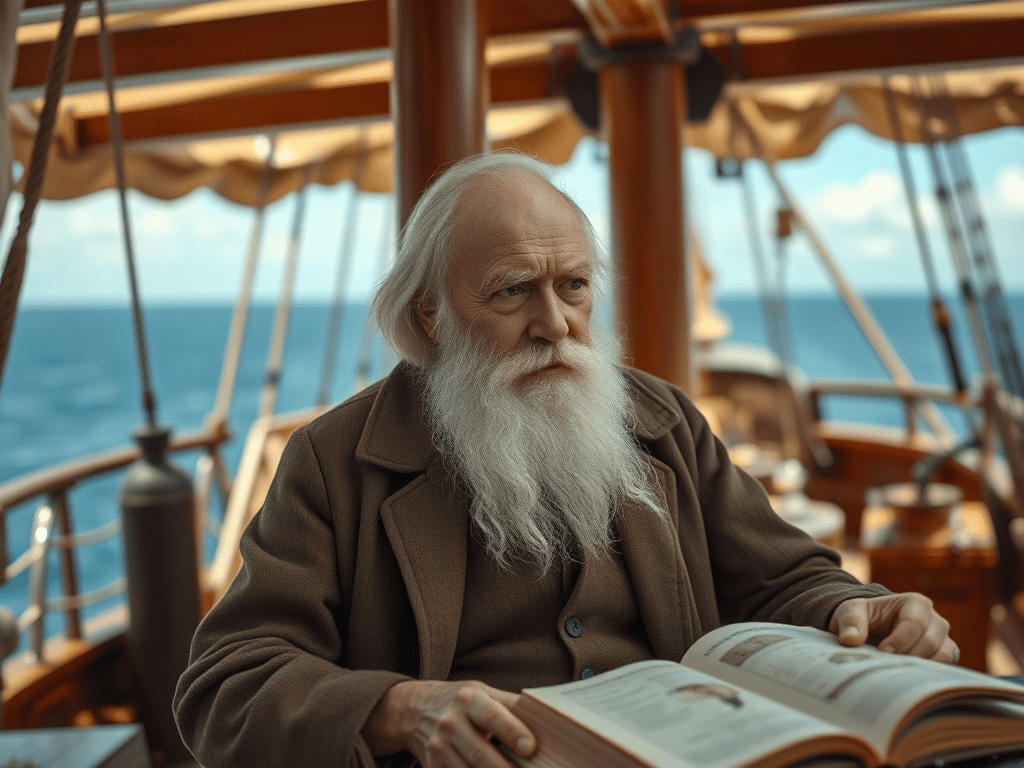
Generally a good article. But I’m puzzled that the illustrations show Darwin as if he were on the voyage of the Beagle, but he’s an old man. As the article says, he was 22 years old when they departed. The illustration should show him as a young man.